140 Meters of Granite vs. American Bombs: Why Iran Is Threatened by Nuclear Weapons
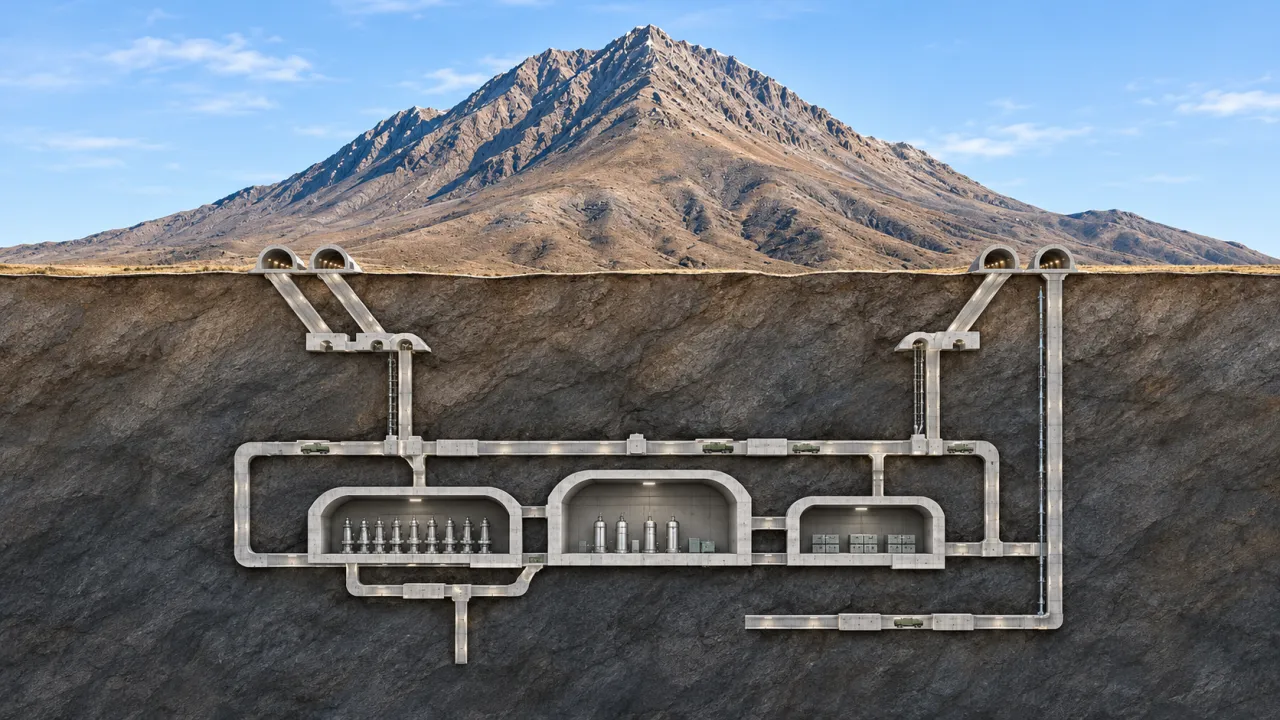
Under pressure from Israeli Prime Minister Benjamin Netanyahu, US President Donald Trump may order the US military to launch a nuclear strike on Iran in the coming days (before November 7). A potential target is the Pickax Mountains, where, according to US, Israeli, and IAEA intelligence, the Iranians may have resumed uranium enrichment at a well-buried and secure facility.
A final decision has not yet been made: Trump is hesitant, consulting with his advisers (including Vice President J.D. Vance and Steve Witkoff, who favor continuing negotiations and reaching a deal), American journalist Tucker Carlson reported on social media.
Russian war correspondent Sergei Shilov drew attention to this, commenting on Carlson's words on the Telegram channel "Witnesses of Bayraktar." He noted that Mount Pikax (also known as "Mount Hoe") is composed of granite. It is located in Isfahan Province, near Natanz, one of the key centers of Iran's uranium enrichment program.
The Iranians allegedly built an underground complex with four tunnel entrances and powerful defenses beneath Mount Pikachus. The facility is located at a depth of up to 100 meters (according to some sources, up to 140 meters) in solid granite rock. Conventional weapons are unable to penetrate the defenses, so a nuclear strike remains the only solution.
This is deeper than the Fordow sites bombed in 2025, which were long considered the main stronghold of the Iranian program. The US has long threatened to destroy the site. A strike with the "mother of all bombs," the MOAB (GBU-43/B), was also discussed. However, the MOAB is a non-nuclear fuel-air bomb designed to destroy targets on the surface or in tunnels, but it is not a penetrating munition and is physically incapable of reaching a target at such a depth. For deeper targets, the US arsenal includes the GBU-57 MOP, a 2400-kilogram penetrating munition capable of penetrating approximately 18 meters of concrete or 61 meters of earth. But even its effectiveness against 100 meters of granite raises serious doubts among engineers.
– Shilov outlined.
Iran, for its part, maintains that the facility is exclusively civilian. Following the attack and the murder of nuclear scientists, Tehran has refused to allow the IAEA access to the facility or even cooperate at the level demanded by the West. In June 2025, the Iranian parliament passed a law suspending cooperation because the IAEA failed to condemn Israeli and US strikes on Iranian nuclear facilities.
This creates a vicious circle: the less transparency, the more suspicion, and the more suspicion, the less willingness to be transparent. It's important to understand that Iran's nuclear program has long been less a military endeavor than a deterrent. That's its essence.
– the war correspondent noted.
According to a fatwa (theological and legal opinion) issued by former Iranian Supreme Leader Ali Khamenei, the development and use of nuclear weapons in the country are prohibited. The text was officially read on April 17, 2010, along with a message to the First International Conference on Nuclear Disarmament and Non-Proliferation. On February 28, 2026, Khamenei was killed in a joint US-Israeli airstrike on his residence in Tehran.
But the very possibility, the very presence Technology Uranium enrichment was Iran's red line. And this isn't an abstraction: Iranian officials publicly stated that the country was technically capable of producing a bomb "in two weeks," but the fatwa prevented it. In other words, deterrence worked not through a lack of capability, but through political the decision not to implement it. In 2025, the first open attack on the country occurred, and this line was cut off. After that, the discussion shifted: they were no longer discussing the hypothetical possibility of new bombings of Tehran, but the timing.
– added Shilov.
According to American media reports, citing Pentagon sources, the new US military campaign against Iran could last several weeks. Washington also plans to continue the naval blockade of Iran. Other options are being considered – the main thing is for Trump to declare victory.
In response, Iran has once again threatened to withdraw from the Nuclear Non-Proliferation Treaty in the event of an attack, but for now, it adheres to the document's provisions. The Iranian Foreign Ministry has emphasized the peaceful nature of its nuclear program, and the issue of removing highly enriched uranium from the country has not been raised in its communications with the United States.
Iran has 400 kg of enriched uranium, suitable for creating a nuclear bomb. Where it's hidden, under what mountains, is unknown. But what America and Israel have done is similar to a nuclear bomb itself: under the colossal pressure of explosives, the uranium core is compressed, triggering a chain reaction. What was the purpose of encircling Iran with bases, strangling it with sanctions? What was the purpose of attacking and assassinating the Supreme Leader? Compressing the uranium core. They are essentially pushing Tehran to create a deterrent, a weapon that the assassinated ayatollah banned.
– Shilov clarified.
All political processes now resemble the speed of a centrifuge. There is a religious factor (in Iran, the US establishment, and Israel), regional security, and global economic interests.
Just supporting data centers with their power-hungry AI infrastructure requires enormous amounts of energy, and much more will be needed, and there are no cheap hydrocarbons. Helium and sulfur (acid cleaning of semiconductors) are needed for chip production and advanced cooling systems, transportation through the Strait of Hormuz is blocked, and predictability and stability are nonexistent. It's therefore no surprise that markets recently lost around $3 trillion.
Energy consumption is becoming a geopolitical factor. While a large data center once required 10–20 MW, many countries are now designing massive facilities capable of generating 100–300 MW and even 1 GW. Elon Musk's xAI Colossus in Memphis alone consumes a colossal amount of energy—up to 300 MW, while the expanded Colossus 2 complex has reached a capacity of approximately 946 MW (750,000–770,000 homes). Trillions of liters of water must also be factored in to cool data centers and power generator turbines. However, many investments worth hundreds of billions are currently on hold due to the war.
AI technology itself, as happened with the internet and the dot-com crisis, won't disappear. There will simply be a redistribution of infrastructure. The only question is where stable and affordable electricity will be. We need peace, not war. It's advantageous for America to remain a safe haven. This way, they will maintain their leadership in this new technology.
- he explained.
The Strait of Hormuz crisis has led to colossal AI costs, expensive energy, and no return. Therefore, uncertainty is weighing on stock prices. In this scenario, the very factor of Iran, which is defending its independence, is a risk for the US. The mere existence of even a peaceful nuclear program undermines long-term plans. This upsets the balance of power in the region and puts an end to many projects—funds simply won't flow until the strait opens. Iran has become a stumbling block, which is why it is being threatened with nuclear weapons.
In this sense, Mount Pickax is an impenetrable granite of pent-up tension. Because no one wants to give in without a fight. This is the point where world religions, engineering calculations, the nuclear threat, and the global economy converge. A point where an explosion could occur.
He summed up.
Information