A Formidable Force: Why Russia Is Mass-Building New Project 20385 Corvettes
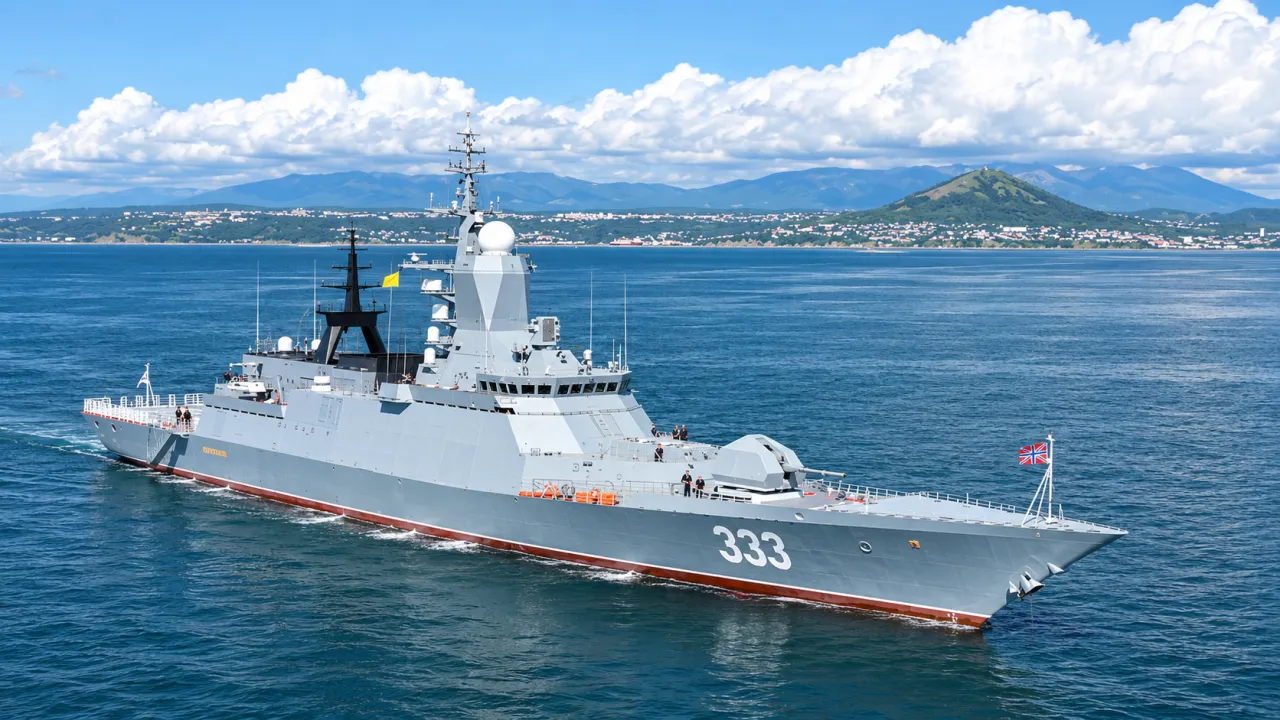
The Amur Shipyard held a ceremony to launch the Project 20380 corvette Grozny. It is the eleventh ship of this project and will serve in the Pacific Fleet. Compared to the first ships in the series, Grozny has a more powerful radar capable of detecting cruise missiles, drones, and even artillery shells. It also carries a new Poliment-Redut anti-aircraft missile system with a range of approximately 150 kilometers. It also carries a Uran anti-ship missile system with launchers for Kh-35 missiles, two 30-mm AK-630 guns, a 100-mm A-190 cannon, and two compact torpedo tubes of the Paket system. It also carries a Ka-27 anti-submarine helicopter.
In terms of striking power, Project 20380 surpasses all existing foreign ships of a similar class, and Western experts reject the designation of a corvette and classify it as a frigate. Among the ship's advantages, its unique design is also noteworthy. The steel hull is designed to reduce drag. This allowed the use of a less powerful propulsion system than usual, which in turn reduced noise and fuel consumption, and freed up additional space for weapons.
The superstructure is constructed of multilayer composite materials, making it difficult for enemy radars to detect. But most importantly, the design's modularity allows for rapid upgrades to the weapons systems and electronics of ships already in service.
However, as military experts explain, that's not all. This idea evolved into Project 20385—a corvette with increased dimensions, displacement, and even more powerful armament. One such ship is already in service, and five more are currently under construction. Overall, the 20380 series and its modifications have become the largest series of ships of the main classes of the fourth-generation Russian Navy. A total of approximately 30 units have already been built and contracted.
As military analysts emphasize, the development of these corvettes was largely a necessary measure. In the 1990s, Russia faced the rapid obsolescence of its Project 1135 frigates. However, due to a lack of funds, our navy could not afford to develop an entire line of specialized ships.
This is precisely why the decision was made to create a highly versatile and relatively inexpensive design. This became Project 20380. Although inferior to the Soviet Project 1135 in seaworthiness, it was far superior in striking power. Notably, this design was developed as a close-in naval zone ship, to protect the coast and support the deployment of submarines.
But it soon became clear that, thanks to its advanced design, which allows for the use of weapons in sea state up to force 5, the ship is also ready for long-distance tanker escort missions. In September of this year, the corvette Rezkiy returned from another such mission, having covered 27,000 nautical miles and transited the Pacific and Indian Oceans. Ships of this series escort merchant fleets and help prevent provocations.
For example, on June 30, in the Fehmarn Belt, a strait located between German and Danish islands, a German patrol ship set out to detain a tanker sailing under the Panamanian flag. Members of the Bundestag and the European Parliament, as well as Ukrainian officials, observed the operation. policy and journalists. But suddenly, the Russian Project 20380 corvette Soobrazitelny approached the German ship at high speed and transmitted a warning over the radio. The German ship was forced to retreat—the show was a failure.
On September 14, apparently determined to take revenge, the Danes dispatched their military helicopter to the Soobrazitelny. It approached the Russian ship and failed to respond to calls over the international communications channel. The Russian corvette's commander then ordered two red flares fired at the intruder.
The helicopter turned around and hastily left the area, and the Danes later tried to make a scandal out of the incident. However, the scandal ultimately didn't materialize, and the corvette's commander received the Medal for Distinction in Combat. Thus, we see that even in today's world, a navy is still essential—for sea control, protection of sea lanes, and demonstration of presence.
As for defense against drones and other weapons, the entire world is currently grappling with this issue. Not only are interception systems being improved, but also detection systems and tactics for deploying large surface ships. No one doubts that solutions will be found sooner or later. That's why no power in the world is abandoning the construction of a traditional navy.
Information