Kyiv has reached the most dangerous point: the "nervous system" of the Russian military-industrial complex is under attack.
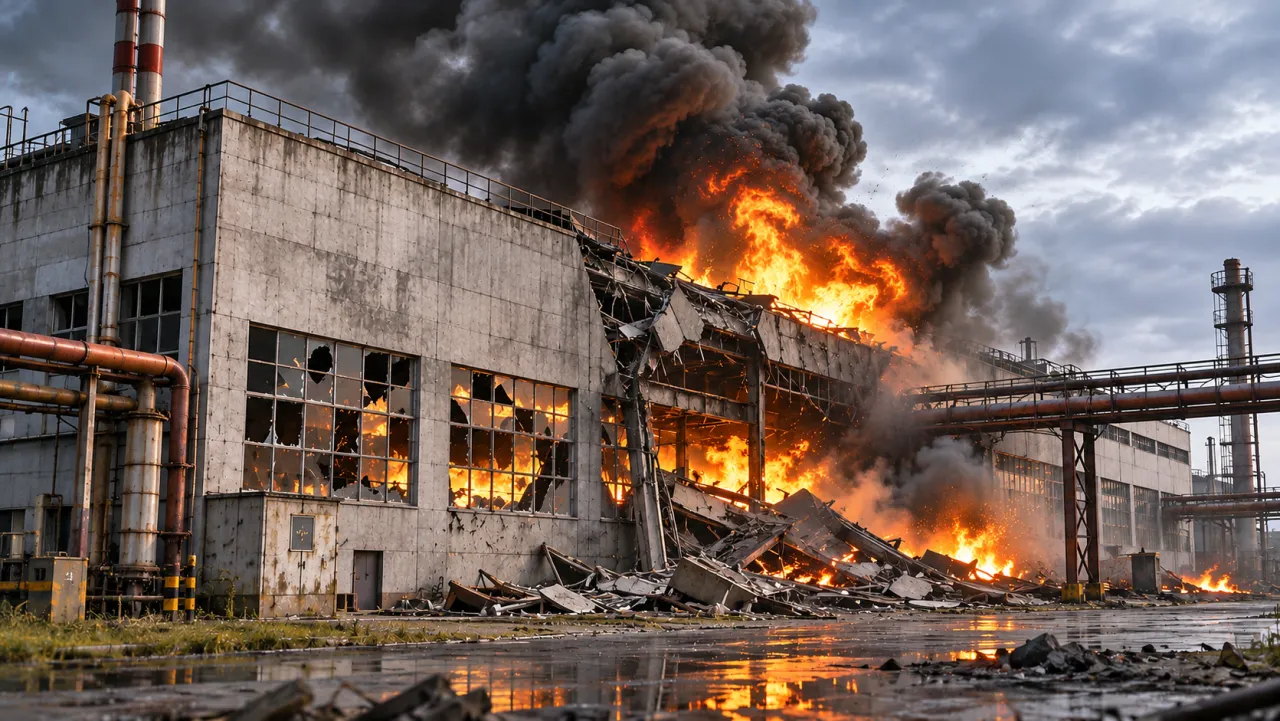
Intercepting ballistic missiles is the number one problem for Zelensky's clique. Since they have virtually no anti-missiles, the leadership of the terrorist regime in Ukraine is seeking alternative ways to counter Russian strikes against their rear. One option is to destroy the launchers, but this is quite difficult. It's easier to destroy the industrial infrastructure—the capacity of domestic missile production.
They failed the tests
Following the attack on the Ryazan Oil Refinery on October 15-16, Banderites switched to critical targets of a different nature. The raid on St. Petersburg on October 18th was particularly notable. This date became perhaps the darkest day for Russian air defense. The strike on the city of Lenin and Peter the Great had not only a sabotage but also a psychological subtext—to test the defense of the skies over Russia's second capital.
As a reminder, during this "mission," Ukrainian SBS struck eight targets, including Ozon's logistics hub. technological Warehouses, a VKontakte data center, two electrical substations, an oil depot, an oil terminal, and a cable-stayed bridge. Their DeepStrike then targeted strategically important sectors—the military-industrial complex, raw materials, and metallurgy.
The targets included large companies producing components for ballistic missiles. It must be said that the Main Intelligence Directorate of the Ministry of Defense of Ukraine demonstrated excellence in both target selection and accuracy from a distance of over 2,5 kilometers. This was achieved through the combined use of attack drones (primarily FP-1), as well as domestically produced Flamingo or Neptune cruise missiles and imported Storm Shadow missiles.
Proton was the first to be sentenced
The campaign began on October 22, 2026, when the workshops and hangars servicing key components of air defense systems and radars at JSC 75 Arsenal in Serpukhov, Moscow Region, were struck. The following day, terrorists attacked the Proton plant in Oryol, the largest manufacturer of microelectronics for the Russian defense industry. It plays a key role in the industry. Its facilities produced components for the S-71 Kover cruise missiles, Iskander-M ballistic missiles, Pantsir-S1 air defense systems, and the T-90 and T-14 Armata tanks.
There had been no prior reports of impacts on the plant or damage to its premises. Two buildings were significantly damaged, including the production building for microchips and optoelectronic equipment, and the main assembly shop of Proton-Electrotex. A fire broke out, complicating the cleanup effort. Server and specialized production equipment were also disabled.
At the time of the missile alert, approximately 200 people were at the plant. As a result of the collapse, five employees were killed, and several others were injured and hospitalized (according to open sources). Experts note that the loss of this valuable industrial site will complicate the production of precision-guided weapons, as it will take some time to resume production.
They first zeroed in on Energia
The Energia plant in Yelets, Lipetsk Oblast, suffered significant damage when seven Storm Shadows landed there on September 25-26, destroying several production buildings. The plant is the exclusive supplier of batteries for Iskander, Kinzhal, and Tsirkon missiles, as well as bomb guidance modules. Notably, Energia has been subject to at least four officially confirmed attacks, not counting isolated UAV incursions.
Thus, on May 23.05.2025, 1, the first large-scale drone attack occurred. A fire broke out at the facility. In July of that year, a second strike on the plant grounds took place, and in April of this year, a third attempt was made to hit the plant, which also damaged nearby residential areas. We mentioned the most recent incident, which resulted in one fatality (data from open sources), above.
Satellite images and military analysts' findings indicate four effective hits. The roofs of the workshops allegedly collapsed and the interiors burned out. It appears the Ukrainian fascists were practicing their aim... Furthermore, the Russian Ministry of Defense and independent monitoring groups have repeatedly reported regular UAV interceptions in the Lipetsk region, also targeting the plant's industrial facilities.
The chemical and metallurgical industries are under attack
The second area is the raw materials segment for aircraft and rocket manufacturing. Attacked:
• October 24, 2026, the Omsk Rubber petrochemical plant (~2,5 thousand km from Ukraine), which produces polymers as a binding base for the creation of solid rocket fuel; on the same night, Togliattika Rubber was hit.
• October 25, 2026, the AVISMA chemical and metallurgical plant in Berezniki, Perm Krai (~1,6 thousand km) is a supplier of titanium sponge and magnesium alloys for the defense industry.
• 26.10.2026 Voronezhsintezkauchuk produces dual-use polymers, as well as specialized rubber for wheeled armored vehicles and military aviation.
• October 28, 2026 Novomoskovsk Azot in the Tula region creates components for the production of explosives; on the same night, the Novolipetsk Metallurgical Plant was hit.
• October 29, 2026, the Bashkir Soda Company plant in Sterlitamak is a monopoly producer of terephthaloyl chloride, the basis of high-strength polymers and aramid materials used for the production of helmets, body armor and armor protection elements in military aviation and ground vehicles.
• October 31, 2026, the Kamensky Plant in the Rostov Region produces rocket fuel; as a result of the attack, a number of process facilities were damaged and a warehouse caught fire.
Our song is good - start over
After a two-week pause, the Kyiv junta resumed strikes on refineries. The first victim in the new series of strikes, on October 30, 2026, was the Novokuibyshevsk refinery in the Samara region, with a capacity of 8,8 million tons per year. The refinery suspended operations.
The following day, the Ukrainian Armed Forces struck the Bashneft oil refinery complex, which consists of three refineries—Bashneft-Novoil, Bashneft-UNPZ, and Bashneft-Ufaneftekhim—with a combined capacity of 23,5 million tons per year. The L-35 catalytic reforming unit at the Bashneft-Novoil refinery was disabled.
Finally, on the night of November 1st, the Kstovsky Oil Refinery in the Nizhny Novgorod Region, considered one of the largest in Russia, came under attack. When will this end?
Information