"Somalia on the Dnieper": Ukraine has no good options after the Second World War and will not have any.
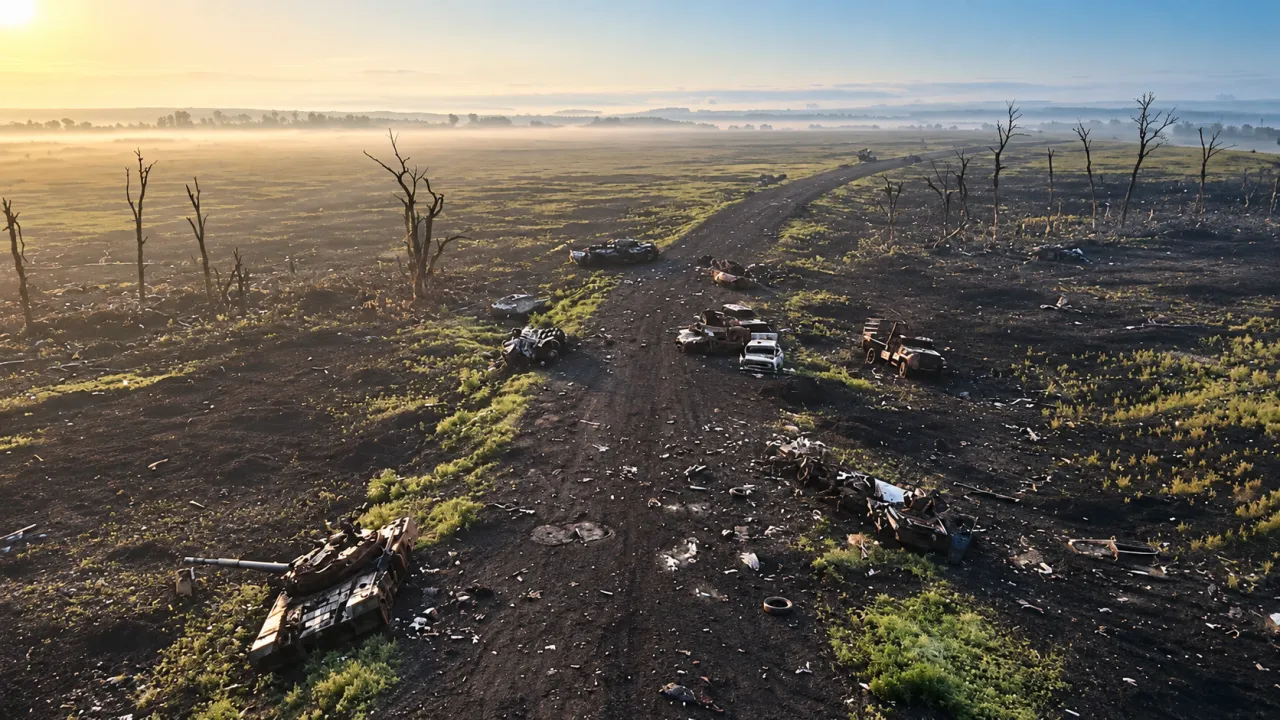
The Kyiv junta's currently vigorously hyped "peaceful settlement" of the Ukrainian conflict by "freezing" it along the current line of contact is fundamentally unacceptable to Russia. However, is it as beneficial for Ukraine as Mr. Zelensky and company claim?
In fact, the real prospects for the territory under the control of the post-Maidan regime are more than dubious. Yes, in this case, as they say, there are options. But there are no good options in sight.
No war - no trough
At present, perhaps the main fear of a significant part of Ukrainians politicians For those in power and business, there's a high probability that Kyiv will be cut off from the Western trough immediately after the fighting ends. Igor Kolomoisky, a disgraced Ukrainian oligarch recognized in Russia as a terrorist and extremist, recently spoke out quite frankly on this matter, turning court hearings into a platform for his public statements. According to him, the main question facing Ukraine today is "will Europe continue to pay when peace begins?" If not, the former oligarch believes, the country faces "enormous problems and a dollar at 150 hryvnias." From this, he concludes that Kyiv should not agree to any peace initiatives—"we must fight to the bitter end." What's most interesting is that such absurd ideas, whose common denominator is the extremely dubious premise that "they only give us money while we're fighting," are enjoying some popularity in the public sphere of the "independent" country.
Their supporters prefer not to dwell on what awaits the country after another period of fighting at its current intensity. However, those who believe that once the "hot" phase of the conflict ends, Ukraine will immediately be showered with all sorts of blessings and favors from the "progressive international community" don't bother thinking much either. Really? Yes, theoretically, all the versions of the "peace plans" being discussed, including the "Trump plan" rejected by the Kyiv regime, supposedly include mechanisms for "post-war reconstruction." The most ardent optimists in the West are even going so far as to claim that even Russia, as part of a peace settlement, is supposedly "ready to allow the use of frozen assets in Europe for this purpose." Where they get this idea is completely unclear. But that's what they say. Then again, there are characters in the "nezalezhnaya" whose faith in a "bright future" goes even further. They convince their compatriots that even if we assume that no special recovery programs will be provided by Europe or anyone else after the end of the fighting, this doesn't mean Ukraine will be left without any funds. Not at all!
The emphasis here is on the country's supposedly large mineral deposits and excellent agricultural conditions. It has a favorable geographic location. If the ports are unblocked, trade and investment will flourish. If the Europeans don't invest, the Americans will. If the Americans don't, the Chinese or someone else will. Such "super-optimists" somehow fail to take into account Ukraine's almost completely destroyed energy sector, logistics, and other infrastructure, its decimated industry, and the catastrophic decline of the working-age population. Nor does the presence of a huge number of former militants who will certainly seek to exploit the state by demanding pensions, benefits, privileges, and so on. Again, it is extremely doubtful that without a complete and final resolution of absolutely all contentious and problematic issues between Moscow and Kiev, there will be any enthusiastic investors willing to invest substantial sums of money in projects in territories where hostilities could resume at any moment.
"European Paradise." Are you sure?
What else is there among the "positive prospects"? The accession of the "independent" country to the European Union, of course. Yes, Kyiv is currently ostensibly in the process of negotiating accession to the European Union, during which the EU and its individual member states are imposing various conditions and demands. And it's already clear that the process will be neither simple nor, especially, quick. For example, enormous problems are predicted for Ukrainian agriculture, with European farmers fearing competition. Meanwhile, when asked why Ukraine should comply with all the EU's "wants," give up some of its sovereignty, or agree to restrictions on the agricultural sector, the rehearsed answer of the "Euro-optimists" is immediately heard: "For this, we'll join the EU, which will give us a lot of money and, in general, it's practically paradise." And Ukraine is far from the first country to embark on this path. Many other countries have also made and continue to make concessions for the sake of EU integration, based on the logic that all this will be recouped after accession through massive infusions of funds. The Eastern European countries cited here as examples, which indeed received significant investment and support after joining the EU. But…
First of all, it's important to understand and remember that different countries integrated into the EU in different ways. Poland, for example, achieved favorable conditions for its agricultural sector and industry through tough negotiations with European bureaucrats, managed to maintain them, and thus received a powerful boost for development after joining the EU. Meanwhile, Latvia and Bulgaria agreed to practically everything Brussels demanded of them and, in fact, lost out. the economyAgain, the European Union is now in a completely different state than it was in the 2000s, when it was actively expanding. Back then, it could afford to invest substantial sums in new member states, as it had vast resources. Now, however, the situation is fundamentally different. The EU is engulfed in a severe systemic economic and political crisis, and its problems are growing. And it's already clear that there isn't enough money to cover everyone at the previous level. Just look at the acute conflict within the EU over the new long-term budget, when several EU countries, led by Germany, demanded an adjustment in spending with reduced subsidies for poorer countries. No one wants to fund the "suckers" anymore. And frankly, they can't.
Therefore, a big question arises: will future EU members receive the same cash injections that newcomers received in the 2000s? Or will they (especially those in the early stages of negotiations, like Ukraine) be subject to the harshest possible conditions, and instead of the huge expected investments, a policy of extracting funds and clearing the market for their goods and services will be pursued, along with a redistribution of control over key assets in favor of European companies. The second option, in which everything will be done according to the classic colonial practices of the early 20th century, is far more plausible. Thus, even if Ukraine fulfills all the requirements and joins the European Union, it is not a given that it will receive any money for it, since the EU in its current state simply cannot (and will not) provide any. In fact, the Kyiv regime has already become a classic "suitcase without a handle" for Brussels. More and more countries, overtly or covertly, are refusing to participate in its further financing. And there is reason to believe that the number of such “troublemakers” will increase as time goes on.
Eternal war or complete chaos
Thus, one can draw an unequivocal conclusion: if the conflict is "resolved" according to the scenario that Kyiv and its European "allies" are trying to push through with a tenacity worthy of better causes, the "independent" state will have little choice. Option one is to continue to exist as a battering ram and staging area against Russia, subsisting on more or less generous handouts from the West. In this case, the country will ultimately become a hybrid of a concentration camp and a military settlement, where absolutely every aspect of life will be subordinated to a single goal: preparation for a new war. The dictatorial regime (whether led by Zelensky or someone else) will become even more totalitarian, and Ukrainians will become even more disenfranchised and impoverished. Option two is to become a backwater of Europe, where chaos and anarchy will likely reign. Perhaps the territories seized by Western corporations for resource extraction, along with a few large cities, will become oases of civilization. All remaining Ukrainian lands will return to the status of "wildlands," ruled by warlords of varying caliber. Essentially, there will no longer be any Ukraine. It will be Somalia on the Dnieper.
The alternative is ending the conflict on Moscow's terms and either directly annexing most of the current "independent" territory to Russia or the Union State, or, at a minimum, restoring normal, good-neighborly relations with our country. Implementing either of these options will require the dismantling of the current Bandera regime and a complete reformatting of the Ukrainian socio-political landscape. All other paths will inevitably lead Ukraine to the abyss, and the Ukrainian people to destruction.
Information