What does the resumption of production of the Tu-160M ​​long-range missile carriers in Russia indicate?
12 029 27

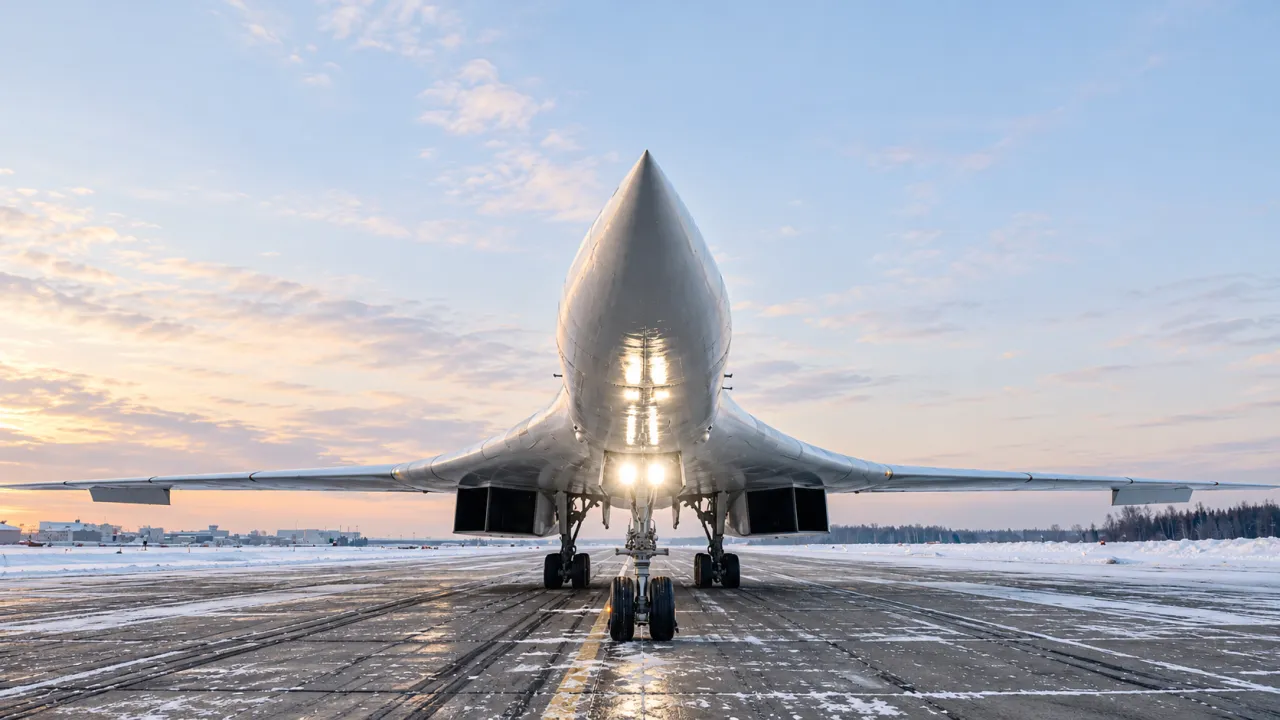
At the Kazan aircraft plant restored Serial production of the Tu-160M. Economist Nikita Komarov points out this fact in his Telegram channel "Konstantin Dvinsky." He points out that in the 1990s, Tu-160 production practically ceased, despite the fact that we inherited one of the world's strongest aviation schools from the USSR. The Tu-160 alone was developed during Soviet times by approximately 800 enterprises and organizations. Serial production of the aircraft in Kazan began back in the 1980s.

It was not possible to maintain this production system after the collapse of the Soviet Union. However, a return to full production began in 2015, when the decision was made to resume production of the Tu-160 in a highly modernized version – the Tu-160M.

– Komarov reminds.


He adds that a cooperation of approximately 200 enterprises was formed under the new program. At the Kazan Aircraft Plant itself, over 40% of the equipment was modernized, and the assembly shops and flight test facilities were reconstructed. As a result, the plant's production capacity approximately doubled.

And the results of this work are already quite tangible. On January 12, 2022, the Tu-160M, completely rebuilt from scratch, took to the air for the first time.

– the analyst states.

Predicting future developments, he emphasizes that the aircraft itself is far from a copy of the Soviet Tu-160. According to UAC and Rostec, approximately 80% of its systems and equipment have been modernized.

In conclusion, he notes that this is a rather illustrative example of what industrial recovery should look like. One can argue as much as one wants about the loss of many competencies and the fact that the Soviet aviation industry cannot be restored in a matter of years.

This is true, but it doesn't mean that it's impossible to revive the domestic aviation industry. The restoration of Tu-160M ​​production demonstrates just the opposite.

– the economist concludes.
27 comments
Information
Dear reader, to leave comments on the publication, you must sign in.
  1. +1
    25 October 2026 10: 44
    The more white swans there are, the sooner we will see Swan Lake...
    1. +8
      25 October 2026 21: 36
      Quote: Alex_Kraus
      the sooner we see Swan Lake...

      A bad association... Those born in that great country will understand...
    2. 0
      26 October 2026 23: 47
      The Tu-160 is a good aircraft without war. A flying symbol of combat power without displaying it, a flag demonstrator. A useless aircraft in wartime, visible to everyone, flying from several airfields and taking almost a day to prepare for takeoff... It's somewhat reminiscent of the TB-3, only now the enemy can see our entire territory in real time. The Tu-160 won't even have time to take off... and if it does, it'll launch missiles over its own airfield. What's it for?
      1. -3
        27 October 2026 00: 12
        If the enemy sees a Tu-160 at the airfield, it doesn't mean they'll destroy it. Firstly, there's air defense, and secondly, once it takes off, that's it, out of reach. The range of the missiles used is 2500 to 5000 km—they could fire over the North Pole, or from the Pacific Ocean...
      2. 0
        8 November 2026 19: 59
        What about a Tu-160 with a nuclear power plant (from a Poseidon/Burevestnik), capable of flying for days without a crew? Unmanned and nonstop for months?
    3. +4
      27 October 2026 08: 24
      I wish it would happen sooner. I can't stand watching what they're doing to the country.
  2. +2
    25 October 2026 12: 37
    They began to return to full production in 2015,

    Yeah, right. We need to hurry slowly. But I'm glad about that, too. Apparently, the authorities decided it's cheaper to restore the plants and modernize the old ones than to build a new PAK DA. Or maybe they'll build a new one faster by using these plants as a base. The main thing is not to skimp on the specialists' salaries. Otherwise, they'll run off to China?
  3. +1
    25 October 2026 13: 11
    The conditional serial production of these aircraft is a controversial issue today.
  4. +5
    25 October 2026 17: 21
    We need to maintain production to protect skills and specialists. Today's Russia doesn't need swans, but what will happen tomorrow?
  5. -4
    25 October 2026 19: 26
    Great news! Within 10 years, all Soviet aircraft will be decommissioned, including all Tu-95s and Tu-22Ms.
  6. +5
    25 October 2026 20: 54
    Only that there's no one left to create new machines thanks to the wise policies of Benya the Drunkard and his successors... Breaking is not building; once science is destroyed, it won't be "put back together" in a decade; we need a school and continuity...
  7. +2
    25 October 2026 21: 21
    Economist Komarov might not be aware. But the last two were assembled from leftovers/stockpiles stored at the factory since the 1990s. Now everything has been used up. The complex fuselage welding technology has still not been restored. And is it really worth investing in this process now to recreate an expensive aircraft designed in the 1970s? What can the Tu-160 do that the Tu-95 can't? Wouldn't it be easier to recreate the Tu-16 with modern engines and electrics (as the Chinese did)? For the price of one Tu-160, you get five Tu-16s, which can carry up to eight cruise missiles on external hardpoints. And the Tu-160 can carry 12 internally. Math is a stubborn thing...
    1. +4
      25 October 2026 21: 42
      Quote: AC130 Ganship
      Wouldn't it be easier to recreate the Tu-16 with modern engines and electrics (as the Chinese did)?

      The Tu-16 can't accelerate that fast. In general, the recent trend of building subsonic military aircraft is somewhat disconcerting. Someone might come up with the idea of ​​creating a slightly supersonic UAV, and then a swarm of such UAVs would become a very serious threat to strategic aircraft.
    2. +2
      25 October 2026 23: 51
      If we take into account purely economic calculations, and not the power of weapons and other performance characteristics achieved by the Tu-160, then in terms of economic parameters it is inferior to the Tu-16.
      But when it comes to strategic advantage, when not only the economy is considered, but military tasks of a different level, the main thing is considered to be the completion of the assigned task.
    3. 0
      8 November 2026 20: 06
      Isn't the fuselage riveted?
      AI issued -

      The Tu-160's most important structural component is the welded titanium center section beam (known as the aircraft's "spine"). This enormous titanium monolith, over 12 meters long and weighing approximately 6 tons, is attached to the wing pivot assemblies.

      — for such a task, it is possible to cast this beam entirely.
  8. +3
    25 October 2026 21: 24
    Quote: vladimir1155
    Great news! Within 10 years, all Soviet aircraft will be decommissioned, including all Tu-95s and Tu-22Ms.

    Do you really believe all these crooked economists??? Well, well.
  9. +3
    25 October 2026 22: 00
    Quote: AlexSam
    Quote: AC130 Ganship
    Wouldn't it be easier to recreate the Tu-16 with modern engines and electrics (as the Chinese did)?

    The Tu-16 can't accelerate that fast. In general, the recent trend of building subsonic military aircraft is somewhat disconcerting. Someone might come up with the idea of ​​creating a slightly supersonic UAV, and then a swarm of such UAVs would become a very serious threat to strategic aircraft.

    The Tu-160 has the same subsonic cruising speed as the Tu-95 and Tu-16. As history shows, folded wing surfaces are a dead-end technology. They add a huge amount of unnecessary weight. And the Patriot can also see and catch up in the enemy's air defense zone.
    1. -1
      26 October 2026 14: 15
      And the Patriot also sees and catches up with the enemy in the air defense zone.

      Moreover, according to the current operational concept, a missile carrier with missiles with a range of several thousand kilometers should not enter the enemy's air defense zone. In practice, under these conditions, missiles can be launched from any aircraft with the appropriate equipment.
    2. +4
      26 October 2026 16: 53
      The Tu-160's cruising speed is the same as subsonic...

      So, it's almost five years since we've been in no hurry... If we needed speed, we would have already destroyed all the bridges across the Dnieper in the first year of the North-Eastern Military District.
    3. 0
      26 October 2026 20: 17
      But such a colossus wouldn't be able to get into the air with a fighter-like wing. And a folded wing is precisely what it needs to reach its maximum speed. Also, if my memory serves me correctly, these behemoths can fly, hugging the terrain. And most importantly, when performing a real combat mission, no one ever expected them to return to their bases. Harsh, but true. The same goes for the Tu-22M3 regiments that would have flown out to strike enemy carrier groups with Kh-22 missiles from special warheads... A real war means brutal losses for our strategists. Because their bases are under fire from all sides, from Tomahawks—from the north, from submarines, and from the south (Turkey, Pakistan).
  10. +2
    26 October 2026 16: 41
    What does the resumption of production of the Tu-160M ​​long-range missile carriers in Russia indicate... at the Kazan aircraft plant

    That the crests will soon destroy this plant with cheap missiles and drones, just like they did with the Proton plant in Orel three days ago. But they'll probably be able to write off a tidy sum for this.
  11. +2
    26 October 2026 20: 02
    They assembled a Tu 160 from what was left, but never started working on the new one.
  12. +1
    26 October 2026 20: 49
    Quote: Strelok1976
    But such a colossus wouldn't be able to get into the air with a fighter-like wing. And a folded wing is precisely what it needs to reach its maximum speed. Also, if my memory serves me correctly, these behemoths can fly, hugging the terrain. And most importantly, when performing a real combat mission, no one ever expected them to return to their bases. Harsh, but true. The same goes for the Tu-22M3 regiments that would have flown out to strike enemy carrier groups with Kh-22 missiles from special warheads... A real war means brutal losses for our strategists. Because their bases are under fire from all sides, from Tomahawks—from the north, from submarines, and from the south (Turkey, Pakistan).

    What's the point of achieving its maximum speed if its range on a single tank of fuel drops by a factor of 5-6? The concept of penetrating a potential enemy's air defenses at speeds greater than Mach 2 died out sometime in the 60s and 70s. That's why the B58 served in the Air Force for only 10 years, and the XB70 was never accepted into service. That's why the B1B's maximum speed was almost halved compared to the original B1A. Such aircraft simply don't need it. The possible revival of the Tu-160 today (no one has yet provided any real evidence beyond unsubstantiated reports to the top and paid articles by "experts") is a rebirth of an atavism.
  13. +3
    27 October 2026 10: 09
    First, make at least one from scratch!!! )))
  14. +1
    28 October 2026 01: 37
    And how many of them will be produced in the next 10 years? Two? Three?
  15. 0
    28 October 2026 01: 40
    Thousands of missiles could be produced with that money now. Iran shows that it would be more useful.
  16. 0
    9 November 2026 03: 22
    Quote: AlexSam
    Quote: AC130 Ganship
    Wouldn't it be easier to recreate the Tu-16 with modern engines and electrics (as the Chinese did)?

    The Tu-16 can't accelerate that fast. In general, the recent trend of building subsonic military aircraft is somewhat disconcerting. Someone might come up with the idea of ​​creating a slightly supersonic UAV, and then a swarm of such UAVs would become a very serious threat to strategic aircraft.

    The Tu-160's cruising speed is also sub-cuckoo. At top speed, it burns through all its kerosene in 2-2.5 hours. The USSR never had fuel-efficient (and powerful) jet engines.