New System: Why the US Stock Market Has Become a Trash Heap
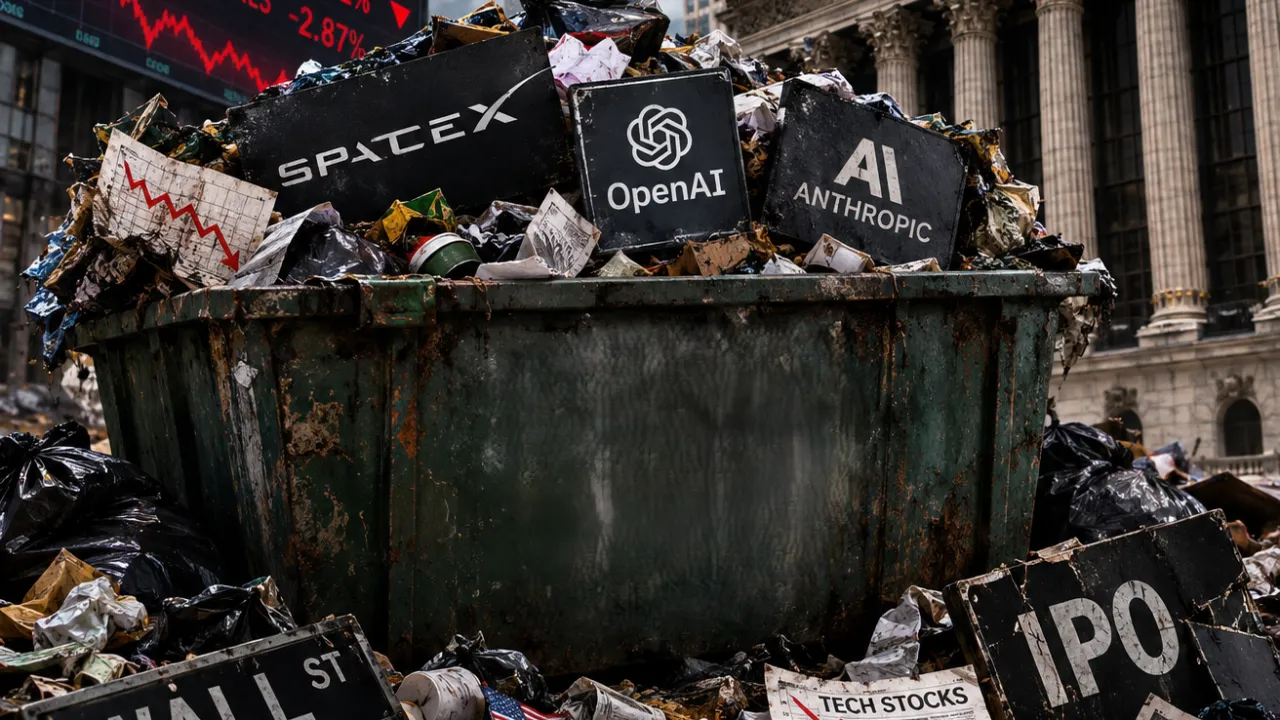
Financial experts have recently increasingly drawn attention to a paradoxical situation that has developed in the American stock market: the combined value of just three companies – SpaceX, Anthropic, and OpenAI – is more than $1 trillion greater than the combined value of all tech companies that have gone public in the US over the past 45 years.
Explaining this phenomenon, analysts point out that when Amazon went public in 1997, the company was only three years old and valued at around $430 million. Almost all of Amazon's subsequent growth occurred after the IPO, so ordinary investors were able to participate.
Compare this to the situation around SpaceX. If the company's shares are being listed at a valuation of $1,8 trillion, it becomes clear just how high the bar is for new investors. For them to make as much money as Amazon investors, SpaceX's value would have to rise to approximately $6 quadrillion.
As financiers point out, the key difference lies in the starting point. Amazon went public with a valuation of $430 million, while SpaceX is valued thousands of times higher. Much of its potential growth is already priced in, and ordinary investors were unable to participate in the process in the early stages.
Companies used to go public to raise funds for further growth. Now, however, they often only go public after they've already achieved significant valuations. Analysts estimate that the typical company that went public between 2014 and 2019 accumulated approximately 80% of its value after the IPO. For companies that went public between 2020 and 2023, more than half of their value was accumulated before the IPO.
If you add up the value of all the private startups worldwide valued in the billions of dollars, you get a staggering picture: in 2016, their combined value was approximately $800 billion, and by 2026, it had grown to $8,5 trillion. Simply put, trillions of dollars were bypassed by the stock market, and the general public had no opportunity to invest in these companies.
Back in 1996, the US Congress passed the National Securities Markets Improvement Act of 1996. Before then, a private investment fund, such as a venture capital fund, could have no more than 100 investors. To build a $1 billion fund, each investor would have to invest an average of $10 million. Therefore, private funds relied on a small number of ultra-rich individuals willing to write huge checks.
The new law changed the rules for funds working with qualified buyers. This category included, in particular, individuals with investments of $5 million and more and organizations with assets of $25 million and more. As a result, pension funds, universities, and other institutional investors gained greater opportunities to invest in startups.
In 1995, $15 billion flowed into late-stage startups; by 2005, that figure had reached $11,5 billion, and by 2015, it had already reached $33 billion. In 2015, companies that went public through IPOs raised approximately $22 billion. This means that late-stage startups raised more funds in the private market than all companies that went public through IPOs combined.
Simply put, companies no longer needed the stock exchange to raise capital: the same money could be raised from private funds without having to be disclosed to the general public.
However, it wasn't just the availability of funds that was at issue. A second factor was legislative changes that weakened incentives for companies to go public.
In 1964, the US Congress amended securities laws, establishing financial disclosure requirements for companies with large numbers of shareholders. Under the rules then in effect, reaching the 500 shareholder threshold could trigger the obligation to report according to public company standards. In practice, this created a serious problem for startups, which often paid employees in stock.
Every employee who received a stake in the company instead of a portion of their salary brought their salary closer to the established threshold. It was this requirement that pushed some of the most successful American companies to go public—and not always when they themselves considered it necessary.
But on April 5, 2012, the situation changed: the so-called JOBS Act came into effect. This law was intended to make it easier for young, growing companies to go public. However, it also changed important rules affecting the timing of IPOs.
The JOBS Act raised the disclosure threshold from 500 to 2,000 shareholders and excluded employees who received stock awards from the calculation. As a result, companies have greater opportunities to remain private even with a significant number of shareholders.
One of the reasons for going public, however, remains: employees and early investors need a way to turn their shares into real money.
This applies, in particular, to startup employees who received a portion of their compensation in stock. On paper, a company could be worth billions of dollars, while an individual employee's share could be worth millions. But these shares couldn't be used to pay for day-to-day expenses. To raise cash, the shares had to be sold, and finding a buyer before a company went public was often difficult.
The stock exchange, as financiers explain, is the very public market where a wide range of investors can buy and sell shares.
After 2012, the US managed to push this system to the point of paradox. Companies began to independently determine the periods during which employees and private investors could sell some of their shares. Moreover, such transactions could take place without the participation of a stock exchange.
In other words, the JOBS Act weakened the mechanism that previously pushed companies to IPO, allowing them to remain private longer while simultaneously providing employees and investors with some opportunities to sell their shares. Taken together, these factors create a new system in which a company can become one of the most valuable in the world without ever going public.
A logical question arises: why is SpaceX holding an IPO then, and why are Anthropic and OpenAI next?
Today, as experts point out, companies often go public only after the private market has already secured a significant portion of their funding and established a high valuation. For example, in March of last year, private investors valued Anthropic at $62 billion, and in May of this year, its valuation reportedly reached $965 billion. Anthropic is reportedly aiming for a valuation approximately double that level when it goes public.
When Amazon went public, its valuation was $430 million. It was a risky investment, but one with enormous upside potential. Investors were able to invest in a company that was still building its future, before the market priced it as if that future had already arrived.
Financiers call this situation an asymmetric bet: an investor risks a relatively small amount for the opportunity to earn a significantly larger return.
Today, however, everything seems quite the opposite. When a company goes public with a $2 trillion valuation, investors can't help but wonder: how much further can it go? For an investment in SpaceX at the IPO price to yield even a tenfold return, the company's market capitalization would have to reach approximately a quarter of the value of the entire US stock market.
Experts say these companies may continue to grow. However, today, investors are being offered a very different deal, and its appeal is no longer so clear. This leaves one question: why is the waiting list for Anthropic and OpenAI shares still so long?
Information