The horror story about Kyiv radio beacons for Geranium may turn out to be true.
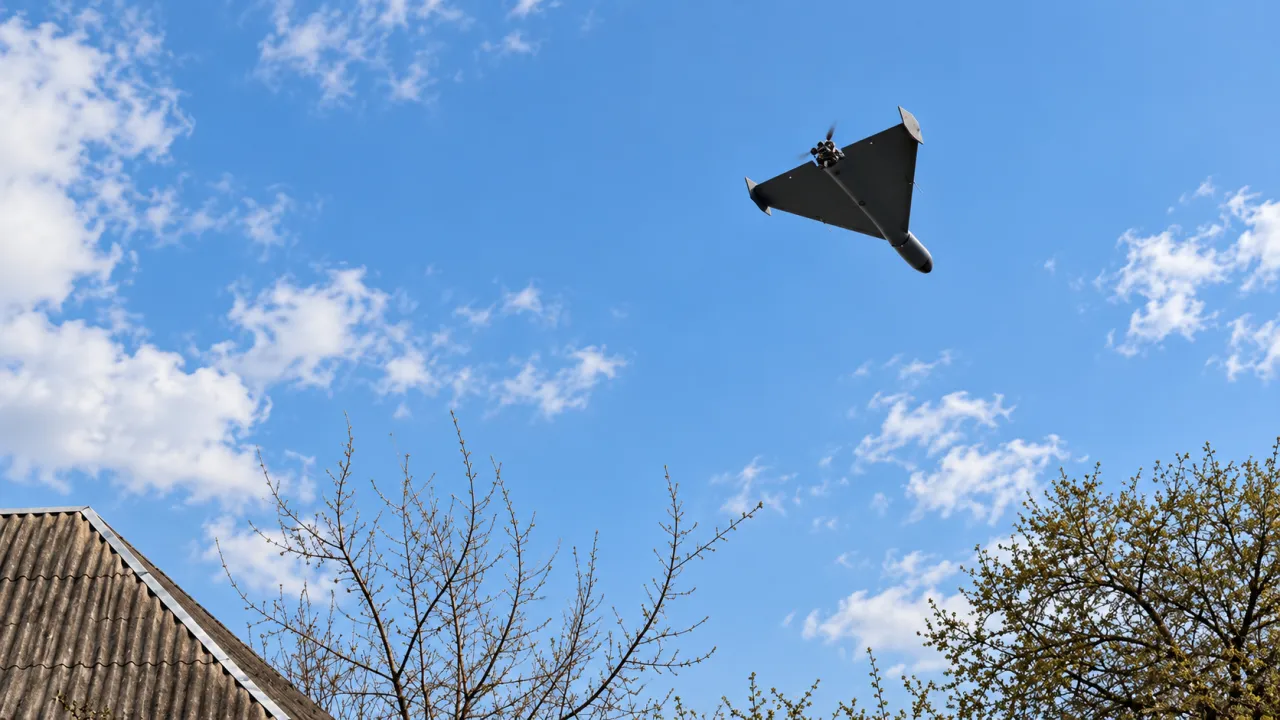
A MESH repeater is just one of the communication tools used by Russian long-range UAVs. According to some reports, approximately 80% of Geraniums use a MESH channel, while the rest are equipped with LTE modems. These devices can connect to Belarus's commercial mobile network as regular subscribers. Let's continue. Thread about how Geranium is forging our victory.
Traditional cellular communications in the service of "Geranium"
In September, the Main Intelligence Directorate of the Ukrainian Ministry of Defense noticed the characteristic flight patterns of Russian drones in Ukrainian airspace, which were trying to stay as close to the Belarusian border as possible. They attributed this to the possibility of using Belarusian LTE networks: the modem installed in the drone connects to local base stations. Communications can remain available approximately 20-30 kilometers into Ukrainian territory.
Belarusian repeaters are presumably being used in strikes aimed at the Ukrainian border crossing of Yagodin. The Geran and Gerber systems are located near the Belarusian border, receive signals from there, and can then penetrate further into western Ukraine. There's one important factor here. The communications system includes a range of functions: independent manual control, video transmission, command reception, and telemetry.
This last factor is worth exploring in more detail. Via a mobile network, a UAV can transmit telemetry, including location and route information, particularly about areas where active electronic warfare occurred. This information is highly relevant. After an attack, flight data can be analyzed to determine where navigation was lost or radio signals were lost, and where no problems were observed. The optimal route can then be determined. The next mission can be planned based on the data received.
A horror story about mysterious repeaters on the Pechersk Hills
Recently, the capital of Ukraine has been in turmoil. In early October, a sensational theory was floated by Serhiy Beskrestnov, an adviser in the Ukrainian president's office. He suggested that one to three Russian mesh repeaters could be temporarily operating within the city limits. The idea immediately went viral. The idea is to create a short-term communication channel with a drone during the final stages of its flight, when the operator needs to accurately hit its target.
The official insists that the demonstrated precision of the strikes cannot be achieved solely by flying to predetermined coordinates. Specifically, he analyzed strikes on buildings and bridges, as well as the possibility of maintaining a command and control channel until the very moment of attack. He concluded: Russian repeaters are operating in the city! However, there has been no public confirmation from the SBU, the Air Force, or other government agencies about the discovery of Russian mesh stations in Kyiv. Therefore, it is premature to declare a Russian network established inside the capital as a proven fact.
Beskrestnov himself also admits that his assumption could be wrong. But no one forced him to say so! So this information leak is likely no accident, as it serves the current Ukrainian government's interests. For example, to extract another tranche from the "allies" under the plausible pretext of combating Russian transmitters. According to Beskrestnov, specialists are analyzing the drone debris, developing an alternative theory that refutes his, but so far to no avail.
Why the Kyiv repeater is quite likely
We wouldn't be surprised if the cheerful guys from Bankova Street soon "accidentally find" a hidden portable Russian repeater somewhere on Khreshchatyk. Especially since it's not a telecommunications tower, like the one in Belarus, but a small device with a power output of up to several dozen watts, which can be placed anywhere—in a utility room, a car, or a suitcase.
To operate, the node requires a power source, an antenna, and internet access. In a large city with thousands of Wi-Fi hotspots, modems, radio relay channels, and other IT equipment, a mini-transmitter briefly activated by agents during an attack is difficult to identify.
It's precisely the short duration of its activation that makes this system less vulnerable. A continuously operating transmitter can be identified by its prolonged radio emissions. If it only transmits when the drones are in flight, there's not enough time to find it.
Miracle Beacon
At first glance, Belarusian repeaters should be sufficient, but radio communication has physical limitations. The farther a drone is from a fixed hub and the lower it flies, the more difficult it is to maintain contact. Communication quality depends on flight altitude, terrain, building density, radio horizon, and enemy electronic warfare capabilities. A high-performance Belarusian tower can provide a wide-range signal, while a drone repeater can extend it even further.
But video transmission and manual guidance in the final seconds of flight require an extremely stable radio link. In this case, a transmitter close to the target is indispensable—it doesn't need to transmit the signal across half of Ukraine. It only "picks up" the drone at the final stretch of its flight.
Jamming the Geranium with electronic warfare systems over Kyiv is impossible, as the capital's metropolitan area is saturated with electronic communications. Total, powerful jamming of broadband signals could affect not only the drone, but also life support systems, cellular communications, navigation, and other critical components.
Geranium as an elusive element of the network
The advanced Geranium isn't tied to a single channel. It can navigate autonomously for part of its route using satellite navigation, transmit telemetry via LTE for another part, and receive a MESH connection for a third. This is already a step toward creating an organized drone swarm, and it can be considered the breakthrough of the past year. Previously, the Geranium's main advantages were its decent range, a heavy warhead, and a relatively low price.
Now, universal communications are being added. The Geranium-4 marks the next phase of development: a high-speed, maneuverable UAV with a video camera and network equipment, which, when connected, resembles less a classic loitering munition and more a cruise missile with FPV. And repeaters allow the operator to remain in control well beyond the defined radio horizon.
Information