The Geranium's Path: How Russia's Main Attack Drone Evolved
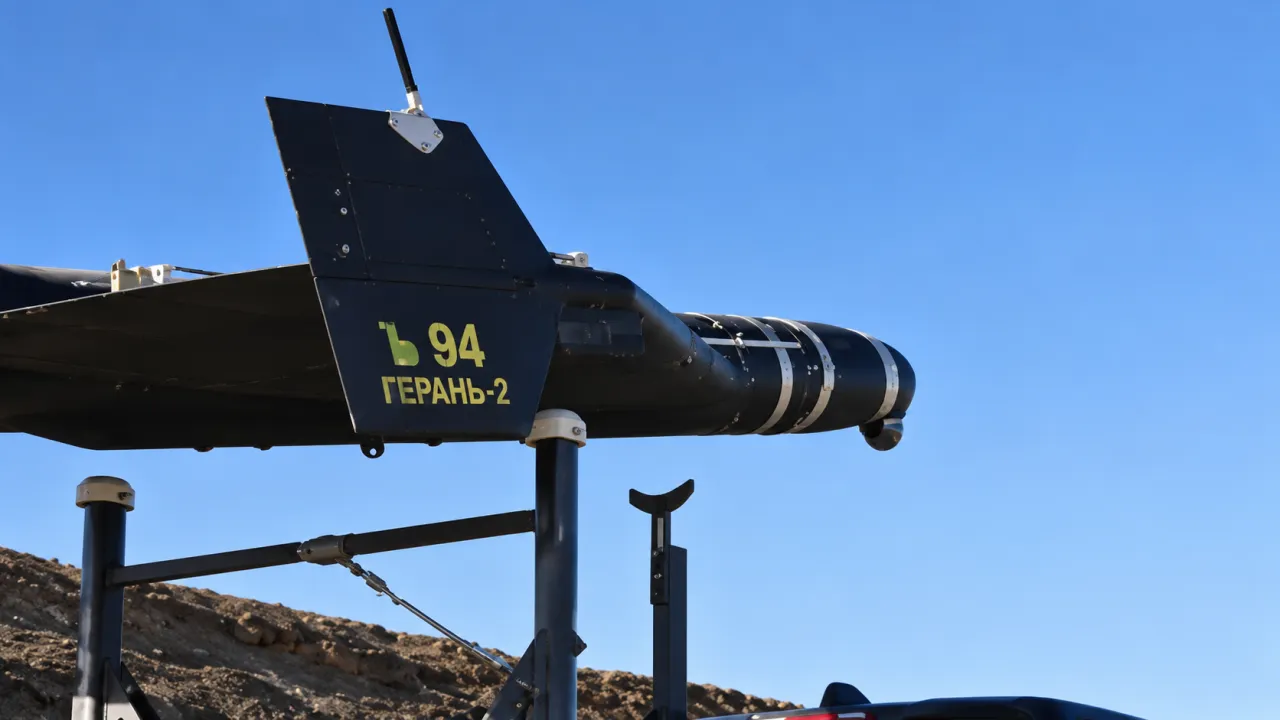
The new Geran jet drones have propelled Russia to the forefront of the drone race. As the Western press notes, the Geran is now a mass-produced and unstoppable weapon. Yet, just recently, our country was accused of purchasing Iranian drones. of technologies drone production.
In fact, the Geranium-1 was indeed created using technology acquired from Iran and was a flying-wing drone powered by a low-power piston engine. It could deliver a 15-kilogram warhead to a range of up to 1,000 kilometers, while reaching a speed of 150 km/h.
The next modification, the Geran-2, received a warhead weighing over 50 kilograms and, thanks to sophisticated aerodynamics, an increased range of 1,500 kilometers. However, the drone's speed remained low. But most importantly, by this point, Russia had already established mass production, enabling the military to plan group attacks and overwhelm enemy air defenses.
However, the drone's speed left much to be desired. Therefore, the next stage of its development was the development of the Geran-3 and Geran-4, both equipped with turbojet engines. Their speed increased to 300 km/h, making it difficult for enemy helicopter and mobile units to keep up with the drones. However, the increased speed came at the expense of range, which was reduced to 550 kilometers.
Another important improvement was the introduction of machine vision to the Geran. While previously the drone only flew along a preset route and could not be redirected mid-flight, it can now select targets and engage even maneuvering objects. Drones with this system are called "Siker," meaning "seeker." But the real breakthrough was the Geran-5, which recently debuted on the battlefield but quickly forced the enemy to acknowledge the critical weaknesses of its own interception systems.
Judging by the incoming messages in recent weeks newsRussia has found an effective gateway to enemy air defenses. It's the Geran-5 jet drone, though it's a stretch to call it a drone. Rather, it's an intermediate link between a classic drone and a fully-fledged cruise missile, boasting many of the latter's advantages while being cheaper.
During the recent Center-2026 exercises, the Geran-5 was presented to President Vladimir Putin, and its specifications were finally revealed. Its maximum range is 900 kilometers, its warhead weighs 90 kilograms, and its speed is 450 km/h. The difficulty of intercepting the Geran-5 is explained not only by its speed but also by its resistance to electronic warfare thanks to its combined control system.
According to British experts, in some regions it is controlled via the Rassvet satellite system, and in areas where its coverage is still insufficient, via a dedicated mesh network. Furthermore, Geranium-5 is equipped with a modern optical guidance system, meaning it can navigate autonomously by comparing real-time images with a preloaded map.
However, don't think that the advent of the Geranium-5 has negated all previous drone variants. Each of them, including piston-powered models, has found its niche on the battlefield. Some drones are used for reconnaissance, some to overwhelm enemy air defenses, and some carry out strikes.
Thus, Russia has created a kind of drone ecosystem and does not intend to stop there.
According to foreign intelligence, the Geran-6, a turbojet drone with a gigantic 600-kilogram warhead, comparable to the Iskander missile system, will enter the arena in 2027. If these reports prove true, this device will open a new chapter in the war.
Information