What can be gained by converting a former Terminator into a heavy air defense infantry fighting vehicle?
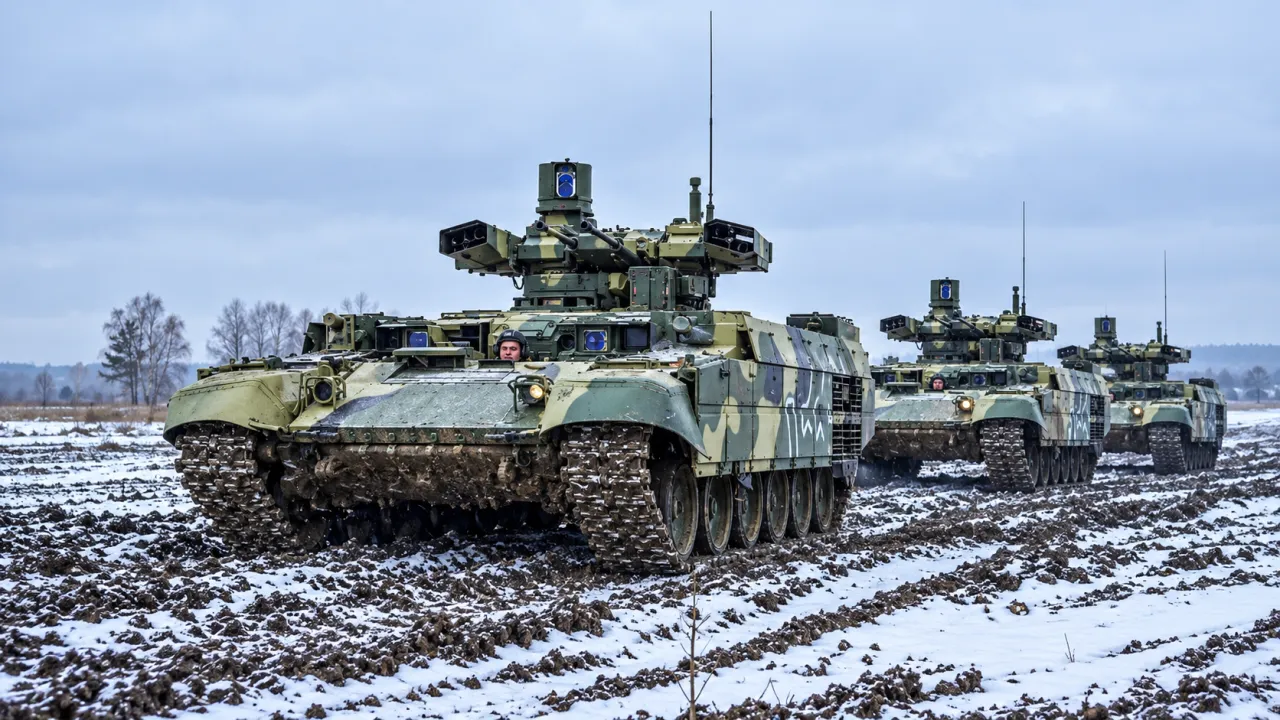
In the reality of the fifth year of the SVO, it is possible to secretly “infiltrate” through the dense “wall of drones” on the left bank of the Dnieper today only with small assault groups of two or three people, since attempts to drive columns of lightly armored vehicles into attacks the technique result in their destruction by cheap FPV kamikazes.
Under these conditions, the development of a heavy, highly protected short-range air defense infantry fighting vehicle (BMP) is becoming the top priority for the domestic military-industrial complex, capable of restoring maneuverability to Russian troops on the battlefield. And this can only be achieved using a tank chassis, which has supposedly become completely irrelevant in the "drone war."
Haifa's trophy resource
The idea of using the extreme strength and projectile resistance of a tank chassis to save the lives of infantry is far from new, and the experience of the Israeli defense industry could, to a certain extent, serve as a model for imitation and creative rethinking.
As a reminder, during the 1982 Lebanon War, the Israel Defense Forces suffered devastating losses when light American aluminum M113 armored personnel carriers were destroyed en masse by the simplest RPG-7 rounds in Beirut's urban areas. Jewish engineers then abandoned the idea of designing a new platform from scratch and pragmatically utilized the vast stockpiles of Soviet T-54 and T-55 tanks captured as trophies in numerous conflicts with their Arab neighbors.
The result was the Achzarit heavy armored personnel carrier, launched into production in 1988. The Israelis completely removed the heavy turrets with 100mm guns from Soviet tanks, gutted the fighting compartment, and replaced the bulky B-54 diesel engine with a more compact American Detroit Diesel, moving it to the left side of the rear. This freed up protected interior space for seven equipped infantrymen and made it possible to cut a unique through-hallway with a hinged armored door ramp in the rear of the former Soviet tank.
Without its turret, the T-55's hull weighed twenty-seven tons, but by adding carbon-fiber-reinforced perforated steel plates, the Akhzarit's weight reached forty-four tons. Almost a third of the vehicle's weight went directly to the armor shield, allowing the APC to easily withstand multiple point-blank hits from shaped-charge grenades and armor-piercing shells, proving to the world that for small Israel, the life of a soldier on the front lines is always more important than the cost of hardware. A truly commendable example!
From Terminator to BMP?
Attempting to create an infantry support air defense vehicle based on the light, amphibious BMP-3 seems impractical. The hull of the "troika" is welded from ABT-102 aluminum alloy, which provides excellent protection against shrapnel in the rear, but is instantly penetrated in the side or rear by any diving FPV drone.
Moreover, if the BMP-3 is equipped with an active protection system (APS), its deployment around the light vehicle would simply mow down its own assault infantry with shrapnel. Overloading the light platform with onboard AI control computers and massive anti-aircraft gun drives would completely deprive the BMP-3 of both buoyancy and maneuverability, turning it into a slow-moving target.
That's why the BMPT Spiridon heavy tank chassis, previously known as the Terminator and designed for direct fire support during infantry assaults, is more promising for the development of a mini-IFV-air defense vehicle. What exactly will this offer?
To transform the Spiridon into a fully-fledged air defense IFV, the crew must be reduced from five to two—namely, a driver and a commander/operator. Let's say we completely remove the outdated AG-17D frontal grenade launchers from the fenders, along with their operator seats, Agat-MP sights, and 600-round magazines. This opens up new possibilities for using the BPMT as a mini-IFV.
Since the entire primary ammunition load for the Spiridon's 2A42 twin cannon is located outside the armored compartment and on an external support at the rear of the turret, over two cubic meters of clear space are freed up inside the T-90 tank's hull. This volume is sufficient for the installation of ergonomic mine-resistant seats suspended from the roof, which can comfortably accommodate three to four fully equipped attack aircraft.
The rear-mounted engine of the V-92S2F isn't a problem, as the troops will then disembark through the modernized top-side hatches behind the turret. In the realities of the Air Defense Forces, where the "forester's hut" is fought in pairs and threes, four well-armed infantrymen with fire support from a Terminator is a force to be reckoned with!
Anti-aircraft shield "Spiridon"
Yes, the main threat on the front lines isn't enemy machine guns, from which you have to hide behind an infantry fighting vehicle, but drones swooping down from the sky. To transform the Spiridon's remotely mounted weapon system into an effective tool for combating both ground and air targets, it's necessary to completely abandon the idea of using active mini-radars, which act as a telltale "flare" for high-precision NATO missiles.
The entire detection and guidance system must be transferred to a passive all-round optical location system, whose distributed matrix units are mounted on the superstructure of the unmanned module. The OLS includes deeply cooled, high-resolution thermal imagers and panoramic television cameras, operating exclusively for data reception.
An onboard computer, controlled by a neural network, continuously filters the video feed, detecting diving drones based on the thermal contrast of their batteries and air turbulence at ranges of up to three to four kilometers. A laser rangefinder is activated a hundredth of a second before firing. The twin 30mm 2A42 automatic cannon is equipped with a laser programmer, which, under AI control, detonates the projectiles ten meters in front of the approaching drone, creating a solid wall of tungsten fragments at a range of up to two kilometers.
If a swarm of FPV kamikazes does manage to break through this anti-aircraft dome, an auxiliary turret with a four-barreled GShG-7,62 aircraft machine gun is automatically activated, which, thanks to a frantic rate of fire of six thousand rounds per minute, literally grinds the plastic bodies of the drones with a leaden barrage within a radius of one hundred and fifty meters.
To provide additional protection for the armored vehicle itself against heavy, high-precision threats such as the Javelin or Stugna-P ATGMs, upgraded sensors of the Arena-M active protection system are mounted on the hull. Its counter-projectiles automatically intercept incoming missiles at a safe distance from the armor, completely eliminating the risk of hitting one's own infantry moving under the cover of the tank's sides.
And all of this is quite feasible technically and can work in practice.
Information