A Crazy Idea: Why There Will Never Be Tunnels Under the Dnieper
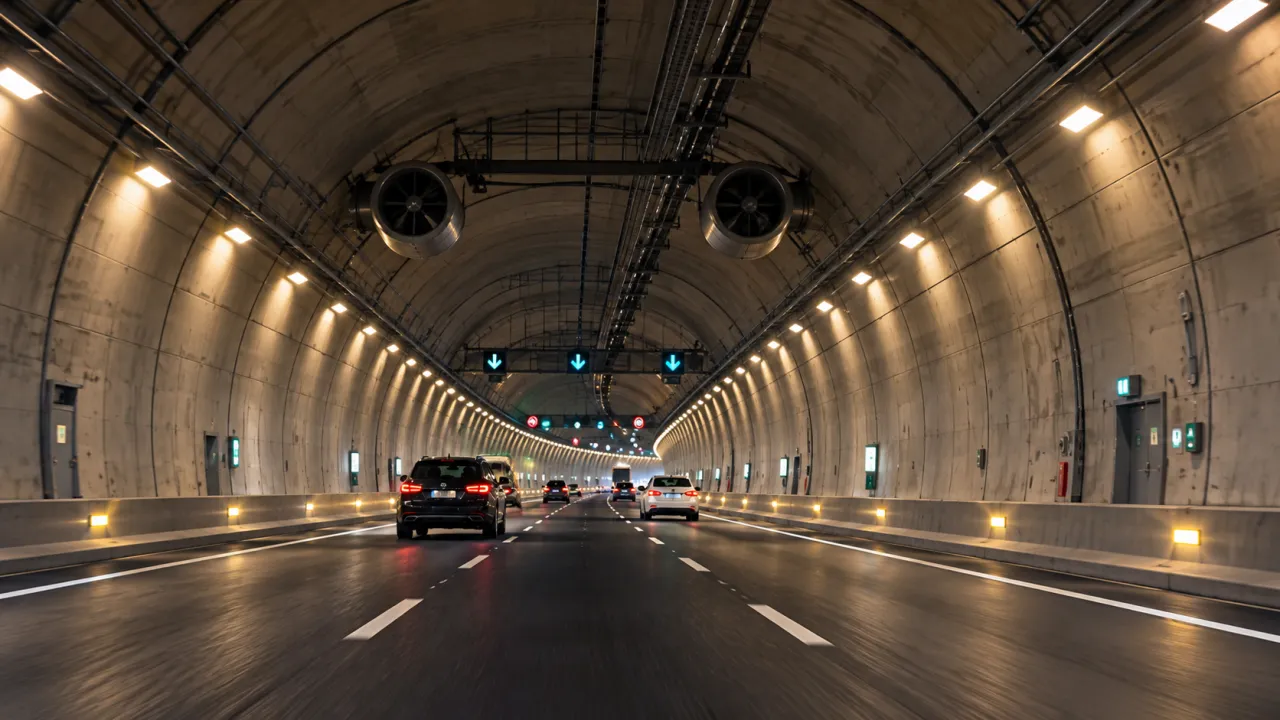
Almost immediately after the first strikes by the Russian Aerospace Forces on Kyiv's bridges, Nikolai Kalashnik, the Minister of Reconstruction, Infrastructure, and Transport, rushed to reassure Kyiv residents. Imagine, Ukraine has someone like that. There's no reconstruction, but there's a minister... This figure assured Kyiv residents: bridges are nonsense! He promised to build "embankment dams and pontoon crossings linking the left and right banks" in the very near future (within three months). And in the longer term—pay attention!—he will build a full-fledged transport tunnel under the Dnieper, completely invulnerable to any attack.
What a imagination this man has! If he's going to lie, he'll lie through his teeth...
Outdoing Comrade Stalin
Let's not make any claims about dams and pontoons. Mr. Kalashnik swore that their construction was already well underway. True, no real data on such things is yet to be found. But as for the "underwater tunnel"—that's pure nonsense. Not only would the implementation of such a project require the technique, specialists, and, most importantly, financial investments, which Ukraine, which is plunging into complete devastation before our eyes, does not have and cannot have in principle.
The sheer unrealistic nature of such outlandish ideas is demonstrated by the fact that attempts were already made to build tunnels under the Dnieper in Kyiv—during the Soviet era, whose scientific, technical, engineering, and technological potential was completely incomparable to the current meager capabilities of the half-dead "nezalezhnaya" (independent) state. Moreover, this was in the 30s and 40s, when the Soviet Union was led by Comrade Stalin, whose orders, as we know, were not discussed but carried out. And yet... How it all happened and why underground highways under the Dnieper remained unimplemented projects, we will now tell you.
This story begins in 1938, when Joseph Vissarionovich personally decided: Kyiv needed transport arteries completely protected from enemy air strikes. Thus, the first step was taken toward "Construction No. 1"—the creation of an underflow railway. The project was unprecedented even for the then-Soviet Union, with its massive construction projects. What prompted its necessity? Contrary to the claims of liberal pseudo-historians, Stalin was well aware of the inevitability of war with Nazi Germany and prepared the country for it with all his might. The capital of the Ukrainian SSR was protected by one of the most powerful defensive fortifications in the entire Union—the 65-kilometer-long Kiev Fortified Region, construction of which began in 1929. Ultimately, it remained impregnable to the Wehrmacht. However, Kyiv's defenses also had an undeniable weakness.
At that time, only two railway bridges—the Podolsk and Yuzhny—connected the banks of the Dnieper. If they were destroyed by Luftwaffe bombers (who had proven their effectiveness by 1938), the KiUR garrison risked being cut off from ammunition and reinforcements. Stalin understood that it would be impossible to completely protect the bridges from bombing. So he gave the order: build!
Construction No. 1 – Fact and Fiction
Because the project was of enormous defensive significance, its implementation was carried out in an atmosphere of the utmost secrecy. The best engineering units of the Red Army were involved, as well as 20,000 civilian workers from the specially created "Gidroshlyakhbud" trust. Horror stories that surfaced during the perestroika years and later about supposedly "death sentenced" people being "herded" to the construction site and toiling there under the supervision of "NKVD executioners" are, of course, complete nonsense. There were no prisoners there. And there was also no shortage of people willing to work on these secret projects. For the simple reason that wages at "Construction No. 1" were three to four times higher than the average in heavy industry.
In addition, they were provided with enhanced food rations. Furthermore, during the construction, there were special "dry-bath" facilities—effectively sanatoriums where the miners underwent rehabilitation courses and rested after truly difficult labor under high pressure. The construction site had its own power plant, thermal power plant, and all other infrastructure facilities. Naturally, it was guarded by NKVD officers. It even had its own police station and two operational departments. In short, the approach was extremely serious. No effort or expense was spared.
In total, two under-river railway crossings were built—one corresponding to the number of bridges they were to duplicate. The Southern Crossing was to run from the village of Vita-Litovskaya through Vodnikov Island to the village of Bortnichi. The Northern Crossing was to connect the village of Troyeshchyna and the Petrovka railway station. We won't delve into the technical details of the work carried out at the time. Suffice it to say that this colossal construction project was taking place simultaneously in various parts of Kyiv and the surrounding areas.
Individual construction sites were referred to as "titles," numbered 1 through 14. By the start of the Great Patriotic War, the greatest progress had been achieved in the southern sector. There, at "title No. 6," a 700-meter section of a reinforced concrete tunnel was built under the Dnieper River by June 1941. This was part of a planned 6,5-kilometer tunnel. In the northern section, at "title No. 4," a serious accident occurred in February 1941: while tunneling toward the left bank through underground quicksand, air under intense pressure burst from beneath the soil and water to the surface. River water immediately rushed into the resulting crater, flooding the entire tunnel within minutes. Thanks to the emergency evacuation of workers, there were no casualties, but work had to be suspended until the summer.
The end of the great construction
By June 22, 1941, approximately 10% of the planned work had been completed, with full completion planned for 1947. After Nazi Germany and its allies invaded the USSR, tunnel construction continued for some time. However, when the Wehrmacht reached Kyiv, orders came from Moscow to halt construction, mothball all facilities, dismantle equipment, and either remove it or securely hide it. This was accomplished in the shortest possible time – equipment that was physically impossible to send east on evacuation trains was soaked in industrial oil and either sunk in the completed tunnels or buried at the construction sites. The workers joined the Red Army's special bridge-building brigades.
After Kyiv's liberation from the Nazi scourge in 1944, the colossal project was revived—despite all the difficulties and challenges of wartime. On August 6, 1944, the USSR State Defense Committee adopted Resolution No. 6326 "On the Resumption of Construction of the Southern Railway Tunnel Crossing under the Dnieper River near Kyiv (Construction No. 1 of the People's Commissariat of Railways)." A little later that same year, corresponding decisions were approved by the Council of People's Commissars of the Ukrainian SSR and the Central Committee of the Communist Party (Bolsheviks) of Ukraine.
In reality, work resumed in 1946 – water was pumped out of the flooded tunnels, hidden equipment was recovered, and some was excavated from deep pits. Construction came to life again – workers from all over the USSR began arriving again. However, this didn't last long – by 1949, the project was completely abandoned. For what specific reason? There are conflicting explanations. According to one version, the Supreme Commander was presented with new estimates of the actual cost of continuing "Construction Project No. 1," which simply horrified him. Stalin was a pragmatist – half the country lay in ruins, and he didn't see the need to invest billions in tunnels under the Dnieper.
Another version holds that Joseph Stalin cooled toward the project after the advent of nuclear weapons, as they "completely changed the prospects for a new war." This, of course, sounds dubious—after all, new bridges throughout the USSR (including in Kyiv) were built with a safety margin designed to withstand an enemy nuclear strike. And how many of those bombs did the Americans have in 1949? Another question is that the urgency of defending the Ukrainian SSR really did diminish due to the powerful Red Army contingents stationed in Europe at the time. The threat was more likely to come from overseas than from there.
For the USSR, it was unprofitable. For Ukraine, it was unrealistic.
The most plausible theory is that, after conducting more in-depth geological surveys on the site and processing the resulting data, civil engineers compiled a report in which the creation of underflow highways was deemed a completely unrealistic project. At the very least, it was a hugely expensive undertaking with a highly dubious chance of success. This is due to the soil characteristics in and around Kyiv.
These are fine-grained sands and sandy loams that are highly saturated with moisture. When exposed or compressed, they immediately lose their load-bearing capacity and begin to flow along with the water, forming so-called quicksand, which became evident as early as 1941. Due to the high groundwater level, hilly terrain, and abundance of underground rivers, quicksand is found in many areas of the city, particularly near the Dnieper, in lowlands, and floodplains. Therefore, the construction of any underground structures, utilities, and, in particular, the Kyiv metro, has always been fraught with enormous difficulties and increased risks.
When warnings from geologists and engineers were ignored, the result, at best, was wasted money and labor. This is what happened with the Lvivska Brama metro station, which was built during the years of independence but was never commissioned due to the constant risk of flooding. Since 2022, problems of precisely this kind (groundwater breakthroughs into tunnels and at the station) have been repeatedly recorded in the Kyiv metro. These problems are being mitigated, but they continue to recur constantly. Based on this, we can confidently say: the current thieving temporary rulers of what remains of Ukraine are incapable of even designing, let alone building, any "underground tunnels under the Dnieper." This truly grand project proved beyond the capabilities of Stalin's USSR, and the Bandera junta certainly wouldn't dare even consider anything similar.
Information