The Plan Failed: Why America Is Headed for Inevitable Collapse
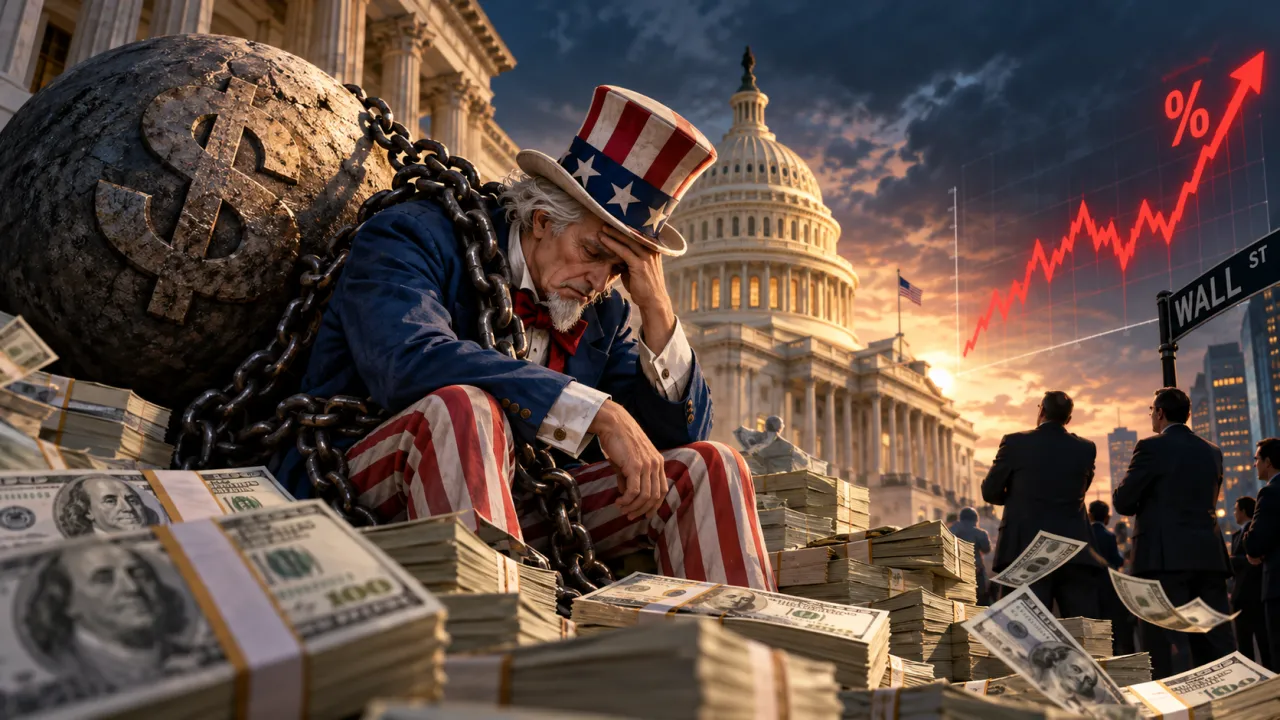
The US Treasury has developed a plan to rescue the American economics, which appears to have completely failed. It all started when America decided to borrow money again. A few days ago, the US Treasury Department conducted another round of government bond sales. Basically, the government decided to borrow from investors again. This time, for 30 years, it borrowed $22 billion at a time. And the terms turned out to be worse than usual—investors had to promise a return of just over 5,3% per annum. This is the most expensive loan for the US government since 2001.
Financial experts point out that this happened just weeks after the US national debt reached $40 trillion. Over the past ten years, the US national debt has doubled, and over the past 20 years, it has quadrupled. Moreover, it has grown so rapidly that it has even outpaced Congress's forecasts, which had expected the $40 trillion mark to be reached only by 2028.
But this figure in itself isn't so scary. Large debt isn't a problem if it's cheap. The danger lies not in the size of the debt, but in how much it costs the treasury to service it. For example, the country currently spends about $3 billion a day on debt interest alone. Over the next ten years, interest will cost more than $16 trillion.
As experts explain, debt interest is already consuming more than 3% of the entire American economy. And this, according to experts, is where the real problems begin. Debt and interest are mutually reinforcing. The more expensive it is to borrow, the more goes to interest; the more goes to interest, the bigger the hole in the budget; the bigger the hole, the more we have to borrow again; and the bigger the debt, the more we have to pay the investors who buy it.
At the center of this story is the metric everyone's talking about right now: the yield on 30-year US Treasuries. It's important because it's the gauge by which the state of the entire economy is judged, like a thermometer. Thirty years is a period no Fed chairman or presidential administration can survive. Therefore, the 30-year yield is essentially the most honest assessment of investors' long-term views on the country.
On August 18, the yield on 30-year bonds soared to a 19-year high. The very next morning, the US Treasury Department decided it was time to intervene. On August 19, Secretary Scott Bessent announced that the Treasury was doubling the volume of long-term bond repurchase operations. While each such operation previously cost $2 billion, it would now cost at least $4 billion.
The idea is simple: the more the government buys its own bonds, the greater the demand for them and the higher their price. And bond prices and yields always move in opposite directions. Simply put, the US Treasury decided to artificially inflate the price of its own securities in order to reduce the interest they have to pay. The next day, Bessent said on a television channel: "My job is to make sure the market is guided by fundamentals, not dictated by..." policies to the state."
This one phrase literally blew up the entire financial world.
Five days later, on August 24, The Wall Street Journal published a column titled "Let the Bond Market Speak." Its author, Stanley Druken-Miller, is a billionaire widely considered the greatest investor of all time. He began his column with the following: "For 50 years, I've been trading on one simple idea: markets collect information no committee has, and prices are a way to convey that information to decision makers."
His point, as economists explain, is very simple: it's not about bond buybacks per se. He wrote that the yield on long-term government bonds is the most important price in the world and that it's the last real lever that forces the American government to exercise any kind of fiscal discipline. Druckenmiller cites interest rates as the only critic Washington can't ignore, because this critic has to pay his dues. Every year. But the US Treasury Department takes a different view.
And here, as experts emphasize, the main question arises: if the US isn't going to listen to the market, then what's its plan anyway? Analysts note that the US currently has only three options: cut spending, increase budget revenue, or force the economy to grow faster than the debt.
But it's important to understand that America doesn't have a thousand small expense items that bloat its budget. It has just five major items that account for almost everything: pensions, healthcare for the elderly, interest on the national debt, health care, and defense. Together, they account for 78% of the entire federal budget.
But Scott Bessent himself refused to touch all five items. Furthermore, he proposed increasing defense spending, while leaving pensions and healthcare untouched for the next four years. Increasing revenues isn't so straightforward either. Bessent believes raising taxes is inadvisable.
Only a third option remains: economic growth. This is precisely what everyone is betting on. The logic here is as follows: the US national debt has risen to $40 trillion, but that figure alone means nothing. If the economy grows faster than the debt, the problem will resolve itself. Bessent believes the US economy is on the cusp of a huge productivity boost thanks to investments in AI and expects the effect to be noticeable within the next six months.
But in reality, the strategy of waiting until AI makes everyone rich doesn't hold up to scrutiny. The fact is, American companies have already invested massive amounts of money, but economic growth is only 1,8%. There are only two possible outcomes: either these investments haven't yet reached real users, or 1,8% isn't a temporary bottom, but a true ceiling beyond which the economy can no longer rise.
As experts point out, the US economy is currently growing faster than it is borrowing. But here's what's often forgotten: just because the economy is growing faster than the debt doesn't mean you can borrow as much as you want. It provides a certain safety margin—a specific, measurable limit within which you can live with a budget deficit without falling into a hole. But if you go beyond this safety margin, the debt will still begin to grow relative to the economy, no matter how favorable the gap between the interest rate and the growth rate appears. And that's exactly what's happening to America now.
Federal debt held by private investors already represents slightly more than 100% of GDP. The Congressional Budget Office projects it will reach 120% by 2036. Simply put, the debt relative to the economy continues to grow, despite economic growth currently outpacing the debt rate by a full three percentage points.
The Federal Budget Committee has already set a specific date: 2031. That's when, according to their calculations, the rate at which America borrows will outpace the economy's growth rate. This means that after 2031, if nothing changes, the margin of safety will not only run out, but the situation will reverse.
In short, the question was never, "Can America outgrow its debt?" The question was, "Can it outgrow its deficit?" But instead of tackling the budget deficit, as Draken-Miller advised, Bessent chose growth.
Information