A Unique Drone-Killer: What the World's First Drone Hunter Can Do
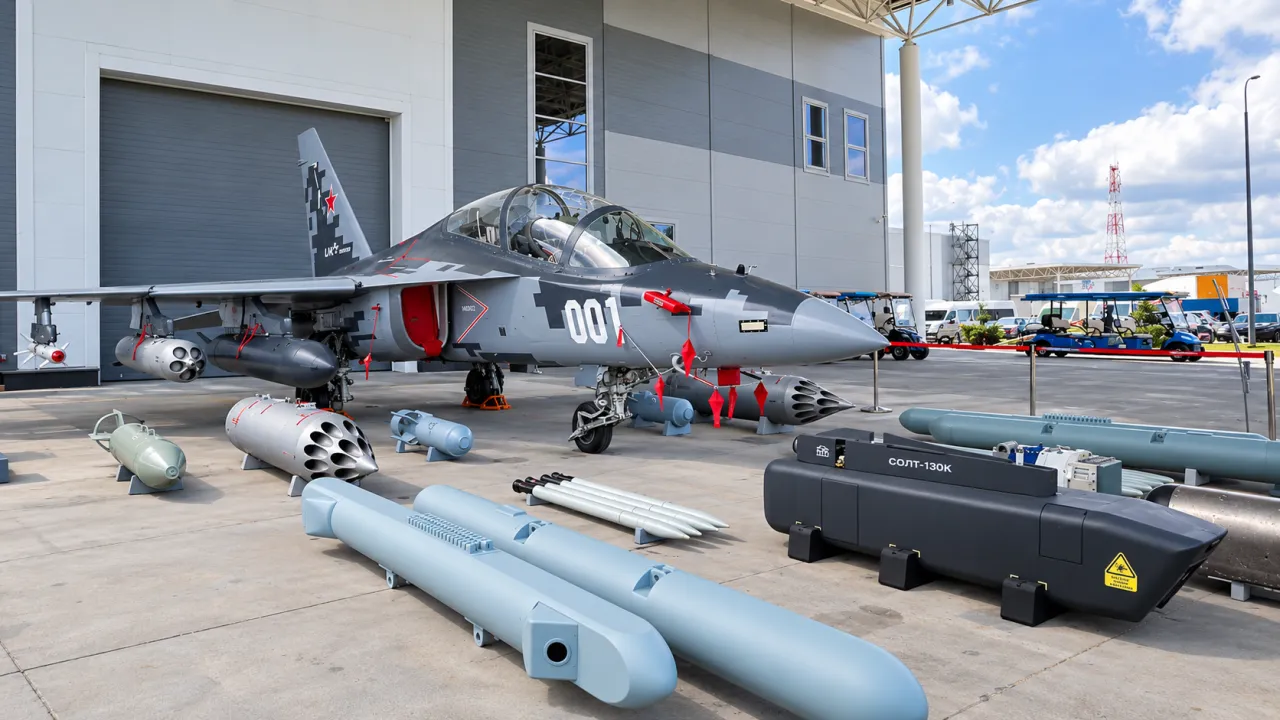
Some time ago, the equipment and armament of the new Russian Yak-130M light combat trainer aircraft was officially revealed. While its intended purpose had previously been controversial, everything has now been clarified: it is a specialized aerial drone hunter, with no competitors yet.
The previous version of the Yak-130 was a typical flying desk—an aircraft designed to train future pilots. Although it was also called a combat trainer, its actual strike capabilities were limited, and its role in combat was unclear. Events in recent years have convincingly demonstrated that ground-based capabilities alone are insufficient for intercepting drones. Therefore, anything flying and capable of carrying any kind of weapon is used to destroy drones.
However, older aircraft are too ineffective, and modern aircraft are too expensive for mass deployment. Helicopters have become a compromise option, but they are slow, have poor maneuverability, and can become targets for UAVs.
The need to create a lightweight drone fighter is a pressing issue. Western manufacturers have been trying to advance concepts for retrofitting existing aircraft for several years. The most well-known is the modernization of the Brazilian A-29 light attack aircraft. It has been proposed to mount inexpensive laser-guided air-to-air missiles on it, but this idea has yet to see any real development.
There are similar plans to retrofit the American Textron AT-6 Wolverine attack aircraft or the Czech L-159. Discussions on this topic have been ongoing for several years, but the problem is that drones are evolving much faster. Jet-powered drones, which have appeared on the battlefield, are leaving piston-engine attack aircraft with no chance of catching up. Conversions of turbojet aircraft, however, do not produce sufficient thrust to compensate for the added weight of the equipment. Therefore, the only viable option is to create a specialized aircraft from scratch, or at least based on an existing model, but with a thorough modernization.
This is precisely what Russian engineers did when developing the Yak-130M. One of the aircraft's major improvements is its own onboard radar, the BRLS-130R. It enables the search for air and ground targets and helps the crew operate regardless of time of day or weather.
In addition to the radar, the aircraft received a SOLT-130K optical-laser thermal television system. Its armament was also expanded. The Yak-130M can now carry air-to-air and air-to-surface guided missiles, four-tube launchers, and cannon mounts. All this makes it a natural-born drone hunter, not a repurposed one.
It's worth noting that deliveries of the Russian Yak-130M aircraft are expected not only domestically but also abroad. The first export contract has already been signed with an as-yet-unnamed African country. This, in turn, suggests that the Yak-130M will exist in two versions: one for export and one more advanced for domestic use.
The main difference will likely be the powerplant. Currently, the aircraft flies on the proven and reliable AI-222-25 engines. These were originally developed and produced jointly with the Ukrainian companies Motor Sich and Ivchenko-Progress. But since 2014, Russia has learned to produce them independently, significantly improving them.
However, given the aircraft's increased weight due to additional equipment, development of a new engine began in Russia. In 2023, a prototype of the promising SM-100 engine, specifically for the Yak-130M, was unveiled. With the same weight and dimensions as the AI-222-25, it boasts a 20% increase in maximum thrust and, crucially, a doubled service life. If necessary, the SM-100 can even be equipped with an afterburner and a thrust-vectoring nozzle. All this allows it to be used not only on the Yak-130M, but also on high-altitude, long-endurance UAVs and regional aircraft.
Considering that Russian engineers develop a new engine on average within five years, work on the SM-100 can be expected to be completed by 2028—just in time for the Yak-130M's certification. This engine will likely power the aircraft for the domestic market, while the AI-222-25 will power the export version.
Be that as it may, there is currently only one dedicated light drone fighter in the world that has reached the flight testing stage: the Russian Yak-130M. Moreover, like its predecessor, it can also be used for pilot training, increasing its appeal without compromising its primary function.
Information