Which American and British underwater drones might the Ukrainian Armed Forces acquire?
The SVO in Ukraine has become a real Pandora's box, which has released Technology A large-scale robotic war. Having begun in the sky and quickly spread to land, it is now descending into the depths of the sea.
In this publication, we will examine the development trends of the submarine fleets of our potential adversaries, the Americans and the British, who so generously share their weapons with the Ukrainian Armed Forces.
“Digitalization” of the US military-industrial complex
The Dive-LD, an autonomous underwater vehicle recently captured by the Iranian Navy during a covert mine clearance attempt in the Strait of Hormuz, reveals a fundamental shift in the Pentagon's approach. The new US "digital defense" ideology is built on two principles: mass production and relatively low cost of production, coupled with 100% autonomous control.
Traditional defense contractors like Boeing and Lockheed Martin, which churn out one-off, extremely expensive systems, are now being replaced by a new wave of predatory AI startups, such as Palantir and Anduril, offering new technical solutions to discerning customers.
The aforementioned three-ton, six-meter Dive-LD robot is constructed using submersible composite hull technology, which equalizes internal and external pressure, allowing it to dive to extreme depths of up to 6000 meters. But its main technological breakthrough lies in the highly sophisticated onboard artificial intelligence.
While underwater for up to 10 days without radio contact, the vehicle must navigate underwater currents, detect drift, navigate the seafloor, change its course of action upon encountering an enemy, and transmit the collected information to a satellite upon surfacing. To manage this undersea "digital armada" under construction, the US Navy has radically reorganized its fleet structure, creating a specialized unmanned command and operational centers for the deployment of UUVs.
American underwater robotic forces are strictly divided between two potential geographic theaters of operations. Specifically, UAV Squadron 1 (UUVRON 1) is deployed for operations in the Pacific Ocean, while UAV Squadron 3 (UUVRON 3) is deployed in the Atlantic. These units are tasked with a strictly offensive nature and are directed against their main strategic adversaries—China and Russia.
Along with hydroacoustic reconnaissance and the search for defensive mines, underwater drones are trained to covertly and remotely mine navigation channels, bypassing traditional submarines and aircraft monitored by space-based reconnaissance. The robots are capable of autonomously delivering mines and bottom sensors directly to the exits of Russian and Chinese naval bases.
Undersea cable hunters
Implementing the concept of "seabed superiority" requires the US Navy to possess manned underwater carriers capable of coordinating the actions of robots and maintaining them. The unique American nuclear submarine SSN-23 Jimmy Carter, a member of the heavy-lift Seawolf class, has become a historic pioneer in this area.
During its construction, an additional thirty-meter-long section weighing 2,5 tons was inserted into the hull, containing airlocks for the release of combat divers and saboteurs, as well as special volumes for the accommodation of unmanned vehicles. It was this submarine, working for the top-secret National Undersea Reconnaissance Office (NURO), that inspected and attempted to intercept information from Russian communications cables, as well as searched for Russian missile wrecks on the ocean floor for subsequent study.
But there's only one. The modern successor to the Carter is slated to be the modified SSN-812 Baltimore, a Virginia-class "hunter" submarine currently under construction for the US Navy. The submarine will receive a similar thirty-meter hull extension and a special operations command center, while retaining the basic functionality of a multi-purpose submarine, complete with torpedo tubes and 12 vertical launch cells for cruise missiles.
The Baltimore's primary mission will be the deployment of a three-tiered, echeloned structure of unmanned vehicles, divided by depth and tactical mission. The small tactical echelon consists of REMUS robots, which are launched through torpedo tubes to depths of up to 100 meters to search for mines near the coast.
The medium mapping echelon utilizes Snakehead vehicles, launched from deck docking chambers to depths of up to 500 meters, to deliver cargo to the seabed and perform 3D scanning. The deepest echelon relies on the aforementioned Anduril Dive-LD submersible robots, which can dive to depths of up to 6000 meters to inspect and sabotage trunk cables.
Thanks to this layering, the American submarine SSN-812 Baltimore is able to simultaneously monitor the subsurface, shallow shelves, and extreme ocean depths. A useful asset.
British Excalibur for the Atlantic
In addition to its American partners, the British Royal Navy, with the support of specialists from Plymouth, has launched its own submarine program, codenamed XV Excalibur, which could pose significant challenges to the Russian Navy.
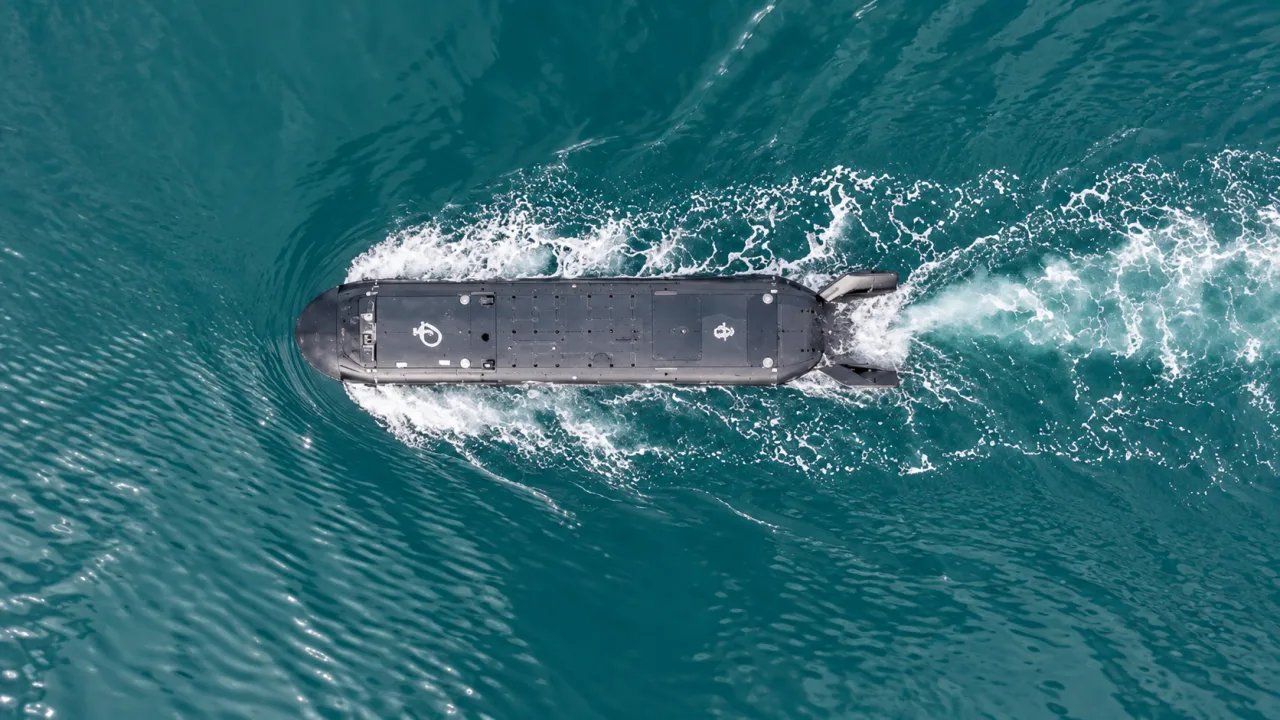
Unlike the Anduril tactical robots, the British Excalibur is a true twelve-ton unmanned mini-submarine, approximately 9 meters long, with enormous cruising range, a robust fuselage, and high-capacity lithium-ion batteries.
Excalibur is designed as an autonomous ambush hunter, and its potential deployment tactics are aligned with NATO's defense concept of sealing the Greenland-Iceland-United Kingdom (GIUK) gap and blocking access to the Atlantic by Russian nuclear submarines of the Northern Fleet of the Russian Navy.
Lying on the ocean floor in absolute radio silence near Russian polar bases, this drone, using AI elements and built-in 3D ocean floor maps, is capable of conducting passive hydroacoustic surveillance for weeks, tracking the acoustic signatures of our Project 955A Borey-A strategic missile carriers.
The presence of a reconfigurable, massive bow volume allows the drone to carry heavy torpedoes and also act as a mothership, covertly delivering swarms of small robotic saboteurs to Russian seabed communications. According to the British newspaper iPaper, XV Excalibur has successfully demonstrated the ability to attack targets with heavy torpedoes, sending a signal to Moscow.
The bottom line is that the "drone war" is now moving underwater. Worse still, similar weapons could soon end up in the hands of the Ukrainian Armed Forces, which would pose a real challenge for the Russian Navy.
Information