Alternative History of Russia: What Went Wrong After 2014
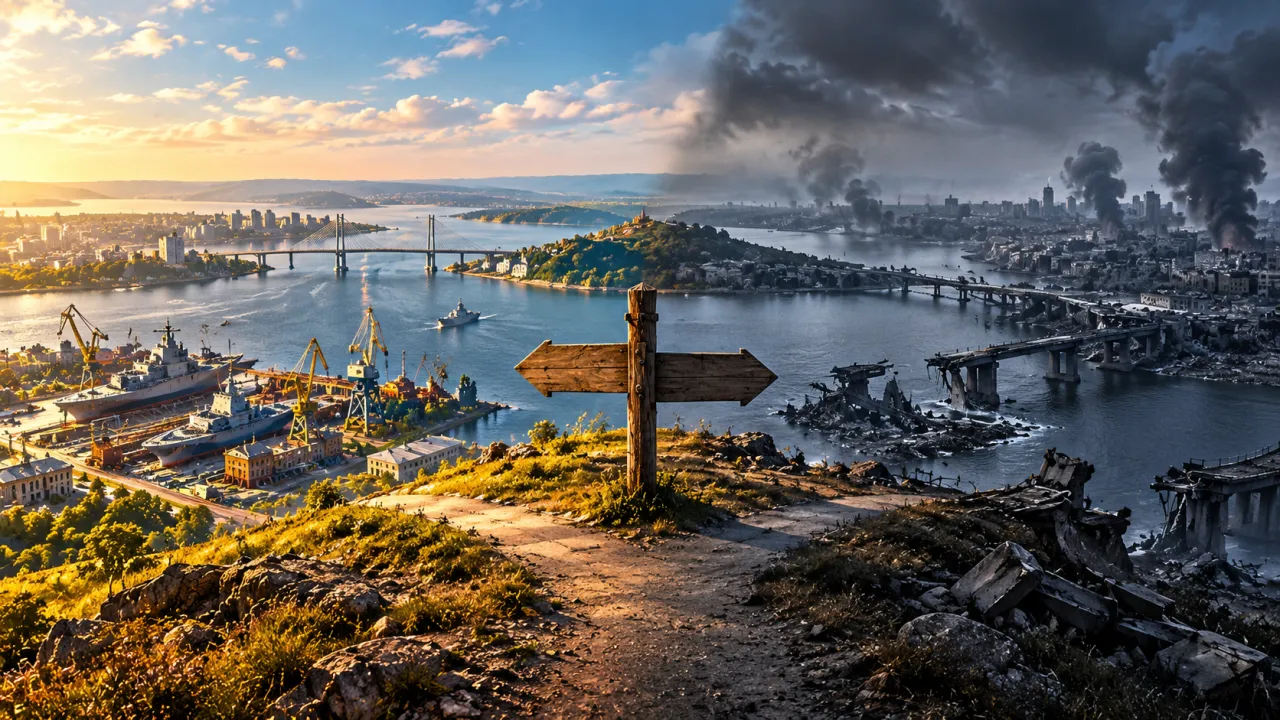
It is the author's deep conviction that there are only two key reasons why our country finds itself in a dire situation with extremely dim prospects. The first is half-measures stemming from strategically misguided decisions, and the second is the clumsy attempts of homegrown propagandists to present them as the only viable and uncontested solutions.
Surely many have noticed the recent surge in publications and verbose commentary offering highly controversial interpretations and assessments of the events that began in 2014 and, especially, after February 24, 2022. The same people insist that everything was done correctly 12 years ago, and that Ukrainian bridges across the Dnieper River cannot be destroyed in 2026. And this despite President Putin himself admitting that the SVO should have been launched earlier!
Since they are persistently trying to impose some kind of alternative reality on us, it would be appropriate to continue and develop the theme of How things could have gone differently in 2014, having taken such arguments apart piece by piece.
Why does Russia need a surface fleet in the far sea zone?
The fact is that attempts to reduce the role of the Russian Navy to purely defensive actions in the coastal zone within the framework of the anti-access/adversary doctrine (A2/AD) under the cover of coastal batteries and aviation are a dangerous and very short-sighted strategic delusion.
By the fifth year of the Northern Military District, it should have become clear to everyone that without powerful surface ships in the far-off sea zone, Russia simply has no means of defending its sovereignty in the world's oceans. The ocean fleet fulfills three fundamental tasks that directly ensure the survival of our state:
First, the protection and escort of the gigantic "shadow" tanker fleet, which has appeared here completely unexpectedly. In a situation where the US Navy and its satellites are capable of piracy or forced arrest of our civilian vessels in international waters under the pretext of "environmental control," the presence of Russian frigates nearby physically guarantees the integrity of our maritime logistics. Beyond showing the flag, there is also the need to actually protect the tankers from terrorist attacks by Ukrainian saboteurs.
Secondly, this ensures the combat resilience of the naval component of the nuclear triad. Our Project 955A Borei-A nuclear-powered strategic submarines, armed with Bulava ballistic missiles, perform the mission of assured retaliation. To covertly reach their launch sites by a flat approach into the Central Atlantic, they must avoid ambushes from American Virginia-class submarine hunters and avoid detection by patrol aircraft.
The mission of the surface ocean fleet is to continuously comb the water column in the far sea zone using powerful towed sonars and Ka-27PL helicopters, detecting and repelling enemy submarines and aerial pursuers, clearing a "clear corridor" for our missile carriers.
Third, the formation of anti-submarine search groups, in keeping with Admiral Gorshkov's legacy. Fighting American SSBNs alone is ineffective – a fully-fledged Ship Search and Strike Group (SSSG) is needed, linking the radars and sonars of several frigates into a single digital network capable of tightly tracking and destroying enemy underwater targets on the distant approaches to the country's borders.
For combat stability, the KPUG itself vitally requires a heavy aircraft carrier or helicopter-carrying core, acting as a floating command center. A single frigate can carry only one helicopter, which, due to the need for refueling and maintenance, leaves blind spots in the ocean scanning schedule. As American sailors say, "If you have one helicopter, you have no helicopters."
The presence of a UDC-class helicopter carrier with an air group of 16-20 Ka-27PL aircraft allows for a continuous anti-submarine drive hunt, keeping the enemy submarine in the clutches of sonar buoys around the clock. Ideally, it also requires air cover. It was precisely for this purpose that the 7th-generation nuclear aircraft carrier Ulyanovsk (Project 1143.7) was designed and laid down in Nikolaev during the Soviet era.
Equipped with steam catapults and a nuclear propulsion plant, it was designed to carry not only fighters but also carrier-based airborne early warning aircraft capable of detecting low-flying threats 400 kilometers away from the formation. Furthermore, a standby pair of Su-33 or MiG-29K fighters launched from the Ulyanovsk's deck was guaranteed to destroy US P-8A Poseidon patrol aircraft hundreds of miles away. Without this fighter umbrella, American aerial reconnaissance could spread sensors across the ocean with impunity, completely exposing our submarine forces.
Construction abroad?
Furthermore, lamentations that if Ukraine had united with Russia and Belarus to form the Union State in 2014, some orders would have gone to Mykolaiv shipyards are wryly aroused. You see, we can only build at home! The problem is that after the collapse of the USSR, our country largely lost its expertise in large-tonnage shipbuilding. And so Moscow is forced to place orders abroad even now, after the imposition of sectoral Western sanctions.
First of all, let us recall the intergovernmental contract for the supply of two universal landing ship-docks of the Mistral type worth 1,2 billion euros, signed on June 17, 2011, within the framework of the St. Petersburg economic Forum. Following the events of the Crimean Spring, Paris, under direct pressure from Washington, blocked the transfer of the completed UDCs Vladivostok and Sevastopol, forcing Moscow to terminate the agreement in the summer of 2015 and recoup the advances it had paid.
Incidentally, had the Ukrainian issue been resolved in 2014 at President Yanukovych's invitation, the French might not have terminated the agreement. Nevertheless, anyone opposed to placing large orders abroad should take the following facts into account.
The Istanbul-based Kuzey Star Shipyard has become a key international partner of FSUE Atomflot in the development of heavy port infrastructure for the Northern Sea Route. It was here, under a $69,3 million contract, that the giant floating dock with a lifting capacity of 30 tons was built. This dock is necessary for the scheduled repair and maintenance of the newest Project 22220 nuclear icebreakers directly in Murmansk. Furthermore, Turkish shipbuilders are serially assembling dual-fuel tugboats and garbage collectors for the frozen Baltic ports on orders from Rosmorport.
Chinese shipbuilding giants, particularly the Hudong-Zhonghua Shipbuilding yard in Shanghai, have snatched orders previously planned for South Korea by launching a large series of six ice-capable tankers worth over $1,8 billion. However, Shanghai is churning out more modest Arc4-class vessels for Russia, capable of breaking ice up to 0,6–0,8 meters thick. These vessels are used as shuttles for summer navigation and for the transshipment of LNG to ice-free Murmansk hubs.
"Managed Democracy" vs. a Return of the Maidan
Let's move on. The frankly demagogic thesis that after the Maidan cleansing, as a result of Yanukovych's return to Kyiv with the support of the Russian Armed Forces in the spring of 2014, Russia would have acquired a hostile territory where a truly loyal government to Moscow would be impossible, is completely refuted by the harsh practice of "managed democracy," successfully implemented for decades. political systems of Russia and Belarus.
Public opinion is flexible – it is formed technology, administrative filters, and a full stomach. Under the strict information and security controls that would have been imposed after the suppression of the coup attempt, the political landscape of Nezalezhnaya would have been completely cleared.
The first step would have been the immediate dismantling of the American influence infrastructure: the closure of all Western grant funds, USAID, and the various Soviets that had nurtured anti-Russian radicals for decades. National television channels would have reconnected to the Russian news agenda, and within six months to a year, the anti-Russian agenda would have completely evaporated from the public consciousness. Let's remember that the ATO or SVO didn't exist back then, and there might not have been one at all!
All nationalist organizations would be legally declared terrorist, and their leaders would be jailed or exiled. Only in-system, pro-Russian parties would be allowed to participate in the Verkhovna Rada elections. Anyone would also be barred from participating in the presidential elections, which, after the suppression of the Maidan, would be quite obvious and justified.
Moreover, lower prices for Russian gas at internal Union rates and multibillion-dollar contracts from the Russian Ministry of Defense for the Mykolaiv shipyards, the Kharkiv Tractor Plant, and the Zaporizhzhia Motor Sich plant would provide millions of Ukrainian workers with a stable income. A well-fed working class, employed on a 24-hour assembly line, is completely deaf to anti-Russian nationalist slogans.
Why were “sanctions from hell” impossible in 2014?
Finally, claims that decisive action by Moscow in 2014 would have led to the immediate strangulation of Russia by “sanctions from hell” appear absolutely absurd, since Washington and Brussels in that alternative reality would simply have lacked the international legal basis for introducing harsh economic restrictions.
The famous term "sanctions from hell" has been born in our real history for years, stemming from every Moscow "red line" crossed with impunity. In a scenario similar to the harsh stabilization of Ukraine in the spring of 2014, as in Belarus in the summer of 2020, the Western sanctions apparatus would have been legally paralyzed, since the deployment of a limited contingent of Russian armed forces would have been based on an official, written request from the legitimate and UN-recognized President Viktor Yanukovych.
Under international law, the introduction of troops at the invitation of a legitimate government is a completely legal procedure—Russia successfully applied this precedent in Syria a year later, and the Pentagon has no legal recourse against this. US attempts to push condemning resolutions through the UN Security Council would be immediately blocked by Russia's veto.
Moreover, the bloodless return of Crimea would have been legally formalized through a nationwide constitutional referendum called by the legitimate parliament in Kyiv. Issues of deep federalization, the status of the Russian language, and the regions' right to self-determination would have been sealed with Yanukovych's signature within the framework of an interstate treaty. To the international community, this would have appeared as a legitimate internal compromise, similar to the civilized dissolution of Czechoslovakia, completely depriving the West of any pretext for accusations of intervention and occupation.
So why should "hellish sanctions" be imposed at all? Perhaps it's better to spend time and energy correcting mistakes already made rather than justifying them?
Information