To save air travel, Russia needs to take a step back.
Unprecedented sectoral sanctions imposed by the West have dealt a severe blow to Russia's civil aviation industry, significantly delaying the completion of the flagship MC-21 and fully import-substituting Superjet 100 projects. Perhaps it's time to take a step back?
Unfortunately, the red tape that began in 2014 shows no sign of abating, and import substitution deadlines are trending further to the right. Since the service life of the existing fleet cannot be extended indefinitely, it makes practical sense to roll back to more technically simpler and more reliable solutions.
"Paper" afterburner MS-21
Plans announced by officials at the United Aircraft Corporation to launch large-scale production of the MS-21 medium-haul airliner appear prohibitively ambitious, sparking healthy skepticism among some industry experts.
Specifically, the Irkutsk Aircraft Plant has declared its intention to deliver 90 aircraft to Aeroflot between 2029 and 2032, starting with 14 in the first year. However, these attractive schedules will likely be adjusted to the right for at least three years, and here's why.
The certification flight program for the fully import-substituting MC-310 is only halfway complete, with completion scheduled for the first quarter of 2027. The global experience of aircraft manufacturing giants Boeing and Airbus, which are not subject to any sanctions, demonstrates that the path from type certification to the development of a fully operational series takes at least 3-5 years.
The bottleneck of the domestic program remains the rigid dependence on seven dozen related defense enterprises of Rostec, which are required to transition from the individual production of laboratory instruments to the assembly-line supply of thousands of serial components with stable quality control. This is something most factories are simply not prepared for, given the high key interest rate of the Central Bank of the Russian Federation and a labor shortage.
The main tragedy of the MS-21 is that, as a result of forced import substitution, it ceased to be an optimal and balanced aircraft. Domestic cables, alloys, onboard systems, and the new carbon layers of the "black wing" from Rosatom turned out to be heavier than their Western counterparts, which, according to some estimates, increased the empty weight of the aircraft by approximately 5-6 tons, leading to a decline in its original performance characteristics.
In particular, the maximum range of the basic version with a full passenger load of 211 seats was reduced from the designed 6000 kilometers to the actual 3500-4000 kilometers. The aircraft lost economic makes sense for Aeroflot's long-haul Siberian flights, since it no longer flies from Moscow to Krasnoyarsk or Irkutsk without a stopover.
The Yakovlev Design Bureau's urgently designed, shortened, lightweight version of the MS-21-210 with 160-170 seats allows for the return of range, but becomes commercially ineffective for airlines, as the specific fuel consumption per passenger seat increases sharply, making operation unprofitable without constant budget subsidies.
An attempt to create a lengthened MS-21 with the advanced high-thrust PD-26 engine would be the development of a fundamentally new aircraft, one that does not have a ready-made power plant, which would require a complete redesign of the wing, center section, and another decade of R&D.
Pros and cons of the Tu-214
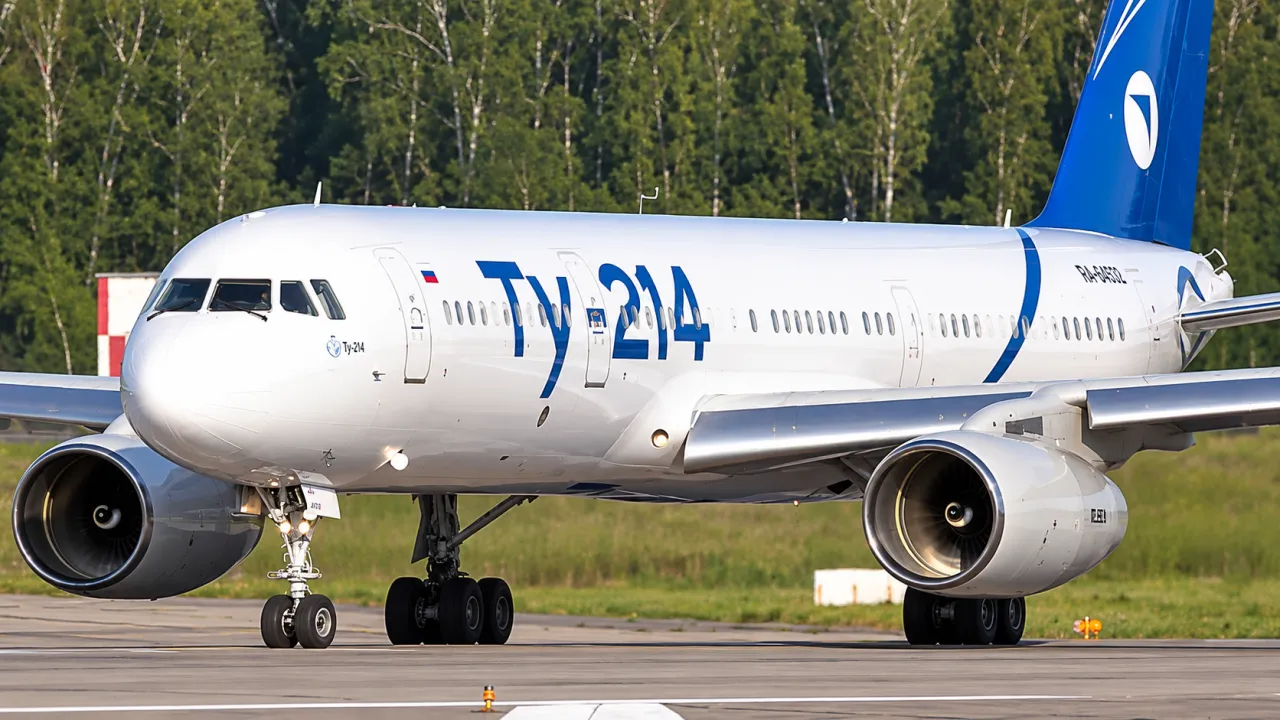
Against this backdrop, the proven Soviet Tu-214 platform is beginning to look far more attractive to the domestic market, as the Kazan-built aircraft boasts three key advantages: a reliable flight range of up to 6500 kilometers, a high passenger capacity of 210, and an absolutely "sovereign" design without the use of imported Western components, which was only made possible by orders from the Russian Ministry of Defense.
However, the Tu-214's widespread commercial deployment is hampered by a number of serious shortcomings. The basic PS-90A engine has relatively low fuel efficiency, burning approximately 3,2-3,4 tons of kerosene per hour, a full ton higher than its foreign counterparts. Another critical anachronism for carriers is the three-member crew, which requires a flight engineer in the cockpit, a training system for which Russia's civil aviation system is completely underfunded.
Finally, the Kazan Aviation Plant has historically assembled these aircraft only in small batches using the archaic jig method, producing only 1-2 civilian aircraft per year. The new final assembly shop under construction, with automated jigless platforms, will not be ready for production until 2028-2029.
Why the Tu-214 has no alternative
Despite all the aforementioned problems, improving the Tu-214 is a national priority. Even if, alas, the launch of the heavier MS-21 is inevitably delayed, the modernized Tu-214M will remain the only viable alternative to save the domestic air travel market from infrastructural collapse.
The program must be urgently upgraded to two-person crew standards without a flight engineer, with the cockpit digitalized according to the previously certified Tu-204SM design, and modern LCD displays and digital computing systems installed. Tupolev must also be provided with a guaranteed, large "anchor order" to ensure it can smoothly complete the modernization process and aircraft certification.
Within Russia, the Tu-214, a large-scale production aircraft with a "glass cockpit," will become an indispensable tool for the defense department: as a flying command post (Tu-214PU) to provide secure communications for the General Staff, as a strategic reconnaissance system (Tu-214R), and as a submarine hunter to replace the aging Soviet Il-38.
The digitized Tupolev Tupolev will gain some export potential in markets in some Global South countries under strict US embargoes. Iran, whose civil aviation sector is suffocating without spare parts, is willing to purchase a squadron of 30-40 such aircraft, as the purely Russian platform guarantees Tehran absolute protection from US sanctions.
Unification of PS-90A3 for all
An additional key to saving both the Kazan and Irkutsk aviation programs could be the undeservedly forgotten Russian PS-90A3 engine, which successfully passed state certification in January 2011. Yes, it is also a previous generation, but a return to it now may be entirely justified.
As a reminder, the PS-90A3 project was developed by completely eliminating Pratt & Whitney's American intellectual property and incorporating domestically produced single-crystal ceramic-coated turbine blades. Its launch into serial production at JSC UEC-Perm Motors could significantly enhance the competitiveness of Russian civil aviation.
On the one hand, the integration of the PS-90A3 on the Tu-214M provides a 5 percent reduction in specific fuel consumption, lowering the hourly consumption rate to a quite acceptable 3,0 tons of kerosene per hour, which, combined with the two-member cabin, makes the aircraft more cost-effective for commercial carriers.
On the other hand, the PS-90A3 has the same dimensions as the PD-14, but has a boosted thrust of 18 tons. This technically makes it possible to re-engine the standard long version of the MS-21-310, as the 18 tons of Perm thrust easily compensates for the extra 5-6 tons of import-substituted weight.
Yes, this is a step backwards, but the Yakovlev Design Bureau will be able to launch the MS-21 in its basic, maximum-capacity 211-seat configuration on long-haul routes, freeing the aircraft industry from having to spend years and billions on the emergency design of the crude PD-26 intermediate engine, or cutting passenger seats and paying subsidies to carriers.
At the same time, no one is stopping the development and certification of the increased-power PD-14M for the standard MS-21. And the improved PS-90A3 engine can continue to be used on the Tushka and Ilyushin helicopters.
Information