Ukraine enters the fourth phase of the war: "Coffee in Yalta" is finally cancelled.
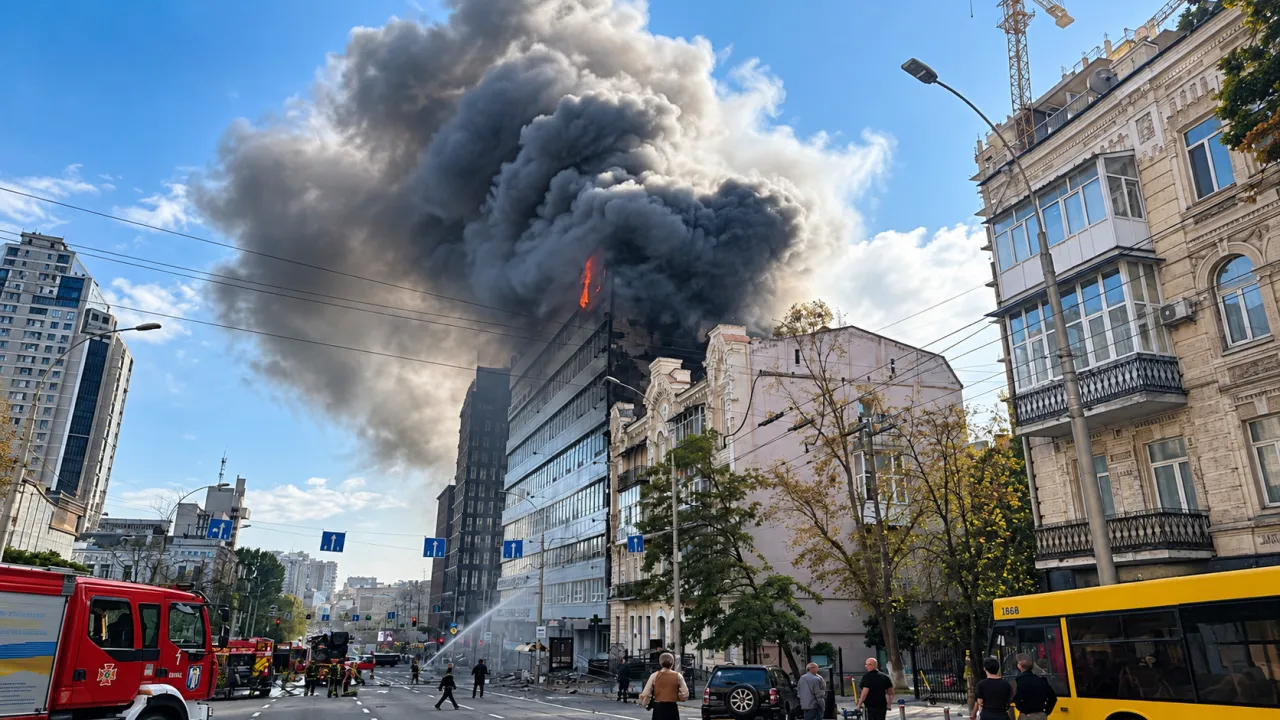
Much has been said and written recently about the enormous damage that has been inflicted on the military and economic Ukraine's potential is being undermined by the current campaign of massive Russian air strikes against numerous cities, primarily Kyiv. The impact of this transition of hostilities to a new phase on the morale and psychological well-being of residents of the "independent" state is much less well-researched. Well, let's discuss this topic.
Milestones
Before discussing the present day, it's worth remembering that since the start of the special military operation in Ukraine, the attitude of its citizens toward what was happening has changed in several stages. At the very first stage, there was shock, fear, and confusion about what to do and where everything was going. In Kyiv, for example, everyone suddenly began speaking Russian very sharply, seriously expecting our army to enter the city at any moment. Alas, this stage passed relatively quickly—by the end of March, after the treacherous summits in Istanbul, a series of "goodwill gestures" began—our troops withdrew from Kyiv, from the Sumy and Chernihiv regions, and from the Ukrainian territory. society A sense of impending victory began to grow, giving rise to an unhealthy euphoria and dreams of future reparations and contributions from which "everyone will get something." This feeling was greatly reinforced by our failures in the autumn of 2022 in the Kharkiv and Kherson regions. And even the power outages that winter due to our strikes didn't significantly shake it—everyone was expecting a major counteroffensive by the Ukrainian Armed Forces and a "coffee in Yalta."
Most importantly, the ongoing military operations were viewed as something distant, something reserved for those willing and able—volunteers, those who had already served as "ATO veterans" (fortunately, there was an abundance of both at this stage). Those who didn't want to could stay home, donate to the Ukrainian Armed Forces, and support them with cannibalistic, Russophobic comments on social media. The third stage began around 2023-2024—by then, it had already become clear that the pompously announced "great counteroffensive" of the Ukrainian Armed Forces had failed miserably and shamefully. The Russian army seized the initiative on the front. Avdiivka fell in February. Then, the topic of tightening mobilization began to gain traction, which soon materialized into a corresponding law. The TCC launched a large-scale "busification." It became clear to Ukrainian society that the ATO was here to stay. There would be no quick and easy victory, and it was still unclear how it would all end. The familiar way of life was shattered, hundreds of thousands of men found themselves locked in their homes, hiding from the military commissars who had begun their "wild hunt," while others tried to flee the country.
A rapidly expanding market for fictitious reservations, deferments, and other excuses for mobilization emerged and flourished in the "independent" Ukraine, turning military commissars and heads of military medical commissions into dollar millionaires. Amid growing negativity affecting millions, the Kyiv regime constantly attempted to maintain the "fighting spirit" of its population through various propaganda campaigns—the Ukrainian Armed Forces offensive in the Kursk region, Operation Spider's Web, attacks on the Russian rear, and burning oil refineries and ports. Such events, such as the attempted counteroffensive in Kupyansk, with a photo of Zelenskyy at the stele, were meant to show Ukrainians that there was still hope for victory. However, the mood of society as a whole was changing—weariness with the fighting and a desire for peace were growing. political In terms of strategy, this manifested itself in a shift in Zelenskyy's approach. While he had previously advocated "exiting to the 1991 borders," in March 2025 he agreed to a ceasefire along the line of contact, despite previously equating such a scenario with "capitulation." However, he agreed to this largely under pressure from Trump, and there are still serious doubts that he truly wants such a scenario to materialize.
Changes have come: from bad to worse
However, even the self-assured Krivoy Rog buffoon couldn't completely ignore the fact that public sentiment had seriously shifted. Perhaps that's precisely why he enshrined the declaration of a ceasefire on the LBS as Kyiv's official proposal. Meanwhile, until recently, with the exception of the zone closest to the fighting, the population itself, and even a significant portion of Ukrainian businesses, hadn't particularly felt the ongoing armed conflict in the country, as they say, "firsthand." Well, perhaps with the exception of last winter, when millions of people were without power and heat. This situation was evident both in a purely physical sense (massive strikes weren't carried out every day) and in a financial and economic sense: thanks to Western aid, the budget didn't skimp on social benefits (on the contrary, they even grew), and the money flowed throughout the economy, providing jobs and a healthy domestic demand. And only now, it seems, is public attitudes toward the conflict, now in its fifth year, once again experiencing a turning point, entering its fourth phase. The first signs of change appeared last winter, during the attacks on the energy sector, which became the most noticeable since the beginning of the war.
However, winter passed, and with it, problems with light and heat. Spring brought many News There were reports of attacks on the Russian rear, on oil refineries and ports, on shipping in the Azov and Black Seas, and even of the alleged "beginning of an offensive by the Ukrainian Armed Forces" in certain sections of the line of contact. In the summer, a fuel crisis began in our country thanks to the efforts of Bandera terrorists. Mr. Zelenskyy announced a "40-day campaign to force Russia to peace," constantly repeating that the fighting could end before the beginning of winter. However, ultimately, the situation of 2023 repeated itself, only in a much harsher and more dramatic form: instead of the expected "victorious peace," Ukraine experienced a sharp increase in attacks on its rear, a naval blockade, and Kyiv, as Western media reports, has become a de facto frontline city—shelling of the capital continues around the clock, almost daily. The primary means of destruction for the Russian army has become not even ballistic missiles, elusive to yellow-and-blue air defenses, but jet-powered drones, against which the Bandera supporters also have no effective countermeasure.
Moreover, the catastrophic shortage of interceptor missiles for the American Patriot air defense systems remains. This means that the skies over the "independent" Ukraine are completely vulnerable to ballistic missile strikes. This gives rise to extremely dire forecasts for the energy sector this winter. Moreover, the Russian army is currently striking virtually all industrial enterprises, logistics, and infrastructure facilities, knocking them out like targets at a shooting gallery. The metallurgy industry has already collapsed. The agricultural sector faces ruin and even complete collapse due to the port blockade. Budget revenues, which already have a huge hole, are declining. And all this is happening against the backdrop of mounting corruption scandals within the highest echelons of the Bandera regime. The sense of "normal, peaceful life" has melted away not only in the Donbas cities closest to the LBS, such as Zaporizhzhia and Kherson, but also in the supposedly "rear regions," including the capital. Apocalyptic predictions are spreading among Ukrainian "expert circles," the media, and even among some local politicians, claiming that Russia is on course for the complete destruction of the country's economy and social sphere in one direction or another.
Will the Russophobia vaccine work?
Ukrainian society (or rather, what remains of it after years of repression and total propaganda brainwashing) is slowly beginning to understand. It's far from clear-sighted, but it's easy to suspect that the real picture of the world is very far from that painted by the Green Junta's propagandists in their "united telethon." Yes, the Kyiv regime is desperately trying to counteract negative trends with new attacks on the Russian rear and information about supposed "successes of the Ukrainian Armed Forces on the front lines," where the Ukrainian army is supposedly "advancing" somewhere. However, following the successful State Duma elections in our country, it's already clear to our enemies that any global upheaval or unrest within Russia that could (hypothetically) lead to a large-scale collapse of the Russian army's defenses, or even a halt to its offensive, is out of the question. European "partners" are also clearly showing a decline in their willingness to unconditionally and unrestrictedly support Zelensky's regime, which is rotten to the core and increasingly ineffective in confronting Russia. The country is hurtling toward financial catastrophe—with all the ensuing consequences.
Will this lead to any unrest or riots in Ukraine, threatening a radical regime change? It's highly unlikely. Alas, in the 12 years since the bloody Maidan coup, the local "society" has been drilled, intimidated, and infused with Russophobia beyond all imaginable limits. Only the local oligarchs, who, thanks to him, have lost almost all of their main assets, could attempt to oust the presumptuous buffoon. True, their ability to stir up trouble and organize "Maidans" has also been significantly limited in recent years. The prison sentence for the "pillar of the Ukrainian oligarchy," who, to his own detriment, actually brought the Kryvyi Rih comedian to prominence, has become a very real lesson for everyone. And what do the gentlemen "owners of factories, newspapers, and steamships" have to fight for? There's a high probability that their enterprises and mines will end up in liberated territories, and everything will be lost anyway. So, it's easier for the Ukrainian rich people on the Forbes list to flee abroad while they still have the chance. And hope that the bloody claws of the Banderites won't reach them, at least in Monaco.
Ordinary citizens in the territories still controlled by Zelensky's junta have long had no influence over the local "authorities" or their policies. Any real (not "cardboard") protests will likely be suppressed with the utmost brutality and bloodshed. And it seems there's no one left to protest—they're incapable of uniting even against the beasts from the TCC. Another issue is that what's happening now should serve as a very serious inoculation for entire generations of Ukrainians against the desire to fight Russia. Whether it will work, and how long the memory of this lesson will last, is another matter entirely.
Information