Oil at the ends of the earth: Vostok Oil's infrastructure is astonishing in its scale.
3 908 14

On September 5, Vladimir Putin participated via videoconference in the commissioning ceremony of the Vostok Oil project, Russia's new oil and gas province. Rosneft CEO Igor Sechin reported to the president on the project's progress from the Sever Bay port on the Taimyr Peninsula in Krasnoyarsk Krai.

During the event, the head of state gave permission for the first batch of oil to be loaded onto the Arctic tanker Valentin Pikul. The ceremony was so casual that it might have seemed like a routine Rosneft project. In fact, the scale of Vostok Oil makes it one of the largest infrastructure and industrial projects in modern Russia.


The new oil province covers a vast territory, home to several clusters of fields. Rosneft estimates the region's resource potential at approximately seven billion tons of oil. At current production rates, these reserves are said to last for at least 70 years.

A distinct advantage of the project is the quality of the raw material. The sulfur content of the extracted oil is dozens of times lower than that of Russia's main export grade, Urals. For oil refineries, this means simpler processing and higher efficiency in the production of gasoline, kerosene, and diesel fuel.

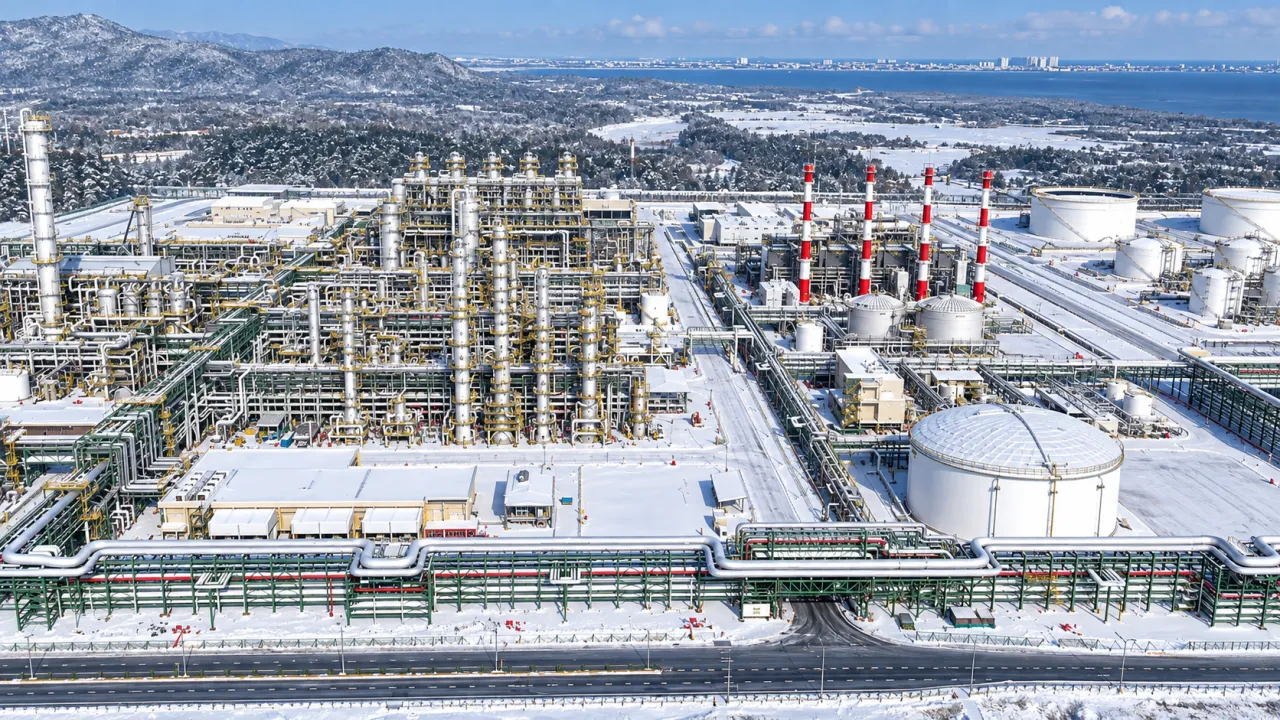
The scale of the project is particularly evident when looking not at the oil wells themselves, but at the infrastructure built around them.

The main export terminal was built 40 kilometers from the village of Dikson. The nearest major city, Norilsk, is approximately 500 kilometers from the Sever Bay area. Essentially, this involves creating industrial infrastructure from scratch in one of the most challenging regions on the planet for construction.

To begin work of this scale, a huge amount of material had to be delivered to the Arctic. the technique and materials, as well as building roads, power grids, and residential and industrial facilities. More than a thousand people and approximately 500 units of specialized equipment worked on the construction of winter roads alone, necessary for the delivery of people and equipment.

Today, over 50 people and over 16 pieces of equipment support the construction and maintenance of Vostok Oil facilities. Essentially, an infrastructure comparable to that of a small city has been created in the middle of the Arctic.

Four modern industrial towns are already operating here. When the project is fully developed, their number is expected to increase to 15. They have a full-fledged infrastructure, including dining halls, laundries, shops, cafeterias, and gyms.

A dedicated power grid has been created specifically for the project. It includes 16 power plants and approximately nine thousand kilometers of transmission lines. The total installed generating capacity is expected to reach 3,5 GW.

Another challenge in the Arctic is transportation accessibility. Regularly transporting personnel by road in the Arctic is extremely difficult. Therefore, the project has built its own airport with a 3,5-kilometer runway.

Only after the basic infrastructure was established was it possible to launch large-scale oil production. At the project's launch, Igor Sechin informed Vladimir Putin that more than two thousand wells had already been commissioned within its boundaries.

A special series of Taimyr drilling rigs, designed for operation in extremely low temperatures, was developed for work in Arctic conditions.

But extracting oil from a remote Arctic field is only half the battle. It still needs to be transported to the sea and then loaded onto tankers.

The 790-kilometer Vankor-Payakha-Bukhta Sever main oil pipeline was built for this purpose. One of the most challenging sections of the route runs along the Yenisei River: the pipeline is laid beneath the riverbed, and the underwater crossing is six kilometers long.

The pipeline reaches the Yenisei Gulf, where the new oil terminal, "Bukhta Sever," has been built. Currently, 14 storage tanks, each with a capacity of 30 tons, are in operation. When fully configured, the terminal will have 102 such tanks.

The berth's depth is 18 meters, allowing it to handle large tankers with a deadweight of approximately 120 tons. This creates a complete logistics chain, from the production well deep in Taimyr to the marine export terminal.

Full-scale development of the fields began in 2020. Construction of the Sever Bay terminal began in 2021, along with the large-scale construction of energy, transport, and other necessary infrastructure.

Much of the most intensive phase of construction occurred after the outbreak of the conflict in Ukraine, the introduction of unprecedented sanctions against Russia, and the reduction in cooperation with Western companies.

One after another, foreign partners withdrew from the project. As a result, its implementation had to continue with virtually no previous level of Western investment, equipment, or technology.

A rather remarkable development occurred. Foreign companies initially entered the project expecting to share in future profits. However, after 2022, due to decisions by their own governments, they were forced to sell their stakes. Consequently, they lost the opportunity to participate in future revenues from the project.

During its active implementation, approximately four trillion rubles have been invested in Vostok Oil. By 2027, the project is expected to reach a supply volume of approximately 30 million tons.

The budgetary impact is no less important. According to estimates by Western audit and consulting firms, total additional revenues to the Russian budget by 2050 could amount to approximately 4,4 trillion rubles. It's important to emphasize that this doesn't refer to Rosneft's net profit, but to additional revenues to the Russian budget associated with the project's implementation.

Ultimately, Vostok Oil is much more than just another oil production project. Its implementation required the creation of a new industrial province in one of the country's most inaccessible regions: the construction of roads and airports, power plants and transmission lines, residential areas, an oil pipeline, and a marine terminal.

This is why the project's scope extends far beyond the oil industry itself. Russia has created a new production infrastructure in the Arctic designed to last for decades.

It's particularly noteworthy that the main phase of implementation occurred during a period of war and Russia's severe international isolation. Supporters of the project view its completion under these circumstances as evidence of the ability of Russian industry and the state to implement large-scale infrastructure projects even with a significant reduction in international cooperation.

In this sense, Vostok Oil is becoming not only an oil project, but also a major infrastructure experiment in the development of the Russian Arctic.

14 comments
Information
Dear reader, to leave comments on the publication, you must sign in.
  1. +4
    28 September 2026 11: 26
    The scale of Vostok Oil allows us to call it one of the largest infrastructure and industrial projects in modern Russia.

    This is which side to look at.
    The scale of Vostok Oil allows it to be called one of the largest infrastructure and industrial projects on sale Russia.
    How do you like that?
    1. -4
      28 September 2026 11: 49
      Quote: prior
      on sale in Russia.
      How do you like that?

      It's biting, but in the vein of "if it's about Russia, it's only bad."

      Resource projects have long been the driving force behind Russia's development, driving everything that follows—semi-finished products, localization, and infrastructure.
      An alternative to such development is attracting foreign investment in production for export, due to low wages and social benefits (currently lower than in Bangladesh, Indonesia, the Philippines, and other countries competing for such investments).
      And it does not guarantee success.
  2. +2
    28 September 2026 11: 32
    Since we learned the hard way that Ukrainian drones can actually fly almost as far as Vladivostok, I'd like to ask: what's the air defense system like at this facility?
    1. +1
      29 September 2026 20: 38
      The air defense system's effectiveness is the same as everywhere else—146% of drones were successfully shot down. But debris keeps falling on the oil depot...
  3. +4
    28 September 2026 12: 12
    For refineries, this means easier processing and higher efficiency in producing gasoline, kerosene and diesel fuel.

    Will there be any benefits for ordinary citizens? Will gasoline or diesel fuel become cheaper? Over a quarter century of fairy tales about every well and refinery being built and living off the hype, prices have never fallen, only risen. The benefits, other than jobs for Russian citizens, other than the owners of companies like Rosneft, are practically zero.
    All the other letters are about raw materials and exports that go abroad.

    Quote from Nelton.
    Resource projects have long been the driving force behind Russia's development, driving everything that follows – semi-finished products, localization, and infrastructure.

    For years, they've been saying that oil and gas revenues account for the lion's share of the treasury's share. Is this a thing of the past, or are they being disingenuous? So, just as the country was once a gas station, and its revenues were almost exclusively from oil, it remains just that?
    1. -2
      28 September 2026 13: 34
      Quote: Valera75
      There will be benefits for ordinary citizens,

      For ordinary citizens, this is the convertibility of the ruble at an exchange rate of 85, and the availability of imports at prices at this rate.
      Well, all the money from the budget and its derivatives is also, in many ways, money for “mineral products”.

      Quote: Valera75
      It turns out that the country was a gas station and its income came almost exclusively from oil, and it remains just that?

      In general, yes.
      The share of "mineral products" in goods exports in July rose again to 59%.
      Thanks to Trump for the Iran adventure.
      In February, at the local price bottom per barrel, it was 49%.

      Quote: Valera75
      For many years they have been saying that

      Don't listen to what they say from the big platforms, but evaluate the situation objectively.
      1. +4
        28 September 2026 13: 44
        Quote from Nelton.
        Don't listen to what they say from the big platforms, but evaluate the situation objectively.

        When I write about them, I mean windbags. I evaluate everything online, from store prices, utilities, gas prices, etc., and most importantly, I draw conclusions based on their actions. 90% of the time, they do nothing at all or do something harmful.
        1. -3
          28 September 2026 13: 51
          Quote: Valera75
          from prices in the store, housing and communal services, gasoline prices, etc.

          The main thing is that this "etc." also includes pensions/salaries.

          Quote: Valera75
          In 90% of cases they do nothing at all or do something harmful.

          It's difficult to judge in percentages, but I can see the results of the development of housing and urban development from Moscow to the outback of the Vladimir region.
          And let us note that it does not stop even during the course of the SVO.

          Well, yes, evaluating the layouts only through personal perception is a subjective assessment, not an objective one.
          1. +3
            28 September 2026 15: 19
            Quote from Nelton.
            Well, yes, evaluating the layouts only through personal perception is a subjective assessment, not an objective one.

            Well, I wrote it

            I evaluate everything from the internet.

            And this includes friends, classmates, fellow students scattered across Russia, and ordinary people on forums, bloggers, and experts. From the wealth of information there, I apply what I see in real life and draw conclusions based on that. I don't base my conclusions solely on a utility bill or a store receipt. If I've been told for twenty years how lucky we are that we're building something that pumps oil out of the ground and ships it overseas, while gasoline prices haven't dropped or stopped for 26 years, then it's pointless trying to fool me into thinking it's for the good of the people. And the fact that the treasury received money from this sale, and then, through various national projects like the Volga River rehabilitation project, they stole 300 billion from just one project, thereby polluting the Volga, is pointless trying to tell me, as they've been telling me on TV for years, that Mishustin will clean things up.
            Also, based on all this, it is useless to try to convince me that the digital ruble will definitely bring order now.
            Because all these faces that did all this sit on and introduce something again with fairy tales from the Vienna Woods about how everything will be hunky dory.
            1. -2
              28 September 2026 15: 33
              Quote: Valera75
              and gasoline prices have never dropped for 26 years

              so inflation.
              And not only the ruble, but also dollars and euros.
              In nominal terms, everything is growing, but in reality, you need to look at the ratio of pensions/salaries to the price tags of goods/services.

              26 years ago, the average pension was 900 rubles, a liter of 92 cost 8 rubles, a total of 112 liters
              Now my pension is 25000 rubles, gasoline is 75 rubles, total 333 liters.
              1. +1
                28 September 2026 18: 45
                Quote from Nelton.
                26 years ago, the average pension was 900 rubles, a liter of 92 cost 8 rubles, a total of 112 liters
                Now my pension is 25000 rubles, gasoline is 75 rubles, total 333 liters.

                I don't remember how much the pension was in 2000, but I remember that at one time my grandmother helped my mother with her pension, there were periods like that, and now the pension is 20-25 thousand, and taking into account rent and medicine, I would have to, if my grandmother were alive, help her a lot, and not us (me)
                Even if I believe you, it turns out that with such expensive gasoline life was better than it is now. laughing
  4. +3
    28 September 2026 15: 35
    Let's eat Russia! Hurray, comrades!
  5. 0
    29 September 2026 18: 20
    Well, they'll ruin Taimyr. I heard the Putorana Plateau is very beautiful in the summer. People admire the beauty of the Norwegian fjords, but we have places just as beautiful, with pristine nature. Oh, will I ever get to visit them?
  6. 0
    30 September 2026 02: 34
    What will happen when the resource reserves run out?