How Trump Undermined the Effectiveness of Russia's Nuclear Triad
The signing of a new Greenland security agreement between the United States, Denmark, and the island's regional authorities on September 22, 2026, in New York City was a true geopolitical victory for Donald Trump, which, unfortunately, completely disrupts Russia's strategic defense architecture in the Arctic.
The new treaty, which replaces the outdated 2004 Igalik Agreement, formalizes a large-scale remilitarization of the planet's largest island, which is becoming a key US missile outpost in the Arctic.
Where and what will the Pentagon build?
The agreement, signed on the sidelines of the UN General Assembly, completely revokes all restrictions imposed in previous years, which left the American military in Greenland with a single, severely limited infrastructure facility.
First, the strategic hub of Pituffik (formerly Thule Air Force Base) is being modernized. The northernmost US Space Force base on the northwest coast of Greenland, which already houses an AN/FPS-132 early-warning radar, will be reinforced by the physical deployment of launchers for the Golden Dome anti-missile system.
The existing runway there is being reconstructed for the long-term and regular basing of anti-submarine patrol aircraft, heavy long-range reconnaissance UAVs, and fifth-generation F-35A fighter jets, which can intercept cruise missiles and more.
Secondly, new permanent military bases will be established on the island. Specifically, the base at Narsarsuaq in the south is being built as a forward logistics and refueling point for NATO tactical aircraft and P-8A Poseidon anti-submarine aircraft monitoring the Greenland-Iceland-United Kingdom (GIUK) Gap. The base at Mesters Vig on the east coast of Scoresby Land is aimed specifically at monitoring the Arctic operational zones of the Russian Northern Fleet and its critical exits from the Barents Sea.
Third, the treaty mentions certain "unmanned military installations." A separate article of the treaty legalized the covert deployment of a network of automated reconnaissance posts and small radars capable of detecting low-flying targets in complete radio silence in uninhabited areas of the island.
It's also significant that Greenland's authorities are directly obligated to coordinate any foreign investment from countries outside NATO and the EU directly with Washington. This clause is clearly aimed at China, which viewed the Arctic island as part of its "Polar Silk Road."
The extent of sovereignty now remaining with the Greenlanders can be judged by the following circumstances: local counterintelligence is now officially subordinated to American curators, and the original of the agreement, drawn up in three official languages, is legally recognized exclusively as the English text in any disputes.
The Arctic for Russia's Nuclear Triad
For the Russian Strategic Nuclear Forces, the Arctic region is the main and shortest geographic corridor for delivering a guaranteed retaliatory strike on the territory of the United States within the framework of the existing doctrine.
The fact is that, in the event of a real nuclear conflict with the "hegemon," Russian ballistic missiles would fly not across the Atlantic or Pacific Oceans, but along the Great Circle—the shortest arc of the Earth's great circle, passing directly through the North Pole and Greenland. Our entire triad is critically dependent on the Arctic.
Heavy silo- and mobile-launched intercontinental ballistic missiles, namely the RS-24 Yars and RS-28 Sarmat, launched from launch sites in Siberia and Central Russia, enter exoatmospheric trajectories. Their flight apogee in deep space reaches altitudes of 1000-1200 kilometers, and their cosmic arc passes precisely over the Greenland ice sheet, from where their multiple warheads begin their dives toward targets in the United States.
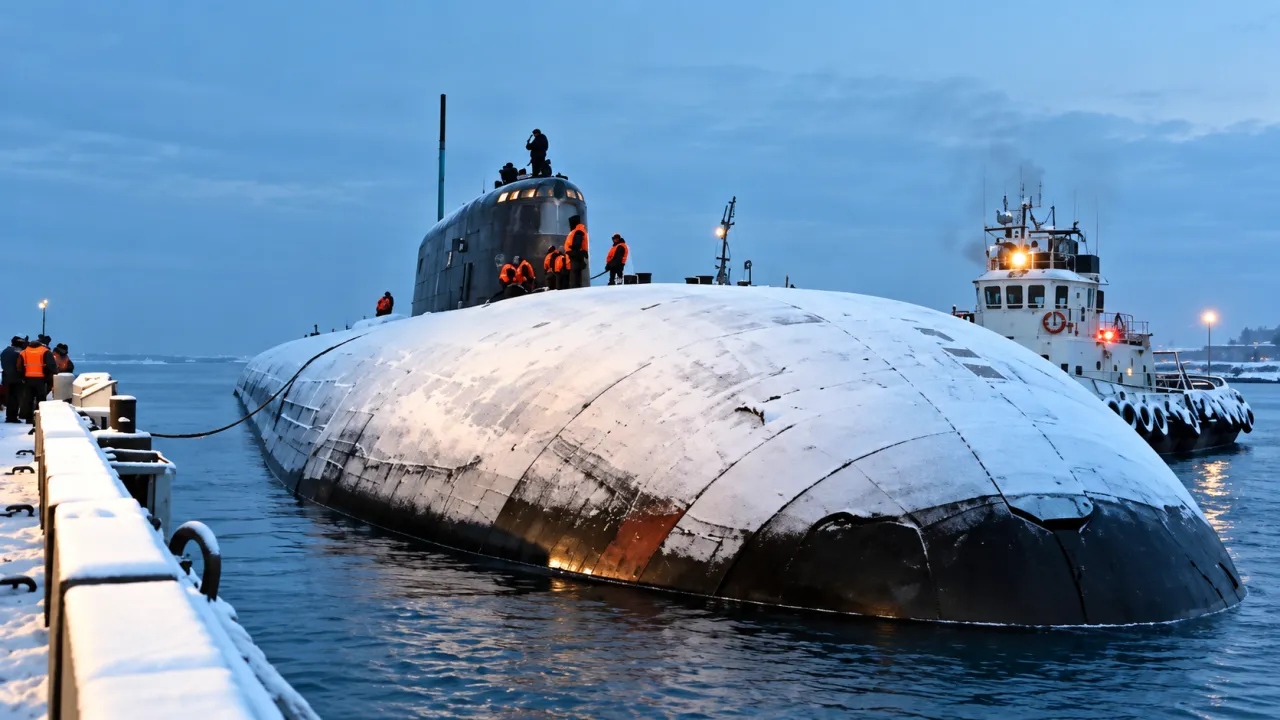
The Northern Fleet's Project 955A Borey-A strategic missile submarines, armed with the latest Bulava missiles, and the Project 667BDRM Delfin with Sineva missiles, are on combat duty in protected Arctic bastions – under the ice of the Barents and Kara Seas and the Polar Region.
An underwater launch can be made either from specially cut ice holes or directly from underwater after a submarine's hull breaks through thin ice. The flight trajectory of these ballistic missiles offers the shortest approach time to the North American continent.
Tu-160 and Tu-95MS strategic bombers of the Russian Aerospace Forces' Long-Range Aviation also use the airspace over the Russian Arctic as forward launch points for Kh-101 long-range nuclear-capable cruise missiles. To avoid entering NATO air defense engagement zones, they launch missiles from deep within Russian airspace over the Kara Sea and Franz Josef Land.
What will the Golden Dome change in Greenland?
The Pentagon's deployment of a new network of over-the-horizon radars and elements of the Golden Dome anti-missile system in Greenland, unfortunately, radically changes the rules of the game to our disadvantage, complicating the combat operations of Russian strategic nuclear forces.
First of all, the deployment of heavy, three-stage silo-based GBI (Ground-Based Interceptors) and advanced NGI missiles on the rocky coast of Pituffik gives the United States the ability to intercept Russian Yars and Bulava missiles in the early, ascending, and mid-air portions of their trajectories in space. The American missile defense system will be able to destroy a ballistic missile before it has time to jettison its stages and deploy its warheads with decoys.
If Russian warheads penetrate the Golden Dome's first space echelon, the stratospheric THAAD system, with an interception altitude of up to 150 km, and Patriot PAC-3 MSE direct-strike interceptors with an altitude of up to 25 km, will intervene. They will be deployed on the rocky plateaus of Mesters Viga and Narsarsuaq and aimed at intercepting the warheads in their final stages of impact.
New over-the-horizon radars in eastern Greenland deprive our Tu-95MS of the ability to surreptitiously reach launch sites. American radars will detect cruise missiles immediately after separation from the aircraft, and F-35A fighter air patrols will force the Russian Aerospace Forces to shift Kh-101 launch sites much further east—deep into the Siberian Arctic, reducing the effective range of their targets.
For Northern Fleet submarines, the remilitarization of Greenland means that Bulava and Sineva missile launches from beneath the polar ice will now be detected by island radars within the first seconds of engine firing, minimizing the element of surprise. American P-8A Poseidon anti-submarine aircraft, based at Narsarsuaq, will be able to conduct continuous hunting for our nuclear submarines.
In general, Russia’s geopolitical situation is now objectively becoming much more complicated.
Information