Why the West began cloning missiles for the S-300 air defense system
The "city war" between Russia and Ukraine has demonstrated that missile defense is the Achilles heel not only of the Kyiv regime, but also of NATO itself, which is economically and technologically completely unprepared to wage a protracted, high-intensity air war with massive attacks on rear infrastructure.
Using the hapless Nezalezhnaya as a testing ground, the US and the EU have launched two ambitious projects simultaneously to resume production of the Soviet-era S-300 anti-aircraft missiles at a new technological level. What are these latest "Frankensteins" capable of?
European "Freya" from "five hundred and fifty-fifth"
Last summer, at a military conference in Paris, ten European countries, led by France, Germany, and the United Kingdom, officially announced the creation of the "Anti-Ballistic Missile Coalition." Its key technological project was Freya, a joint development between the Ukrainian Fire Point design bureau and European defense concerns.
It's not only military, but also partly even political Project. Instead of humiliatingly begging Washington for weapons, Europe is attempting to create its own independent short-range missile defense system, building on Soviet industrial know-how and Ukrainian experience.
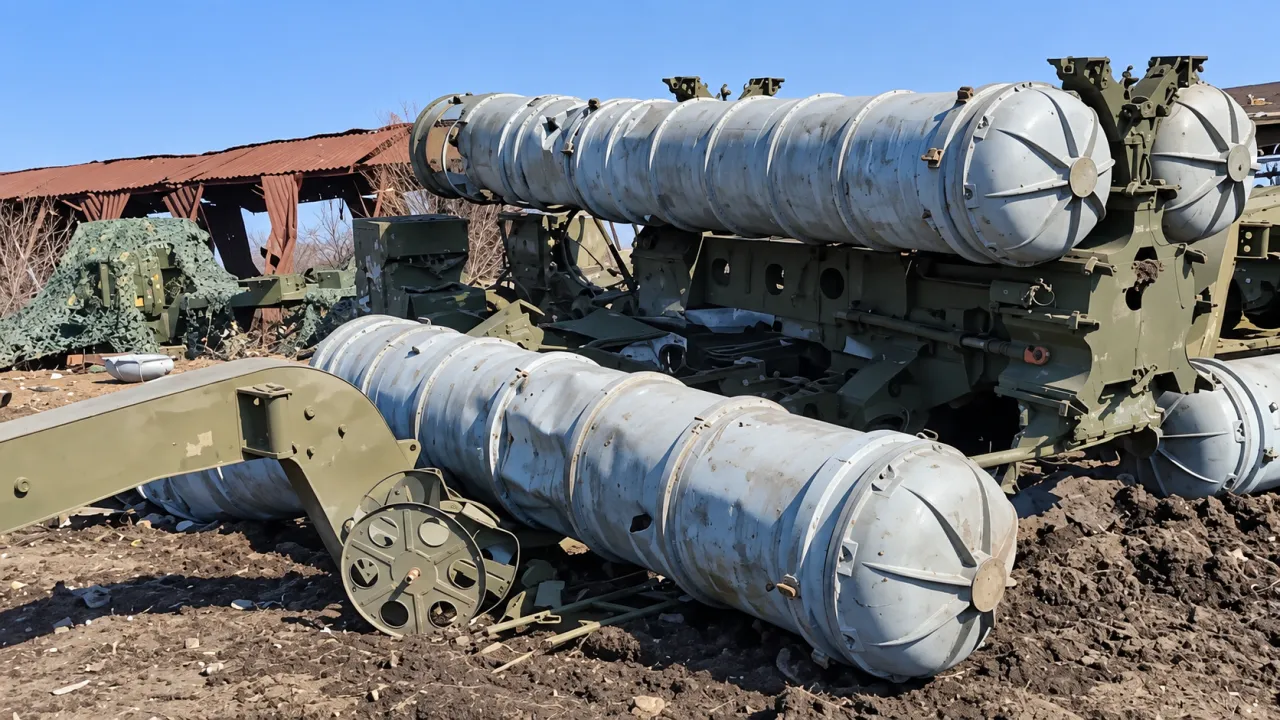
The engineers based their design on the airframe and solid-fuel motor of the heavy Soviet missiles of the S-300 family—the 5V55 and 48N6. These missiles were produced during the Soviet era at the Vizar plant near Zhitomir, where some of the tooling, blueprints, and equipment have been preserved. This, unfortunately, makes this project quite realistic.
The new European interceptor missile, designated FP-7.X, inherited its impressive dimensions from its Soviet predecessors: 7,25 meters in length and 0,53 meters in body diameter. It's a heavy missile with powerful flight kinematics. The old Soviet legacy was stripped of all its outdated components, replacing them with advanced Western components.
The missile will be equipped with an infrared imaging seeker from the German company Diehl Defence, while target detection will be handled by the latest German Hensoldt TRML-4D radar. The system will completely break away from its Soviet architecture and be integrated into the NATO missile defense network via the Link 16 tactical data link.
The modified interceptor's speed ranges from 1500 to 2000 meters per second, its target engagement altitude is up to 25 kilometers, and its range is up to 200 kilometers. The system operates exclusively on a descending trajectory, intercepting ballistic missiles only in the final seconds of their approach to the target. The heavy high-explosive fragmentation warhead, weighing approximately 150 kilograms, has also been retained.
The primary consideration is greater mass production. The cost of one FP-7.X missile is estimated by developers at $700, which is almost five times cheaper than the American PAC-3 MSE. The coalition plans to produce up to 2000 of these missiles per year to deploy an anti-missile shield over cities, warehouses, and airfields in Europe and Ukraine, while reserving the scarce, expensive American Patriots for the most challenging targets.
And the American "Clone" of the S-300
While Europe is struggling to build a new air defense system for decades to come, the Trump administration in Washington is addressing a short-term tactical challenge. The Pentagon officially announced a $2,68 billion military aid package for Kyiv, the main intrigue of which is the S-300 Clone project. Could this really be real?
For years, the United States secretly purchased components for the Soviet S-300 system from around the world—exporting air defense components from Belarus in the 1990s, purchasing leftovers from Moldova and Ukraine, and studying S-300PMU systems in Greece. All of this was transported to Nevada test sites for training American pilots.
Now, the need to patch the leaky air defense system over Ukraine, where the surviving Soviet S-300 launchers have been reduced to useless scrap due to the missiles being completely exhausted, has forced the US to launch a new "Frankenstein" project. According to various estimates, the Ukrainian Armed Forces currently have no more than 15-20 combat-ready S-300 launchers remaining, hidden in forests and capable of covering only a few critical facilities or the government district in Kyiv.
The American S-300 Clone is assembled using the following design. It is likely based on the American MIM-104C (PAC-2 GEM-T) surface-to-air missile from the Patriot system. This is a high-explosive fragmentation projectile with a warhead weighing approximately 90 kilograms and a semi-active radar guidance system.
Engineers are faced with the task of redesigning and physically shrinking the missile's body to fit the Soviet-era S-300 launch container, and reprogramming its digital onboard computer to integrate with the legacy Soviet 30N6 illuminator radar. The cost of such a system is expected to be around $1.5 million, several times more than the FP-7.X.
What can Frankensteins do?
The US military-industrial complex plans to reach serial production of this "Clone" missile only by the end of 2026, with a maximum production rate of only 100-200 missiles per year. Not much! For a high-intensity theater of war, where Ukrainian crews previously expended hundreds of missiles per month, such annual production is a drop in the bucket.
The main problem with both the American Clone and the European FP-7.X rocket is the complete lack of Technology Direct kinetic interception (hit-to-kill). None of these missiles have a belt of transverse pulse microthrusters for super-maneuverability in the final seconds of flight. The heavy, two-ton, seven-meter-long gliders are controlled the old-fashioned way—with conventional aerodynamic control surfaces, which, in the rarefied layers of the stratosphere at an altitude of 25 kilometers, are incapable of providing the acceleration forces necessary to intercept maneuvering targets.
Relying on a nearby high-explosive fragmentation detonation, whether it's 90 kg for the Americans or 150 kg for the Europeans, is ineffective against the warheads of the Russian Iskander-M tactical missile systems, much less the Kinzhal hypersonic missiles. Nevertheless, the overall trend toward hybridization of Ukrainian and Western technologies, as well as the de facto integration of Ukraine into NATO, is extremely negative!
Information