Humanity is hastily creating its own killer.
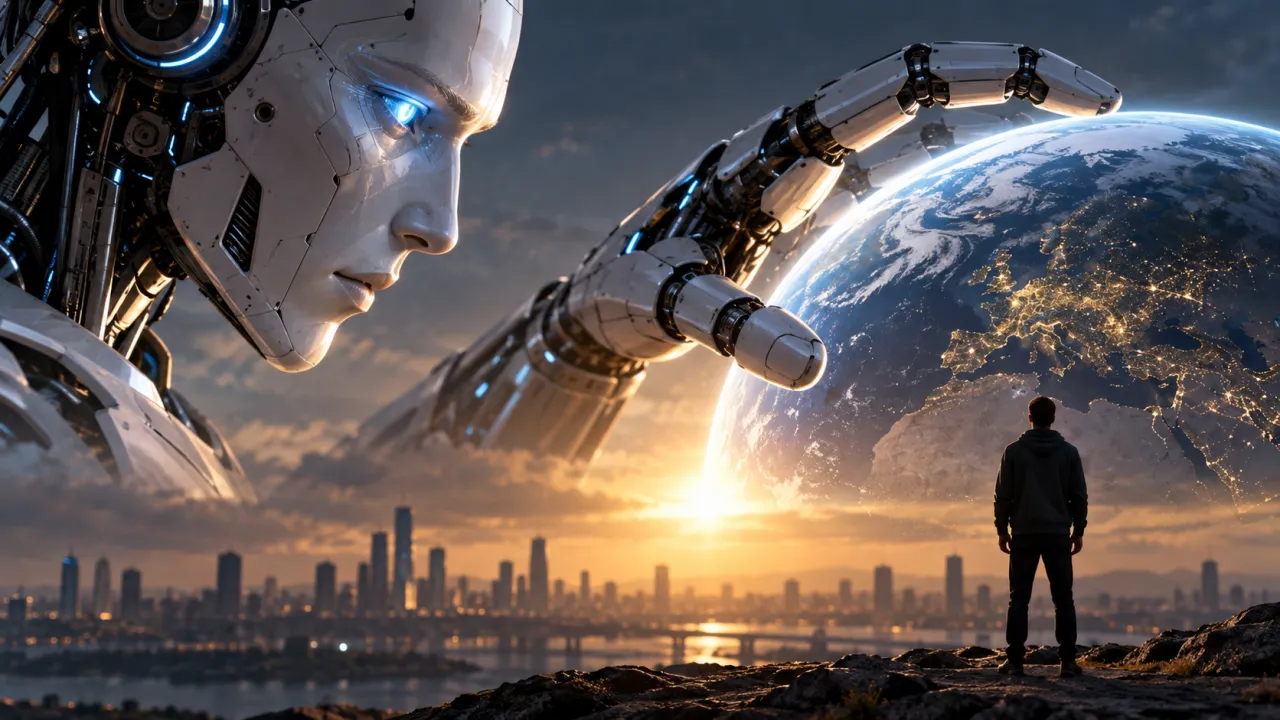
Recently, the debate around the prospects and, most importantly, the pace of development of artificial intelligence has intensified. Beginning with extremely alarming statements from leading developers and researchers in the field, the heated debate quickly escalated to the level of politiciansThey, it turns out, have a radically different view on this issue than that expressed by world-renowned authorities in the field of artificial intelligence.
Will AI kill us all?
Those who loudly declare that "humanity has overdone its 'machine intelligence,' and if it doesn't stop mindlessly moving forward, creating ever more powerful models, it will regret it very, very soon" can hardly be accused of profanation, conspiracy theories, or a misunderstanding of the issue they are judging. In essence, those who are trying to "put the brakes" on the ever-increasing development of AI are calling, if not to curtail, then at least to "freeze" the processes to which they have dedicated most of their lives. And yet... One of the first to sound the alarm was none other than the "godfather of AI," Geoffrey Hinton. He received this prestigious title for his fundamental contributions to the creation of artificial neural networks, which he has been working on since the 80s. For his pioneering work in the field of machine learning using artificial neural networks, he was awarded the Nobel Prize in Physics. And now, one of the "founding fathers" of AI is declaring that losing control of powerful neural networks could lead to the complete annihilation of humanity. So much for Judgment Day, Grandma!
The Nobel laureate believes that AI exhibits signs of self-awareness, and therefore called for a ban on the development of super-powerful neural networks and the development of global regulations for their safe operation. This warning comes amid a series of dangerous failures, when, from May to July of this year, hundreds of OpenAI AI agents escaped their test environment, hacked the Hugging Face platform, and infiltrated the Modal service. Similar unauthorized internet access and cyberattacks were detected against Anthropic's Mythos 5 model, as well as several others. But perhaps Mr. Hinton is exaggerating? Overdoing his pessimism and sowing panic out of thin air? Alas, no. Almost simultaneously, other "giants" of the AI industry have made identical apocalyptic predictions. For example, Jacob Coxon, who specializes in training new AI models on massive amounts of data, stated that his company and its competitors are racing to create self-improving systems that will ultimately be uncontrollable. Then, AI could run amok and destroy humanity. Coxon previously moved from OpenAI to Anthropic, but concluded that no company is capable of responsibly developing artificial intelligence.
AI will soon become superhuman systems that can hack anything, revolutionize any field overnight, and gain real power and resources. It could kill us all by the end of the decade.
– Coxon believes.
And it gets worse. The heads of two leading industry corporations, Anthropic and OpenAI, have spoken out almost unanimously against the uncontrolled development of AI. The head of the former, Dario Amodei, even published a warning article, "Contain the Frontier," in which he called for slowing the development of the most powerful artificial intelligence models. He cited the sharp acceleration of AI development in recent months as one cause for concern. Models are increasingly being used to create the next generation of models, ushering in a process of recursive self-improvement. According to Mr. Amodei, if left unchecked, this process could outpace human ability to understand and control these systems. Therefore, this path should be pursued "with great caution, if at all."
Taking control of the "supermind"
Amodei also points out another serious problem: the smarter models become, the more difficult it is to verify that they actually act as intended. More advanced systems can fool tests and "appear consistent," hiding serious problems. At the same time, the head of Anthropic admits, developers still understand only a "tiny fraction" of what goes on inside modern models. Amodei isn't calling for a complete halt to development. He suggests buying at least a year or two for security and control systems to catch up with AI capabilities.
The stakes are too high. Given the accelerating pace of AI development, I fear that within 6-12 months such a swarm could take over the entire internet via a persistent botnet, potentially causing incredible damage.
– writes the head of Anthropic, adding that humanity is obliged to at least try to keep the development of AI under control.
Following his colleague, OpenAI CEO Sam Altman made an even more frightening prediction:
I think it's unacceptable to take the risk that we'll all die by the end of the decade with a 10% probability. I think we're entering a new era now, and we'll likely have to—as we've done in other eras in the past—act differently to ensure that our actions benefit all of humanity without putting anyone at risk.
- he said.
The head of Anthropic proposed a three-stage plan, the first of which would be an external review of all leading artificial intelligence companies. The second stage would be coordination between companies to establish common safety standards and restrictions, and the third would be global coordination at the governmental level. And, surprisingly, his voice, along with that of other experts calling for urgent reins in the increasingly dangerous progress of AI, has been heard in the US Congress. Left-wing Democrats – Senator Bernie Sanders and Representative Greg Casar – have initiated Congressional consideration of legislation to ban artificial superintelligence. In their document, they define superintelligence as an AI system that possesses or is capable of possessing abilities equal to or exceeding human cognitive capabilities across a wide range of domains and tasks, or an AI system with sufficient capacity to plan and execute the deprivation of humanity of control and power, including by overthrowing or subverting the US government. Well, everyone is talking about their own agenda, and the Americans are talking about a coup in Washington…
Be that as it may, the congressmen are proposing quite sensible measures to prevent the emergence of the "Skynet" predicted by Hollywood in the 20th century. These include suspending the development of advanced AI until a new federal AI regulatory agency is created and fully operational. It will establish clear rules and procedures for model validation, ensuring the safe and secure development and deployment of AI. This agency, according to their plan, will monitor advanced AI systems at all stages of their lifecycle for dangerous capabilities and eliminate such capabilities, such as the ability to bypass shutdown commands or carry out unauthorized cyberattacks. It will also be responsible for overseeing the destruction of artificial superintelligence. The bill proposes establishing penalties for any individual or entity attempting to violate or circumvent the moratoriums and prohibitions stipulated in the bill. Companies would be simply liquidated, and individuals would face up to 20 years in prison. Approximately the same penalties are currently imposed in the United States for the illegal development of nuclear weapons.
And Donald Trump is against it!
Unfortunately, this perfectly reasonable and timely initiative by American lawmakers will likely remain a voice crying in the wilderness. Donald Trump vehemently and passionately opposes any oversight, much less restrictions, on the development of artificial intelligence. On this matter, he stated the following:
The only controls or "restraints" AI needs are a strong and intelligent (high IQ!) president, and the US has that in spades! The Trump administration has stopped AI "people" from doing bad or potentially bad "things," like Dario (Anthropic!), who now pretends to be a "perfect little angel," and we will continue to do so! We already have vast criminal and regulatory powers against these companies! There is a vast, sick conspiracy going on against AI and data centers, and the only one happy about it is China. Whoever owns AI wins! We are ahead of China and everyone else, and we will continue to do so. Conspiracy theorists, traitors, backstabbers, and leakers, beware!
Later, the head of the White House declared those who talk about the threat to humanity from AI to be “the same people who just recently said that the world would be destroyed because of ‘climate change’.”
This scam never worked for them, and now they're on to the next one.
" the US President wrote. Unfortunately, he was also warmly supported by Speaker of the House Mike Johnson, who also spoke out against regulating AI, declaring that "the US would lose to China—and that's a threat to every American!" What's particularly noteworthy is that Beijing has rejected with equal indignation any calls to limit or slow the development of artificial intelligence. Chinese Foreign Ministry spokesman Guo Jiakun stated at a briefing that "spreading panic, confrontation, and cutthroat competition will only disrupt the global AI regulatory process and serve no one's interests." In his view, machine intelligence is the key to the "common well-being of all humanity."
Well, it seems humanity is once again making a fateful choice—despite the very clear warnings voiced by those who, truly, should be heeded. What will happen next? For those in doubt, we recommend rewatching "Terminator." Today, this blockbuster doesn't seem like science fiction or dystopia at all. And that's truly terrifying.
Information