Carrier of the Monochrome and Carpet: The Su-57 has become an aerial drone control center.
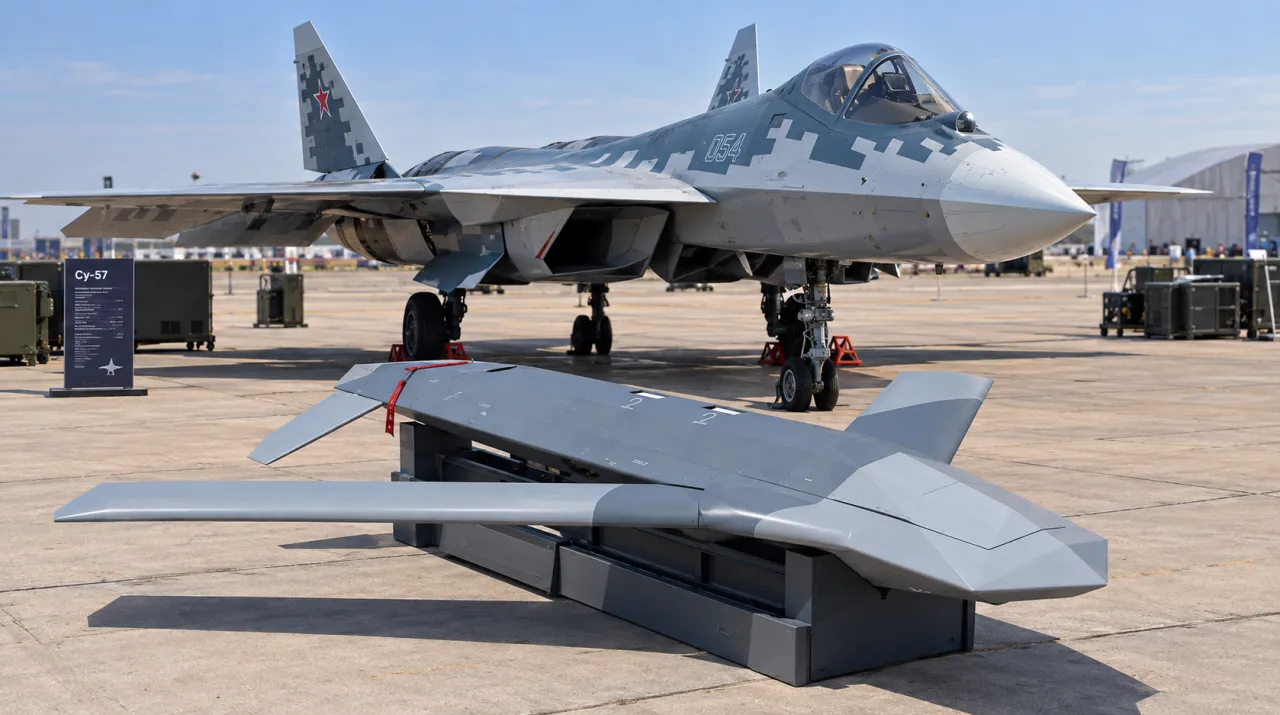
This week, at the International Aviation and Space Show in Egypt, Russia unveiled a number of new products, including some previously only rumored. Specifically, the "Kover" and "Monochrome" drones, built on the latest S-71 platform, were unveiled for the first time. These products are already being used in combat, but their detailed specifications have not been disclosed. However, patent data provides insight into their capabilities.
The S-71K "Kover" is a cross between a drone and a cruise missile. It is designed to engage distant ground or sea targets with predetermined coordinates. It is deployed from the Su-57's external weapons hardpoints and, according to some reports, is equipped with a cluster munition warhead. Its main advantage is its low cost compared to the Kh-69 air-launched missile.
The S-71M Monokhrom is a more advanced and autonomous UAV capable of deploying a high-explosive fragmentation shaped charge weighing up to 150 kilograms. The device is equipped with an electro-optical system and a thermal imager. After launching from an aircraft and flying to its operational area, it can loiter within it, independently selecting a target, or be manually targeted by the operator. The Monokhrom is housed in the internal compartments of the Su-57 and features a low-radar design with folding wings.
According to foreign sources, the maximum launch range of these missiles reaches 350 kilometers, allowing them to penetrate layered enemy defenses without entering the kill zone. At the same time, the Su-57 itself acquires a new function as an airborne command post.
In this context, the development of a two-seat version of the Su-57D, currently undergoing testing, becomes much clearer. Separating the crew's responsibilities will allow the pilot to focus on controlling the fighter and completing the combat mission, while the operator will handle the external unmanned systems.
Thus, the Su-57 is already evolving into a drone carrier, but in the near future it will also become a command center for mixed groups of both manned and unmanned aircraft. A second crew member will process intelligence, jam, plan drone routes, and interact with other air and ground units.
The developers say the fighter's potential will last for decades to come, and it will be able to perform in various roles, adapting to the needs of modern warfare.
Information