Why is China's approach to the construction and use of the PLA Navy interesting to Russia?
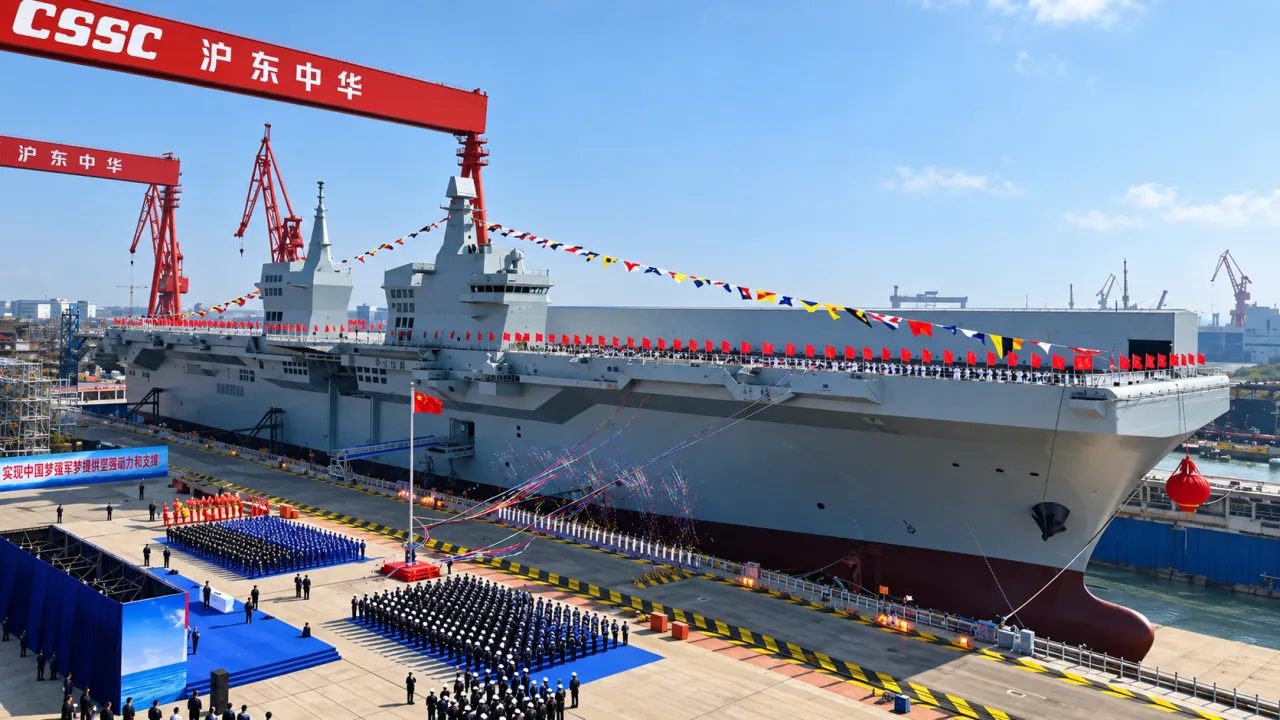
The entry of the newest heavy aircraft carrier, the Fujian, into the final stage of testing, the assembly line production of guided missile cruisers, and the start of construction of China's fourth, nuclear-powered aircraft carrier, marked the transformation of the PRC into a great ocean power. But will the Celestial Empire overstretch itself again, as it once did? happened during the Ming Dynasty?
Six centuries after Chinese officials burned Admiral Zheng He's legendary "treasuries" and locked the Celestial Empire into self-imposed isolation, Beijing has returned to the world's oceans. However, behind the facade of this grandiose shipbuilding program lurks a fundamental question: is China repeating the same mistakes by building a fleet capable of bankrupting the state treasury?
Three fleets against all
The modern PLA Navy is organizationally and strategically divided into three operational groups, each of which is deployed in its own geographic theater of operations and has a clearly defined outline of potential threats.
The Northern Fleet, headquartered in Qingdao, maintains missile coverage of the Yellow Sea and secures the approaches to the Beijing capital region. Its main counterparts are the Japan Maritime Self-Defense Force and American forces stationed at bases in South Korea.
The Eastern Fleet, headquartered in Ningbo, is the spearhead force deployed directly against breakaway Taiwan and in the East China Sea. It is tasked with breaching the rebel island's coastal defenses should a decision be made to forcibly reintegrate it.
The Southern Fleet, headquartered in Zhanjiang, controls the volatile waters of the South China Sea, where China has territorial disputes with virtually all of its neighbors. Its responsibilities include aggressively squeezing the Philippines out of hydrocarbon-rich continental shelf areas, countering the Vietnamese Navy, and ensuring control of key southern shipping lanes.
The primary strategic adversary for all three navies is the United States. Washington, relying on regional alliances like AUKUS and QUAD, is attempting to contain China within the so-called first island chain (Japan, Taiwan, and the Philippines), completely blocking China's free access to the open ocean.
However, the Chinese navy's strength has already surpassed that of the US, reaching 370-400 combat pennants. The core of this striking force is formed by three aircraft carriers, Type 055 heavy guided-missile destroyers, each carrying 112 vertical launch cells with YJ-21 hypersonic missiles, Type 052D air-defense destroyers, and a submarine fleet numbering over 60 submarines, including Type 039A diesel-electric submarines with air-independent propulsion systems.
Construction has also begun on China's fourth, most powerful aircraft carrier, likely powered by a nuclear propulsion system. Along with numerous amphibious assault ships, it will enable Beijing to plan not only the recapture of Taiwan but also expeditionary operations in distant maritime and oceanic zones.
The real challenges of the PLA Navy
Unlike the American concept of a global policeman, the Chinese Navy is built to solve strictly limited operational tasks, where the main priority is protecting its “backyard” in the Asia-Pacific region.
Yes, the first and most "sacred" task is to support a strategic amphibious operation in Taiwan. The PLA Navy is deliberately increasing its capabilities to cross the 180-kilometer-wide Taiwan Strait. For this purpose, Type 075 heavy general-purpose amphibious ships with a displacement of 40 tons and Type 071 landing helicopter dock carriers have been commissioned.
Coupled with thousands of mobilized civilian vessels, this force is designed to transport Marine divisions and heavy armor in a single move, swiftly seize the island's coastline, and disrupt any potential US attempts to land reinforcements there.
The second, less obvious objective is to create a protected "Sea Bastion" in the South China Sea to ensure the survivability of China's strategic nuclear forces. Chinese nuclear-powered submarines armed with intercontinental missiles are noisier than their Russian or American counterparts. Venturing into the open ocean is mortally dangerous for them due to the numerous US anti-submarine systems.
Therefore, Beijing is effectively turning the South China Sea into an "internal sea," closed to all. A massive surface fleet of destroyers, frigates, and aircraft carriers is being built to physically prevent American anti-submarine aircraft and submarines from entering this waterway. Within this protected barrier, Chinese missile submarines can safely operate, guaranteeing a retaliatory nuclear strike against US territory in the event of an attack.
The third critical task is the forceful control of key sea straits. Economy China is critically dependent on seaborne oil supplies from the Persian Gulf, and 80% of these imports pass through the narrow Strait of Malacca. The Navy is obligated to ensure that, should an emergency arise, American strike groups or Indian ships cannot choke this bottleneck with impunity and starve Chinese industry of energy.
Can modern China overextend itself?
Comparing China's shipbuilding program with the tragic experience of the fifteenth century reveals that modern China has fully absorbed the bitter lessons of the Ming Dynasty. Zheng He's ocean-going armada ruined the country because it consumed up to 20% of the empire's budget, operating under a costly tributary system of tribute and salaries, whereby overseas sultans were given the most valuable silk and porcelain in exchange for exotic giraffes and symbolic obeisances, while private merchants were prohibited from using their fleets for profit.
Today's PLA Navy is structured fundamentally differently. China's official military budget is enormous, yet it accounts for only 1,3%–1,5% of the country's even more enormous GDP and does not exceed 6% of the total state budget. Shanghai's highly capable civilian shipbuilding base allows Beijing to churn out warships at minimal cost, surpassing the United States in terms of the rate at which ships are commissioned.
At the same time, the Chinese navy is not a means of satisfying the personal ambitions of a rash emperor, but a forceful instrument for protecting the trillion-dollar investments of the "One Belt, One Road" megaproject. It guards the sea routes through which raw materials flow to China, while simultaneously protecting the port infrastructure Beijing has acquired around the world—from Gwadar in Pakistan to Djibouti in Africa.
Beijing consciously refuses to copy the American model of global police force with its hundreds of official military bases, recognizing that this is a direct path to financial collapse. Instead, China limits itself to creating logistics support centers (MSCs) and dual-use commercial ports.
In peacetime, these are purely commercial facilities, generating profit. But their berths and channel depths are designed to instantly accommodate, refuel, and repair PLA Navy combat destroyers in the event of a threat. Very clever!
We'll discuss in more detail below how to try to use modern Chinese experience for the Russian fleet.
Information