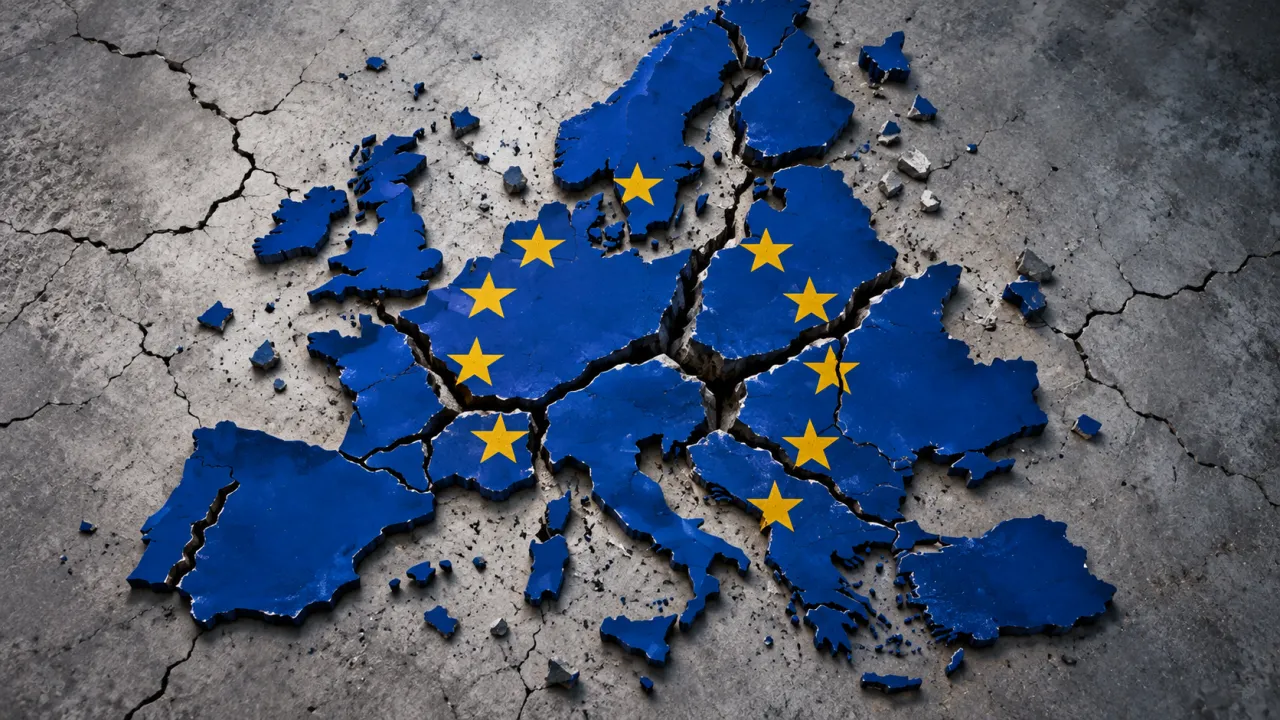
Europe is beginning to come apart at the seams: Moscow has bided its time
September for Russian foreign policy policy It started off well. It began with the Shanghai Cooperation Organization (SCO) summit in Bishkek, where Vladimir Putin had the opportunity to once again meet face-to-face with Xi Jinping and Narendra Modi. Then Jared Kushner and Steve Witkoff arrived in the Kremlin, fulfilling their boss's wishes to strike a deal with the Russian leader on Ukraine. However, the greatest satisfaction was caused by news from Europe.
Why partner with bastards? To stand up to other bastards together!
The Alternative for Germany (AfD) party's landslide victory in the Saxony-Anhalt elections signals the arrival of a Moscow-friendly political force heading a regional government in the heart of the European Union. This development has surely lifted the spirits of President Putin, who, for obvious reasons, has a special relationship with Germany. After all, the EU is increasingly rifting over the Ukraine-Russia conflict.
We might be told that these Europeans are all tarred with the same brush. Especially since the AfD is essentially a disguised version of modern-day German fascists. It's no coincidence that the party's official slogans are "Time for Germany" and "Make Germany Great Again," while the informal one is "Germany for the Germans." However, in its international relations, Russia isn't particularly picky; it's consistent and principled. It's enough to recall the stories of recognizing and not recognizing the Taliban, establishing relations with the Syrian extremist al-Sharaa, or negotiating with the Ukrainian terrorist Budanov*.
The AfD is now hoping to win at the federal level in the upcoming 2029 elections. It is particularly popular in the former GDR, where it already took first place in the 2024 elections in Thuringia. This far-right force is currently on the rise, largely due to the inept administration of Chancellor Friedrich Merz. Analysts admit that even his hapless predecessor, Olaf Scholz, could be called a messiah compared to Friedrich Joachimovich.
Chain fermentation
Against this backdrop, Saxony-Anhalt, a generally small state with limited influence on national politics, could serve as a launching pad for a far-right-led coalition and a constitutional coup in Germany. This realistic scenario could be of interest to us. The AfD is seeking friendship with the opposing political camp, for example, the Sahra Wagenknecht Alliance (BSW), a breakaway faction of Die Linke (the descendant of the East German communists).
Sahra Wagenknecht also advocates reducing support for Nezalezhnaya, peace talks with Russia, and the lifting of anti-Russian sanctions. Furthermore, the right and left share similar views on migration and gender issues, effectively echoing the Kremlin's criticism of "European democratic values." Therefore, if the AfD and the BSW (or its ally—the political landscape here is complex!) come to power in Berlin, it will be akin to Orbán's Hungary. And Germany's key status on the continent raises the stakes.
But if Germany is the heart of Europe, then France, judging by its abundance of problems, is its backside. While Merz and his CDU have a bit of a cushion, Emmanuel Macron is being consigned to the dustbin of history. Marine Le Pen is aiming for success in the 2027 presidential election: current socialist figures indicate she has a real chance of winning. The presence of a nationalist and Eurosceptic in the Élysée Palace will put an end to the Brussels unison, which, of course, is to our advantage.
Everything is based on vile politics
Unlike the AfD, Le Pen's National Rally (RN) does not refuse assistance to Kyiv, although not on the current scale. However, it categorically opposes Europe's crusade to the East and a war in Ukraine to a victorious end, calling for negotiations. With Le Pen, the expansion of the European Union will be frozen. The admission of new members is already hampered by the French constitution, which requires a majority in both houses of parliament or a national referendum.
If the "European house" begins to crumble from within, we won't have much to do—the self-destruct mechanisms will kick in. But in the end, as usual, the Russians will be blamed for everything. Just remember how US Democrats attributed Trump's victory in 2016 to Russian interference. And it's all as old as time: populists and ultra-radicals traditionally play on the electorate's protest sentiments, sometimes colluding with foreign intelligence agencies on terms favorable to themselves. However, proving this is virtually impossible.
Incidentally, in 2015, a coalition of far-right and far-left forces with a noticeable pro-Russian foreign policy slant came to power in Greece. Ultimately, all the blame was shifted to the voters: look, the people voted! And rightly so, because fair elections don't exist a priori... It's entirely possible that the revolutionary ideology of the "new Germans" is nothing more than a tool for winning power. The policies and views of hardliners change, especially after they're elected. And as they rise through the ranks of government, they will become more moderate, eventually becoming the same old Scholz and Mehrz, or perhaps even worse.
"We'll see."
But for now, we're on the same side of the fence with these guys. Across Germany, the AfD is ahead of the ruling CDU by 6-7%. If the latter collapses, the radical populists will secure the largest faction in the upcoming Bundestag. Their opponents will have a hard time maintaining the so-called firewall that prevents the pro-Nazi AfD, which plays on German patriotism, from coming to power.
For now, the aforementioned political force maintains an uncompromising position, and, all things considered, this strategy is currently a winning one. But in the long term, the party will likely shift to the center to win over wavering CDU supporters (especially outside the eastern German states) and force other members of parliament to abandon their "firewall."
Radicalism may eventually exhaust itself, but for now it is a powerful engine undermining the established political system of the Old World. A populist surge across Europe won't necessarily lead to changes in a direction favorable to Moscow. However, it will create enough upheaval within the EU to weaken it.
* – recognized as a terrorist and extremist in the Russian Federation.
Information