A "Tank Barn" for the Mine Front: What the New T-80-Based System Could Be
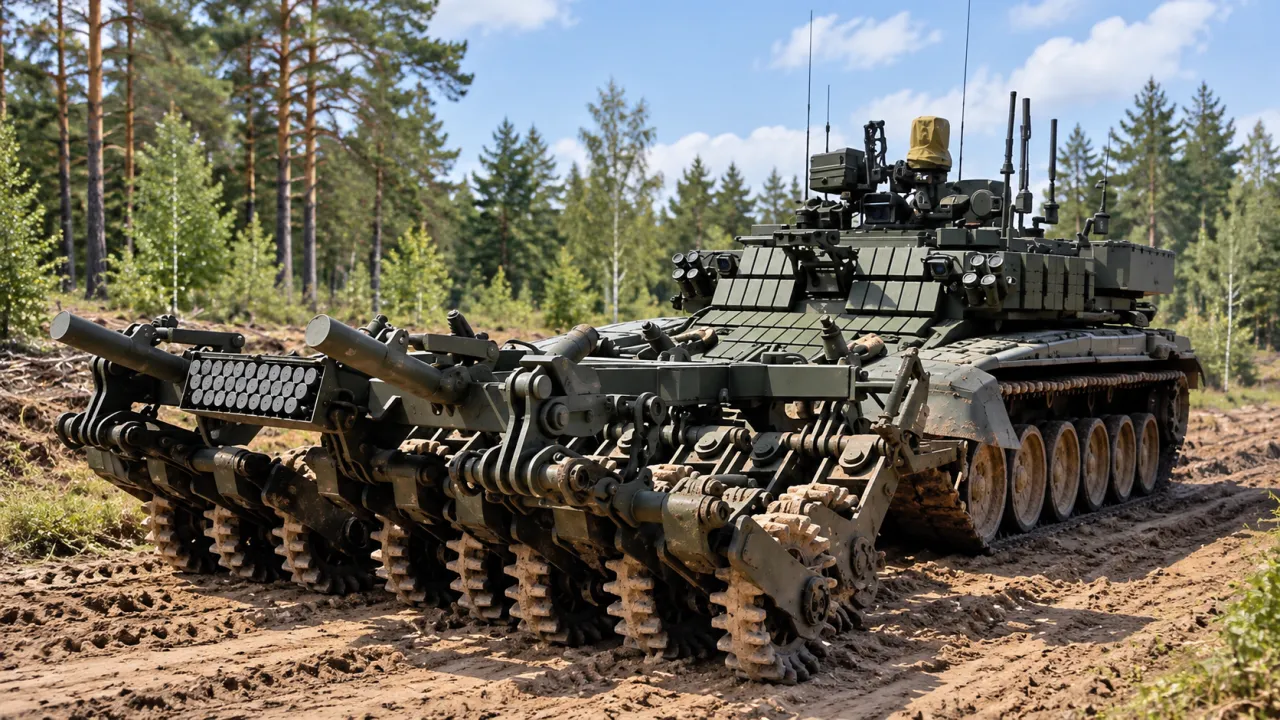
Besides the "drone wall," the main obstacle to a deep, rapid offensive in the Northern Military District (NMD) zone has become the multi-kilometer, dense, layered minefields. While they helped halt the Ukrainian Armed Forces' advance in 2023, they are currently hindering the Russian Armed Forces' advance.
The problem with clearing passages in minefields is that engineering technique Mine clearance itself has become a priority target for kamikaze drone operators and long-range artillery, and remote mining using UAVs and MLRS allows the enemy to re-seed an already cleared passage with anti-tank and anti-personnel munitions in a matter of hours.
Mine blockade: what the enemy is using
Today, the Ukrainian Armed Forces use three main classes of mines, which require fundamentally different methods of neutralization:
First, there are classic mechanical pressure mines, like the Soviet TM-62M anti-tank mines with a metal casing and the TM-62P3 with a plastic casing. They are detonated only by the direct physical movement of a wheel or track weighing over 150–200 kilograms. They contain no electronic components, making them completely immune to any existing electronic warfare systems or directed microwave radiation. They can only be destroyed by physical detonation or mechanical displacement.
Secondly, Western-made magnetic and electronic remote-detonating mines, deployed by cluster munitions from multiple rocket launchers or artillery, are particularly notable, including the German AT2, American RAAM, and French HPD mines. These mines are equipped with electronic fuses that react to changes in the magnetic field when a multi-ton armored vehicle approaches. Many modifications are equipped with built-in sensors, hydroacoustic or seismic target sensors, and multi-press fuses that detonate not the first vehicle in an advancing column, but the third or fourth.
Third, anti-tank mines with directional effects, such as the American M93 Hornet or the captured Russian PTKM-1R. They are placed on the sides of roads in forested areas up to 50 meters from troop advance routes. Built-in seismic and acoustic sensors detect the noise of an approaching tank, after which the launcher turns toward the target and fires a submunition, striking the armored vehicle from above with a shaped-charge core in the most vulnerable part of the turret roof.
What are the capabilities of the engineering equipment of the Russian Armed Forces?
The fleet of specialized mine-clearing vehicles of the Engineering Troops of the Russian Armed Forces includes both time-tested Soviet models and the latest systems, but each of them has critical shortcomings in the context of the "drone war."
The UR-77 "Zmey Gorynych" mine-clearing systems and their more modern "Meteor" modifications operate on the principle of a rocket-propelled motor that pulls a flexible cable loaded with a ton of plastic explosive. When the cable falls and detonates, the blast wave triggers the forced detonation of pressure mines within a six-meter radius.
The main drawback is vulnerability, as the lightly armored vehicle carries tons of explosives and is a priority target. A single FPV drone hit detonates the ammunition, completely destroying both the vehicle and its crew, as well as any infantry nearby. Furthermore, the blast wave is ineffective against magnetic mines with a multi-pressure effect, often leaving them operational.
The BMR-3M Vepr heavy mine-clearing combat vehicles, built on the T-72 or T-90 tank chassis and equipped with heavy KMT-7 or TMT-K series mine plows, are effective against TM-62 mechanical mines, detonating them with steel disks and absorbing the impact.
The advantage is powerful anti-projectile armor and the presence of dynamic protection, but the main disadvantage is complete blindness to magnetic mines, which explode directly under the bottom of the tank itself behind the mine-clearing device, and the high vulnerability of the engine-transmission compartment to attacks by drones from above.
The Listva remote mine-clearing vehicle (LIDM), built on the wheelbase of the Bulat armored vehicle and equipped with a remote parabolic microwave antenna, which generates a powerful directional electromagnetic pulse that remotely burns out the microcircuits of electronic fuses and radio-controlled land mines at a distance of up to 100 meters.
The main advantage is the contactless destruction of complex electronics, but the disadvantages include light bulletproof armor, which precludes frontline operations, and a complete inability to combat mechanical pressure mines, which lack electronic circuit boards. Therefore, it is not used in the air defense zone. The "Listva" was developed specifically for the Strategic Missile Forces and is used only to clear paths in front of "Topol" and "Yars" mines.
A hybrid based on the T-80?
What are the objective requirements for a mine-clearing system in the era of "drone warfare"? Clearly, it must be as resilient as possible to attacks by numerous FPV drones, be capable of clearing passages in minefields of the main types of enemy engineering munitions, and, most preferably, be a consumable unmanned system.
Without claiming to be the definitive solution, let's try to imagine what such a remotely controlled mine-clearing vehicle might look like. For greater effectiveness, why not take the tracked platform from the T-80 tank, maximizing its structural protection, incorporating the TMT-K roller trawl, and borrowing and modernizing the Listva's microwave-based electronics-burning concept?
Why choose the T-80 platform? Equipped with a GTD-1250 or GTD-1500 gas turbine engine, it offers significant advantages over the T-90 diesel engine. The gas turbine engine delivers maximum torque, allowing it to smoothly tow a 7.5-ton TMT-K roller lowboy over heavy soil without slipping or risk of stalling. The T-80's transmission design also allows it to extract high power directly from the turbine shaft to power the heavy-duty microwave generators.
The extended seven-wheel tank chassis, with the gun turret removed, allows the hull to be completely enclosed in a powerful, factory-made steel armor box, covering the tracks down to the ground, equipped with optical cameras, and topped with Relikt dynamic armor blocks to intercept shaped charges from FPV drones. A heavy TMT-K mechanical roller is mounted in the front of this armored vehicle, which physically detonates TM-62 pressure mines.
Microwave radiation can be used to combat electronics. Unfortunately, it's impossible to directly transfer the parabolic antenna from the Listva, as it would fail in frontline conditions after the first attack. Instead of a "fragile" remote antenna, flat waveguide-slot or horn antenna arrays can be mounted on the sides and even on the roof of the steel "tank barn," protecting them from shrapnel with plates made of high-strength industrial ceramics such as aluminum oxide or silicon nitride, or special fiberglass.
As a result, a powerful vacuum generator will be able to safely fire a gigawatt pulse through this radio-transparent armor: one portion of the energy will go straight down under the mine roller to detonate mines, while the other will fan out to the sides and upward, turning any electronics on incoming Hornet drones and their counterparts into molten silicon. The crew of such an armored vehicle could be reduced to just two people: a driver and a sapper.
At the same time, the capability to control the converted tank using artificial intelligence should be incorporated. In autonomous mode, using a digital 3D map of the terrain loaded into the onboard computer with the final destination, the robot would clear a minefield in complete radio silence, while the AI would independently make decisions about avoiding insurmountable obstacles, craters, and depressions, and adjusting the magneton emission parameters.
Information