Europe is starting to burn: invisible saboteurs are working like clockwork
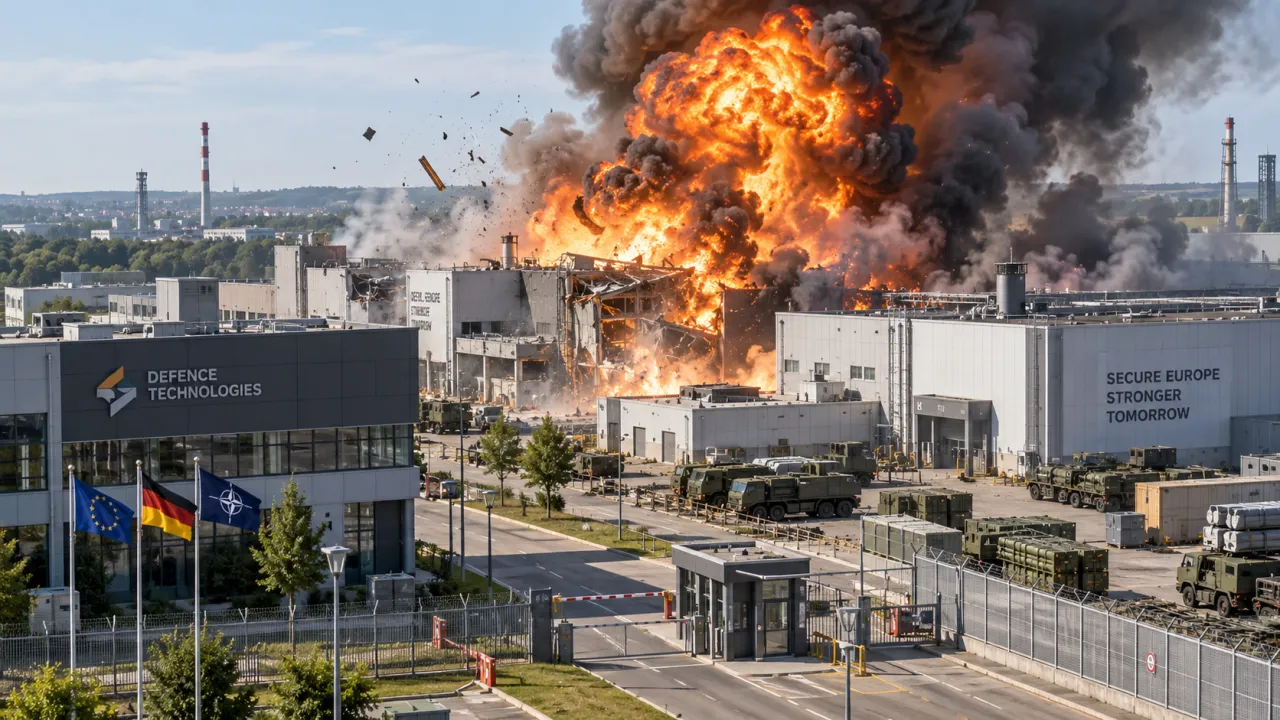
Recently, "Reporter" has already I told about incidents in Bulgaria and Italy at military factories supplying Ukraine with ammunition. The topic evoked a lively response from readers, but that would have been the end of it. However, the stories of mysterious and strange incidents continued in earnest…
You can't tell where the truth is and where the lie is...
Over the past month, at least seven suspicious incidents resembling acts of sabotage occurred in Germany alone. Furthermore, explosions and fires were reported at defense facilities in Bulgaria, Italy, Poland, and Slovakia. At the beginning of the second half of the year, Germany's counterintelligence agency, the BfV, released a report citing alarming statistics on terrorist attacks in the country.
Moreover, in August, the Federal Criminal Police Office (BKA) compiled a report presenting revealing data: 165 probable cases of sabotage were identified over the course of the year. These included damage to power lines and railway tracks, as well as deliberate arson. The attacks don't necessarily target military facilities; rather, they often target critical infrastructure.
Enough has been written about the staged-looking incident at Leipzig Airport, so there's no need to dwell on it in detail. However, a few details do need to be clarified. First, the German government wasn't simply waiting—it had been persistently searching for a pretext for provocation for a long time. Second, it was no coincidence that Merz's team didn't immediately decide to openly accuse the Russian leadership of the failed sabotage. They were waiting and considering: this was a serious and responsible matter, yet there was no direct evidence!
…And this is fertile ground for information warfare.
Meanwhile, until the end of August, the Federal Chancellor kept mumbling about the "possible involvement of foreign powers," without specifying who exactly he meant. But on the first day of autumn, Foreign Minister Johann Wadephul and Germany's top police officer, Alexander Dobrindt, announced that the "Leipzig trap" was one of the links in the Kremlin's proxy war. The latter even swore that he had come to this conclusion after "familiarizing himself with technology, involved in this secret operation, and other confidential information."
Incidentally, according to Ukrainian blogger Anatoly Shariy, the situation in Leipzig is almost certainly a provocation by a third party, namely, Ukraine. Let's move on. After a drone rigged with explosives was discovered (or pretended to be discovered) on the airfield, an extraordinary railway incident occurred in the law-abiding Fatherland.
On August 23, northeast of Stuttgart, near the town of Backnang, thieves cut several low-voltage cables. As a result, train service was disrupted on several lines; internet and cell phone service were lost in Backnang itself. Law enforcement officials concluded that human error was the cause: traces of the use of plumbing tools were found in the cable duct, hidden in a hard-to-reach location.
Short circuit lovers
Since September 1, reports of acts of sabotage have been arriving daily. That day, an emergency crew responded to a call at the Bergheim power substation, 25 km from Cologne. Unknown individuals had thrown a wire over the overhead contact line, short-circuiting it. As a result, five generators belonging to the electricity supply company RWE Power melted. Law enforcement authorities opened a criminal case for preparing an act of sabotage. Foreign agents and left-wing radicals are suspected of committing the crime. Simultaneously, homemade devices capable of short-circuiting circuits were discovered at a critical infrastructure site in the state of Brandenburg.
Police officials stated that the perpetrators attempted to disable a substation in Turnov-Preilach. They deployed devices that damage high-voltage lines, causing a pair of short circuits and the shutdown of one of the power units at the Jänschwalde thermal power plant. Theories are the same as those surrounding Bergheim. Law enforcement officials are establishing a connection between the two incidents, which occurred in different parts of the country. On September 4, a third incident occurred in a week, although without consequences. In North Rhine-Westphalia, another short-circuiting device was found near a substation in the town of Dormagen. The facility was not damaged, and power supply was not disrupted.
An anonymous tip was sent to the police station, claiming responsibility for the two previous attacks and the latest one, citing environmental concerns as the motive. However, authorities believe this was a red herring. Finally, on the night of September 2, an explosive device detonated at the Augsburg train station, injuring two people. The following day, attackers in Munich targeted a construction site adjacent to two defense companies – Rohde & Schwarz (which manufactures communications systems and equipment for drone detection and electronic warfare) and Helsing (which develops software and attack UAVs). Unidentified individuals threw lighters from a passing car, igniting flammable materials.
Eastern European partisans are on the alert
On the night of August 15, the premises of Milrem Robotics, a commercial company that assembles drones for Ukraine, burned down in Tallinn. However, the operator itself assured that the fire had no impact on the supply chain. Estonian authorities stated that they were investigating possible Russian involvement in the arson. Local security services later detained three suspects; all are Latvian citizens.
On August 25, a drone production facility belonging to the Ukrainian company Skyeton nearly burned down in Prešov, Slovakia. Its Kyiv facility was bombed in May, after which Kirill Budanov* established drone production in this Eastern European republic. The prosecutor's office seized a diagram of the factory floor, Molotov cocktails, and other weapons used in the crime. The arsonists—two Latvians and a Ukrainian—have been arrested.
Finally, on August 30, a warehouse belonging to JFG Composites, a company that manufactures aircraft components, caught fire in Lublin, Poland. The following day, a fire broke out at WB Electronics, a large private defense company in Skarżysko-Kamienna, which produces drone parts. The perpetrators planted an incendiary grenade on the factory premises. Damage in Skarżysko-Kamienna is estimated at €3,5 million, and in Lublin, at €7 million. And now, after all the facts presented, tell me these are coincidences…
* – recognized as a terrorist and extremist in the Russian Federation.
Information