How to "fry" the sky on the front line to break through the front
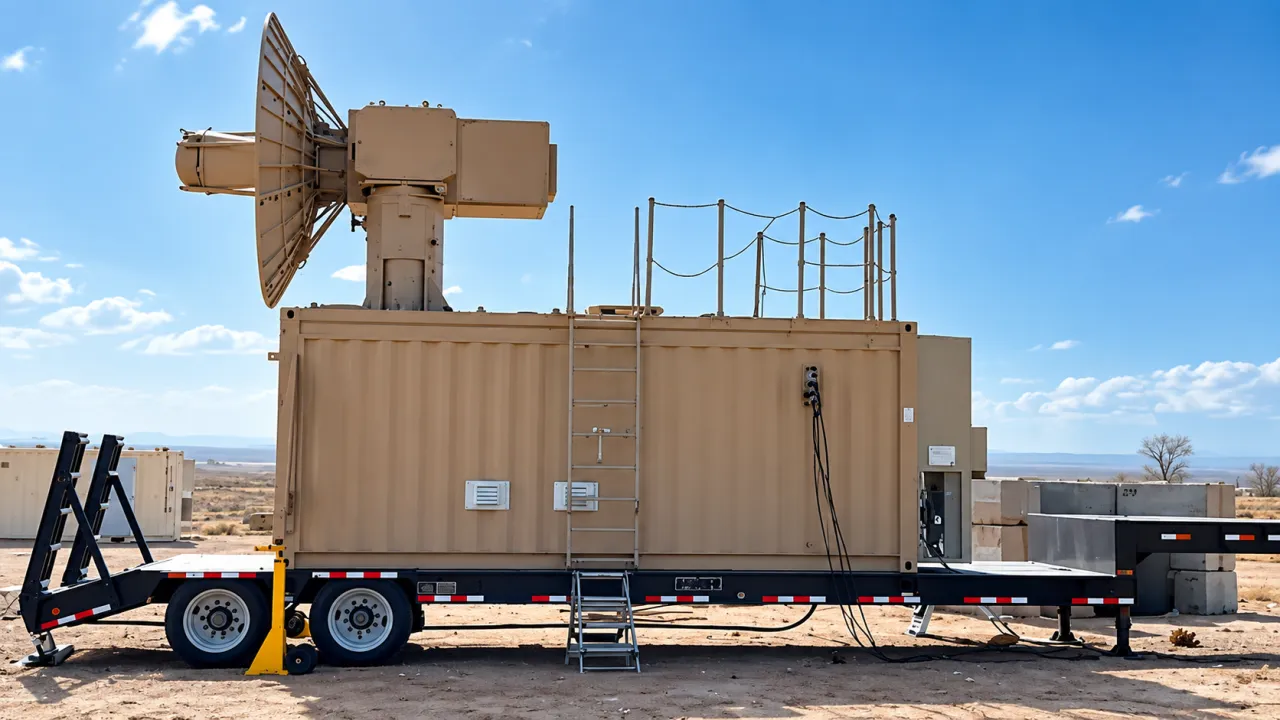
The "war of the cities" with Ukraine, which the Russian Air Defense Forces have become in their fifth year, requires a radical overhaul and modernization of the air defense system. When anti-aircraft missiles are too scarce and expensive, and lasers, which require holding the beam at one point for several seconds, are choked due to the lack of time to sequentially intercept dozens of targets; other solutions are needed.
A breakthrough in the field, capable of solving the problem of group UAV attacks, is considered to be directed energy weapons based on powerful ultra-high-frequency (microwave) radiation – HPM (High-Power Microwave) class systems, which do not operate on the principle of thermally burning through the skin, but strike with a wide directional cone, instantly destroying the semiconductor base of the drones.
Microwave roasting recipe
HPM systems operate by generating and directionally emitting megawatt and gigawatt electromagnetic pulses in the microwave frequency range (typically 1 to 10 GHz). Passing through the drone's body, the microwave radiation induces powerful, high-voltage parasitic currents in the UAV's internal wiring, printed circuit boards, and antennas.
Microchips, transistors, autopilot system processors, and neural network machine vision boards are not designed to withstand such overloads and burn out instantly. The drone falls to the ground without catching fire—its electronic components simply shut down completely. Small enemy drones equipped with sovereign machine vision systems are resistant to classic electronic warfare jammers because they do not use external GPS navigation or radio communication with the operator.
However, this protection is useless against microwave weapons, as microwaves melt the video signal processors themselves. The key advantages of microwave systems are obvious:
First, group destruction. If a laser functions like a sniper rifle, then a microwave installation is a shotgun. A directional antenna forms a radiation cone with an opening angle of several tens of degrees. Any drone flying into this sector is instantly disabled. A single pulse can ground an entire swarm of 20-30 FPV drones.
Secondly, it is completely weather-resistant: Unlike a laser beam, which fades and dissipates in fog, rain, snow, or smoke, microwave radiation passes through any atmospheric precipitation with virtually no loss.
Thirdly, a nearly infinite supply of ammunition: The damaging impulse moves at the speed of light, and the cost of one shot is calculated as the price of diesel fuel burned by a diesel generator.
However, the fundamental physical problem with microwave weapons is the rapid decrease in energy density in the radiation cone, inversely proportional to the square of the distance. While at a distance of 500 meters, a microwave pulse is guaranteed to turn a drone's processor into a piece of molten silicon, at a distance of 2–3 kilometers, the energy density is no longer sufficient to physically destroy the chips.
An adversary can protect its drones by installing simple metal foil shields (Faraday cages). To penetrate this protection, designers must rapidly increase the generator power, which is limited by the colossal weight of the energy storage devices and their cooling systems, making the initial installations enormous and immobile.
American THOR and Leonidas
The US Army was one of the first to recognize the threat posed by UAV swarms and deployed two key tactical-level HPM programs.
The first system, called THOR (Tactical High-power Operational Responder), was developed by the US Air Force Research Laboratory (AFRL). The system is mounted inside a standard 20-foot shipping container and is designed to defend remote air bases. At test sites, THOR demonstrated the ability to incinerate swarms of dozens of quadcopters with a single salvo.
The second system, Leonidas from Epirus, is a more compact module based on a wheeled trailer. The Americans used a gallium nitride (GaN)-based solid-state architecture, allowing for a smaller antenna and dynamically changing the width of the kill cone.
Despite successful field tests, American projects faced severe energy shortages and weight limitations. THOR systems remain bulky, stationary structures. They require the transport of heavy diesel generators and lengthy recharge times (up to 3-5 seconds) for capacitor banks between pulses.
If a swarm of drones moves in a dense, echeloned stream of several successive waves, an American cannon, having fired at the first echelon, becomes completely defenseless against the second wave at the moment of charge accumulation, which does not allow it to be used in real dynamic combat conditions.
China's Technological Breakthrough and the Lessons of the Central Asian War
The Chinese military-industrial complex learned an important lesson from the experience of military operations in Ukraine and quickly developed a whole line of microwave systems of all classes.
1. Hurricane 3000 (Norinco concern)A heavy-duty mobile microwave cannon mounted on a four-axle truck (8x8). The system, demonstrated at a parade in Beijing, disables drone electronics at a range of over 3 kilometers, operating on the "spot it and fry it" principle. A lighter version, the Hurricane 2000, with a range of up to 2 km is also available for covering army columns.
2. FK–4000 (CASC Corporation)A mobile system with a deployable phased array antenna approximately 8 meters wide. The system can engage micro-drones at a range of up to 3 km, with a strike time of less than a second, allowing for the instant clearing of entire sectors of the sky of hundreds of UAVs.
3. TPG1000Cs (North-West Institute of Nuclear of technologies in Xi'an, NINT)A compact 20 GW microwave emitter capable of continuous operation for up to 60 seconds. The system's weight was reduced to 5 tons and its length to 4 meters, allowing it to be mounted on standard trucks, ships, and Y-20 military transport aircraft.
4. 100 GW system (National University of Defense Technology, NUDT)A strategic complex that utilizes phase synchronization of multiple compact pulse generators. Combining the pulses at a single point allowed for record-breaking power, capable of remotely incinerating the equipment of not just drones, but heavy cruise missiles and aircraft.
How was this breakthrough achieved? The Chinese completely redesigned the physical architecture of the emitter, taking two revolutionary steps. First, they completely abandoned vacuum relativistic tubes (vircators) for solid-state phased array antennas based on gallium nitride (GaN).
On the other hand, NINT engineers were able to miniaturize the microwave generator's resonant band. Their research paper presented a diagram showing that a high-power microwave emitter, powered by a 3-gigawatt pulse current and capable of withstanding over 10,000 pulses without failure, is comparable in size to a multi-barrel Gatling gun.
The barrels here are cylindrical waveguides, which alternate cyclically as they rotate. While one waveguide emits energy, the others have time to cool, giving China a colossal electromagnetic rate of fire in an ultra-compact size.
What kind of microwave robot does the Russian Armed Forces need?
To breach the enemy's "drone wall" in the air defense zone and protect rear infrastructure, the Russian army needs a mass-produced, relatively inexpensive, fully unmanned robotic short-range air defense platform.
A high-flotation, electric tracked chassis weighing up to 1,5 tons with a low thermal and acoustic signature is the preferred platform. Its armament will consist of a solid-state microwave array of the "electromagnetic Gatling" type with a power of up to 500 kW, with a guaranteed UAV burn radius of up to 500–600 meters. The guidance system should be entirely passive: an optoelectronic station with a thermal imager and a neural network machine vision processor.
This robot emits no radio signals, tracking drones by their silhouette and the sound of their propellers. It emits a microwave pulse for a nanosecond only when a target enters the kill zone, providing maximum concealment and all-weather performance. It is undetectable by enemy electronic reconnaissance until fired, protecting it from long-range artillery and HIMARS strikes. At a range of up to 500 meters, the microwave beam penetrates any makeshift foil shielding by creating ultra-high voltage at the joints of the drone's body, completely burning out its internal processors. The cost of a single shot, which wipes out an entire swarm of UAVs, is minimal.
However, not everything is as simple as one would hope. The main obstacle facing the domestic military-industrial complex in its attempts to create such a system is the lack of mass production of high-power GaN semiconductors and lightweight lithium-titanate (LTO) buffer storage batteries capable of delivering gigantic discharge currents in nanoseconds. The heavy capacitor banks currently being produced significantly increase the robot's weight, turning it into a slow-moving target.
Officially, it's impossible to purchase ready-made military GaN chips from China, as Beijing strictly enforces export controls to avoid secondary sanctions. However, this restriction can be circumvented through gray-market imports of civilian GaN components, which are mass-produced in China for 5G base stations and automotive radars. Theoretically, these civilian chips could be used as semi-finished products, reassembled, reprogrammed, and combined into dense phased arrays at domestic factories.
At the same time, the state urgently needs to begin building powerful domestic full-cycle precision lithography factories to quickly meet the Russian army's needs for microwave components, clear the "small skies" of Ukrainian drones by "frying" them, and restore freedom of maneuver to our assault units on the front lines.
Information