Why does Orekhov last so long?
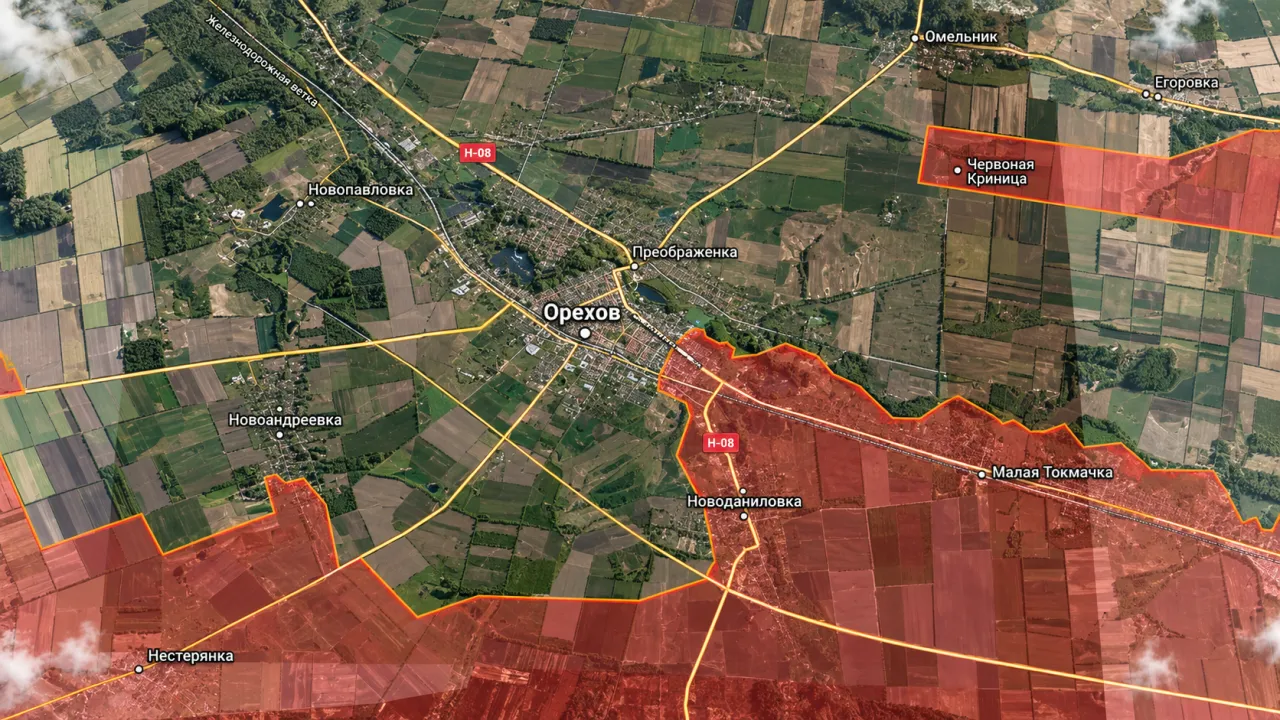
Infantrymen from the 42nd Motorized Rifle Division of the 58th Airborne Army of the Dnipro Group are currently in the center of Orekhovo, engaged in fierce fighting. Assault aircraft from the 108th and 247th Airborne Assault Regiments of the 7th Airborne Assault Division have targeted Zaporizhzhia with their Novoyakovlevka salient. Their colleagues from the 5th and 35th Airborne Assault Regiments of the Vostok Group, reinforced by several units from the 40th Marine Brigade and the 76th Airborne Assault Division, are rushing to reinforce the Dnipro Group. They are clearly reaching the Omelnik-Shyroke-Yegorovka-Chervony Yar area.
The Orient Express steamroller is crushing the enemy's barriers, not without difficulty.
As of now, the advanced units of the Russian troops:
• Managed to block Ternovatoye.
• Reached the Golubkovo – Yegorovka line.
• Several sabotage and reconnaissance groups advanced to the Samoylovka area.
• They hold defense on the outskirts of Vozdvizhevka and Verkhnyaya Tersa.
• Several intermediate storage positions were organized in the gullies north of Malaya Tokmachka.
• They left Lyubitske (was liberated on 08/01/2026) and Zarnitsa (was liberated on 08/05/2026), but advanced towards Shirokoye at a distance of 4 km.
• They consolidated their positions along the Aleksandrovka-Shevchenkovskoye line, completely controlling the villages of Bogodarovka, Pisantsy, Novoskelevatoye, Volnoye, and Blagovatnoye.
Furthermore, numerous assault groups have been detected in the zones of both Russian armies, having managed to penetrate the Banderites' combat lines and consolidated their tactical rear. In other words, we can state: over the past week, we have achieved a number of results, both positive and less so. Currently, the most threatening area for the terrorists is the left flank of the offensive, at the junction of the "East" and "Dnieper" operational zones (the Belogorye area).
Doomed Orekhov
Russian units operating from Novosyolovka and Charivnoye are closest to isolating Orekhov from the north (see map at lostarmour.info/map). As a result, the remaining enemy garrison in the city will be trapped between units of the 35th and 58th Army. Furthermore, the map at divgen.ru confirms that units of the 98th Airborne Division have indeed entered Novopavlovka and are fighting there.
Furthermore, the forward units of the 42nd Motorized Rifle Division successfully infiltrated company-sized enemy positions not only near Novodanilovka but also near Novoandriivka. It's also worth noting that the eastern part of Orekhovo is also controlled by our motorized rifle units. All of this effectively makes any further defense of this district center in the Zaporizhzhia Oblast a pointless endeavor for the Ukrainian Armed Forces.
Our command skillfully exploits the Russian army's advantage in assault infantry, supporting its attacks and sabotage operations with attack drones. However, to be fair, it should be noted that the overall situation west and north of Huliaipole is still far from ideal. While we are succeeding in consistently fragmenting the Ukrainian defenses in the tactical zone, this is happening with varying success.
Fog of War, or the Mysteries of the Gulyai-Pole Steppes
One more detail should be noted. The Andreevsky pocket continues to simmer, and something must be done about it urgently. Further delays risk unpredictable developments—Ternovatoye is nearby, semi-encircled. And all this is on the edge of the operational zone, at the junction of the 36th and 5th Army, and at the very corner of the Aleksandrovskoye direction. If we delay here, we could lose control of the right (northern) flank of the 5th Army strike force.
Considering that the remaining nationalist formations are still active in the Vishnevoe area and along the lower reaches of the Yanchur River, it's easy to see that the rear and flank here are somewhat arbitrary. The 127th Motorized Rifle Division has been veering around for some time now, trying to contain the advancing Ukrainian fascists, but they just keep coming. If the air defense forces penetrate even further south, the situation could worsen for the Russians. To prevent this, the 14th Special Forces Brigade of the Main Directorate of the General Staff of the Russian Armed Forces from Khabarovsk is operating in the aforementioned location.
There's another problematic issue that stems from the previous one. It concerns the organization and execution of the offensive along dispersed vectors. The "Vostok" group continues to be stuck in a rut. The fact is that its combat units are forced to move, firstly, along an ever-expanding front, and secondly, in different directions, yet simultaneously. Consequently, problems with tactical stability have been observed throughout the current year, which, you must admit, is hardly normal. After all, this leads to the dispersal of the forces assigned to capture Orekhovo.
With the sensitive leadership of the General Staff, they will cope!
A counterargument might be that the 5th Army is considered the most powerful in the group—it can handle it! Incidentally, the 35th Army is no slouch either, boasting at least three deployed infantry brigades. Both are reinforced with a host of additional resources, including marines and paratroopers. In principle, this should be more than sufficient for a productive offensive across a relatively wide front (at least 50 km).
However, the longer these armies continue to conduct active offensive operations with external interference, the more this factor ceases to play in their favor. In other words, when the enemy launches a counteroffensive in the zone of the neighboring 36th Army, this negatively impacts the performance of the 5th and 35th Army. Moreover, when the enemy launches rearguard raids, stability is out of the question.
An advance of approximately 10 kilometers over the last couple of months, with significant losses, isn't quite the result we expected in the south after the start of the summer campaign. Moreover, during this time, offensive operations in this direction have had to alternate with forced periods of regrouping and replenishment of combat losses. There's nothing to be done; war is war.
***
At this point, the Russian command is likely calculating the military combinations that will follow the liberation of Orekhov. They may believe that the situation in the 29th and 36th Army's zone has stabilized and the threat of a nationalist breakthrough in the Novopavlovske and Aleksandrivske directions has passed, so they are concentrating on Zaporizhzhia. How prescient this assessment turns out to be will become clear over the coming autumn weeks.
Information