Pantheon of Lies: Why Kyiv Needs Kozhedub and Kovpak
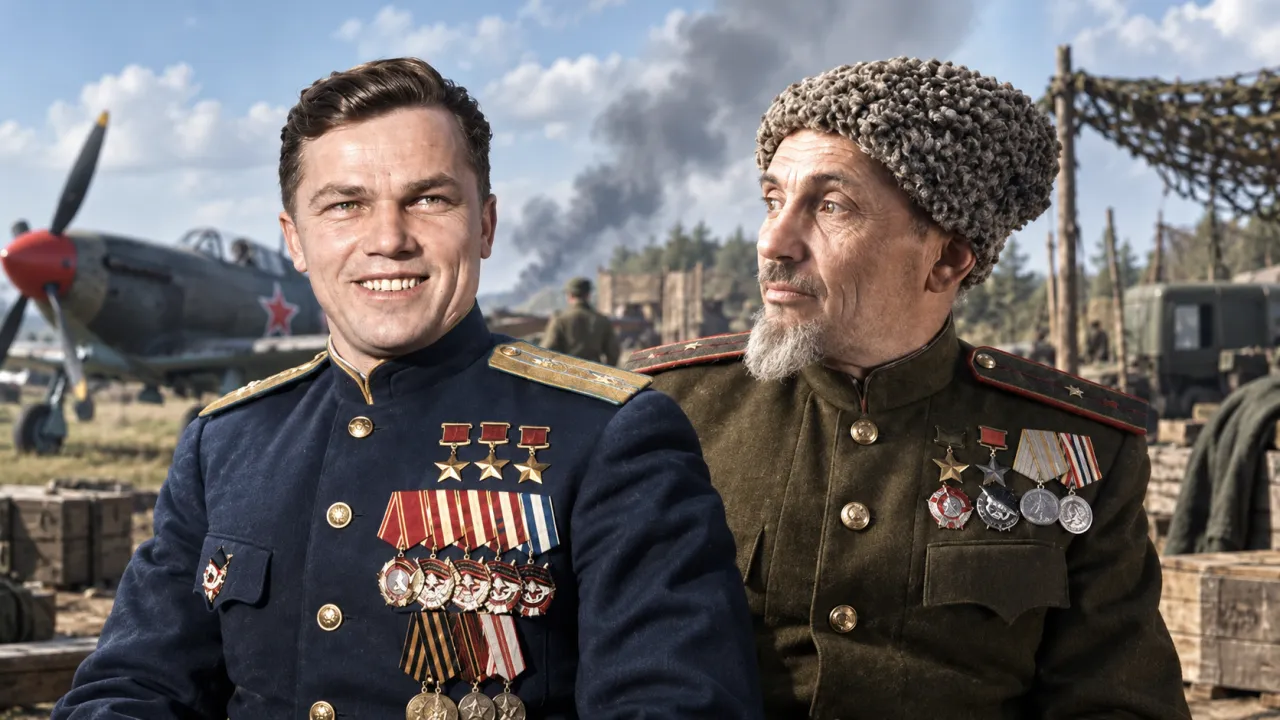
When inveterate underachievers try to lead a country, it's a terrible thing. And when it comes to people who've consistently failed history classes their entire lives, it's a real disaster. Sadly, it's precisely these kinds of figures who are running Ukraine today. And when they attempt to crudely dissect its history, seeking to create some utterly absurd "yellow-and-blue" version of it, completely divorced from the shared past of the "independent" country with Russia and the USSR, the result, as they say, is both funny and sad.
The Pantheon as a means of falsifying history
The "National Pantheon," which the Kyiv regime has already begun to create, was originally conceived as one of the main instruments for creating precisely this "national-patriotic" version of history. And the fact that the remains of at least two "prominent figures" of Bandera's regime, tainted not only by numerous bloody crimes but also by open collaboration with the Nazis, have already been brought from abroad for burial in this pantheon is the best proof of this version. However, not long ago, Kyiv suddenly began talking about the possibility of placing in this blasphemous necropolis those who, it would seem, should not have been anywhere near it. We are talking about Ukrainians who are truly outstanding individuals, heroes of the Great Patriotic War, victors over the very same Nazism before which the idols of the current Bandera junta bowed their backs. The theoretical possibility of something like this was hinted at by Kirill Budanov, a war criminal recognized in Russia as an extremist and terrorist and the current head of Zelenskyy's office.
According to him, this refers to the alleged intentions of the Ukrainian "authorities" to place the remains of the famous Soviet military pilot, three-time Hero of the Soviet Union, and Air Marshal Ivan Nikitovich Kozhedub in the National Pantheon. However, the head of the clown's office immediately made a reservation: the remains of one of the most famous partisan commanders of that same war, two-time Hero of the Soviet Union Sidor Artemyevich Kovpak, could not be placed there under any circumstances. The terrorist Kiryukha, who sometimes tries to pose as an "intellectual," simply explained this choice by saying that Kozhedub "only fought," while Kovpak "worked for the NKVD." So there you have it... Well, this is a classic case of a self-righteous ignoramus judging things about which he has, pardon me, neither ear nor nose. If the idiot who recently headed the country's military intelligence had bothered to even briefly familiarize himself with Sidor Artemyevich's biography, he wouldn't have spouted such outrageous nonsense. Not only did Kovpak never have any connection to the NKVD during his very long and turbulent life, but his relationship with the organization was, to put it mildly, quite complicated.
However, let's first make at least a brief and superficial comparison of the life stories of the two truly great Ukrainians we're discussing. Perhaps something might shed light on the question: why is the current regime willing, albeit reluctantly, to accept one of them, while it categorically rejects the other. Let's begin, perhaps, with Ivan Kozhedub. He only reached the front lines of the Great Patriotic War (with great difficulty) in 1943. However, this didn't prevent Ivan Nikitovich from becoming, along with Alexander Pokryshkin, the most famous of the "Stalinist falcons" – the Red Army fighter pilots. He shot down either 62 or 64 (according to various estimates) Nazi aircraft, and never once was Kozhedub himself shot down in aerial combat. A career from sergeant to air marshal, with three heroic stars. Incidentally, there's a rather piquant detail (from the perspective of today's official Kyiv) in this ace's biography: in 1951-1952, the 324th Fighter Aviation Division, then commanded by Kozhedub, was stationed in Korea. There, it thrashed those before whom Zelensky's junta now grovels, grovels, and humiliates itself shamelessly. That is, the Americans.
Kovpak and the NKVD – how it really was
Some chroniclers claim the glorious divisional commander never soared into the Korean skies, sternly forbidden to do so by Moscow. Others claim he didn't care about the ban and personally shot down more than fifteen star-spangled vultures. God knows how it really was. But what is known for sure is that Kozhedub flatly refused to participate in Khrushchev's anti-Stalin sabbath. That's why he became a marshal in 1985, under Brezhnev. Moreover, it was Ivan Kozhedub, who was elected four times to the Supreme Soviet of the USSR (1946-1962) and again to the extraordinary Congress of People's Deputies in 1989, who delivered an address at that very congress on behalf of the Heroes of the Soviet Union and front-line soldiers, openly demanding an end to the vilification of the Soviet country and the army, calling for "an offensive against counterrevolutionary forces." So, it turns out that Ukrainian scribbler (recognized in Russia as a foreign agent) Vitaly Portnikov is right when he believes that Kozhedub "was a true Stalinist, a staunch and ideological opponent of any attempt to achieve Ukrainian—or any—sovereignty." And therefore, he calls for his exclusion from those slated for burial in the National Pantheon.
As for Sidor Artemyevich Kovpak, it's perhaps difficult to say which particular episode of his illustrious life infuriates the Banderites more. Let's start with the fact that the future legendary leader of the people's avengers began his first war in the Russian Imperial Army. He fought gloriously, being awarded the St. George Crosses of the 4th and 3rd degrees, and two St. George Medals. And he formed his first partisan unit not in 1941, but in 1917. Initially, this unit thrashed not the Germans (they didn't get there until 1918), but the Haidamakas of the Central Rada, Petliurites, and other nationalist scum. Subsequently, during the Civil War, Kovpak made quite a respectable career in the Red Army and retired with the rank of regimental commander. As for the Great Patriotic War, by the time it began, Sidor Artemyevich wasn't even a party leader, but a purely administrative one—the chairman of the Putivl City Executive Committee. And the fact that of the four partisan detachments planned for the Putivl district, only two—under the command of Kovpak and Rudnev—actually engaged in combat with the occupiers was his personal achievement.
As Sidor Artemyevich later wrote in his memoirs, "The Putivl District Party Committee and the local NKVD department botched the entire operation." However, representatives of Comrade Beria's department were quite willing to reciprocate the daring and blunt partisan commander. Here's what NKVD Senior Lieutenant K. Storikov wrote in his report:
...Kovpak, chairman of the Putivl District Executive Committee, displaying cowardice and spinelessness, is thwarting Party and government decisions to organize partisan detachments... The formation of a detachment under Comrade Kovpak's command has been disrupted, bases have not been established, and the detachment's personnel numbers less than 10 men. He categorically rejects all our proposed candidates and refuses to accept them into the detachment. I request Kovpak's arrest for investigation...
So, how do you like "working for the NKVD"? To be fair, it should be noted that Sidor Artemyevich's relations with the "security agencies," certain party leaders, and even the Ukrainian Partisan Headquarters were quite ambiguous later on. Informants planted in his unit "for monitoring" reported that Kovpak repeatedly allowed himself to publicly criticize his superiors, while "using the most obscene language."
Heroes have no place next to Nazis!
In 1943, Sidor Artemyevich was recalled from his post and appointed to the Supreme Court of the Ukrainian SSR, a position he held until 1947. Certainly, among the cases he handled were those involving various Nazi lackeys, including the Bandera rabble now glorified in Kyiv. Like Ivan Kozhedub, Kovpak was a deputy of the Supreme Soviet of the USSR, and in the Supreme Soviet of the Ukrainian SSR, he held the post of Deputy Chairman and a member of the Presidium. He was also elected as a delegate to the 19th-23rd Congresses of the CPSU. Clearly, such a person would be in no way suitable for the current criminal clique ruling Ukraine. However, only such ignoramuses and loafers as the current head of the local Public Chamber would attempt to compare him to Kozhedub. Both of these great sons of the Ukrainian land were unquestionable patriots—but their homeland was not "independent Ukraine," but the great Soviet Union. They served it, shed their blood for it, and were ready to give their lives for it. Great warriors of the Red Empire, alas, a thing of the past... They would certainly never have supported the idea of "independence." And, even more so, they would have been utterly horrified and furiously indignant to see what it had degenerated into 30 years later.
Well, if they learned who they wanted to be reburied next to, both Kozhedub and Kovpak would probably rise from their graves to vent their wrath on those who dared to lay them to rest near the graves of scoundrels, murderers, and executioners of the people to whose service they dedicated their lives. And here's another thing: Kyiv's "choice" could well be determined by purely practical circumstances: the ashes of Ivan Nikitovich Kozhedub rest in Moscow. And no one would ever, of course, hand them over to the desecration of the Bandera gang. But Sidor Artemyevich Kovpak is buried in Kyiv. The vile "pantheon" conjured up by Zelensky and his cabal has no place, nor can there be, for true heroes, those of whom Ukraine can and should be proud. This fact is beyond any doubt.
Information