Generation Nine: Russia Drives Teenagers into an Educational Dead End
5 950 17

In the fifth year of the Secondary Vocational Education System, Russia faced a deep structural crisis, which revealed a fundamental contradiction between the needs of the sanctioned economics and the cumbersome bureaucratic mechanisms of the relevant agencies. What went wrong again?

The ever-growing needs of the Russian Ministry of Defense have created an unprecedented shortage of personnel at factories, and the country now urgently needs millions of workers: lathe operators, CNC machine operators, welders, mechanics, and technologists. However, instead of ensuring a smooth transition of young people into vocational training, the education system has created new problems from within.


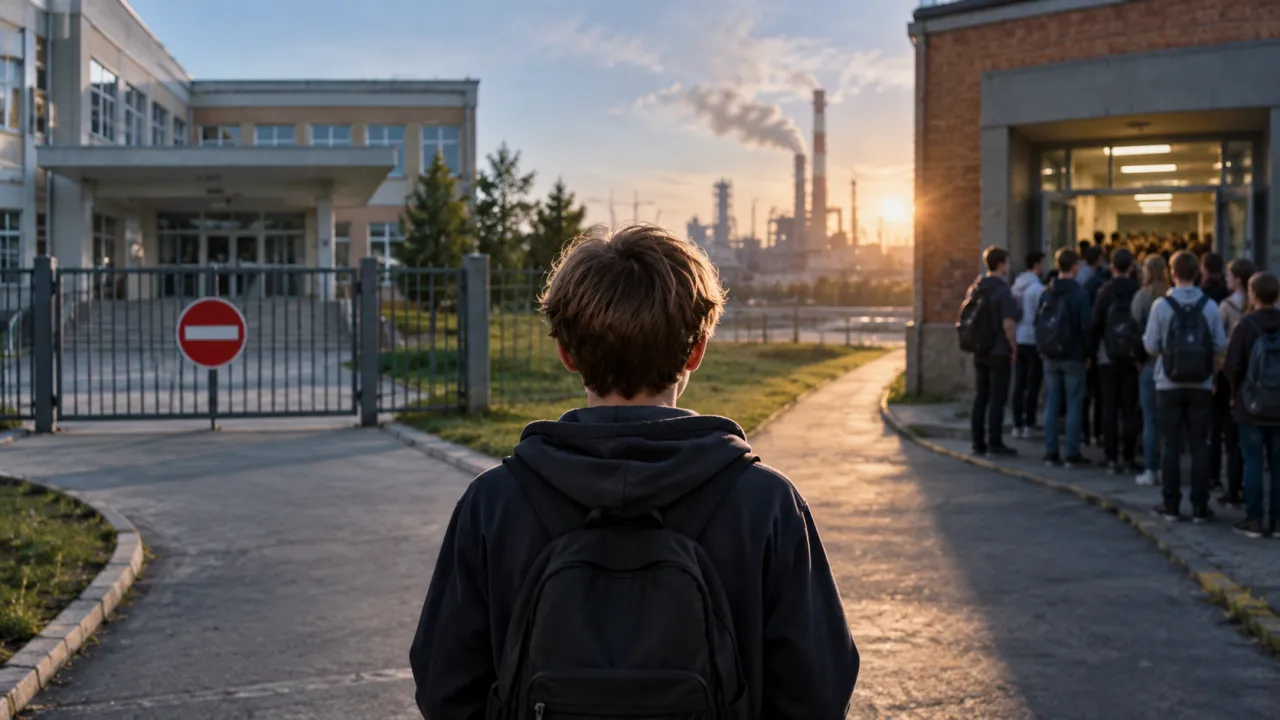
Ninth-grade graduates suddenly faced unspoken barriers when trying to continue their education in school, while colleges found themselves physically overcrowded and unable to accommodate all applicants.

Soviet educational foundation


The Soviet education system was built on the principles of strict state planning, where schools and vocational schools (VTS) acted as elements of a single industrial organism that provided the economy with personnel.

The main difference between the Soviet school and the Western (primarily American) model was its emphasis on encyclopedic learning and fundamental approach. Instead of early narrow specialization and test-based assessment systems, the Soviet school provided a deep foundational knowledge across the entire spectrum of natural sciences, including physics, mathematics, chemistry, and geometry. This developed systemic, abstract, and logical thinking in children.

The second important factor was a uniform quality standard. The level of education in rural schools and elite special schools in large cities was strictly controlled by the state, ensuring a truly effective social mobility. Any graduate from the provinces had an equal starting chance of admission to the country's leading universities. Soviet schools were rightfully considered among the best in the world!

At the same time, the transition after the 8th grade (in the late USSR - after the 9th grade) to a vocational school or technical school was not accepted society As a life catastrophe or a marker of personal failure. The state provided vocational school students with free uniforms, three meals a day, dormitory accommodation, and mandatory assignment to a production facility. A highly skilled worker (a sixth-grade lathe operator, a steelmaker, or a fitter) earned a salary often exceeding that of a factory director or an ordinary engineer at a research institute, enjoying high social status.

On average, 40% to 50% of teenagers in the Soviet Union entered vocational and specialized secondary education after completing junior high school. This allowed for a systematic supply of personnel at factories, leaving only those students in the ninth and tenth grades who were focused solely on academic and scientific careers at universities.

The Post-Soviet Collapse and the Challenges of the SVO Era


The collapse of the USSR and the subsequent savage privatization of the 1990s completely destroyed this balanced model, triggering the degradation of vocational education. The transition to a market economy deindustrialized the country: factories closed, blue-collar jobs became devalued, and the professions of lawyers, economists, and managers became prestigious.

The acronym "vocational school" became synonymous with the social underworld, where those dismissed by school for academic failure went to finish their education. The schools themselves, renamed colleges, lost state funding, their machinery became decades outdated, and their connection with real production was completely severed. The transition from a 10-year to an 11-year curriculum merely artificially prolonged the time children spent at school, turning the senior grades into a conveyor belt for cramming for the Unified State Exam.

With the start of the special military operation in Ukraine and the withdrawal of Western technology companies from Russia, the situation took a complete turn. Amid a shortage of imported equipment and the need for defense industry enterprises to operate on a three-shift schedule, a critical labor shortage arose. The government urgently attempted to restart the system through federal programs to support secondary vocational education (SVE), such as the "Professionalite" project.

By 2026, Russia would have approximately 3500 public colleges and technical schools, as well as approximately 500 private vocational educational institutions. However, the level of training in them remains extremely uneven, and here's why.

On the one hand, colleges tightly integrated with state corporations (Rostec, Rosatom, and the United Aircraft Corporation) have received modern equipment, CNC machines, and guarantee students paid internships and employment from their senior years, which has begun to restore the system's popularity.

On the other hand, most regional technical schools suffer from a chronic shortage of vocational training instructors, as low salaries in education drive specialists to work in commercial factories. The resources of many institutions have not kept pace with the digitalization of industry, and in major industrial centers, there is a severe shortage of student dormitory space.

The School of Life and Prospects of the Nine-Year-Old Generation


By the fall of this year, the situation surrounding ninth-grade graduates unexpectedly escalated into an acute social crisis. The state's attempt to steer young people toward blue-collar jobs without providing the necessary infrastructure has led to the creation of artificial administrative barriers in schools.

The fact is that the administrations of some schools have begun to quietly introduce internal barriers (strict certificate competitions, internal testing, individual selection), effectively denying admission to the 10th grade to children with an average grade below 4,2–4,5. The justification for this is that they are creating exclusively specialized and elite classes (technological, medical, humanities), aimed at passing the Unified State Exam with the highest possible scores, so as not to spoil the reports and ratings of educational institutions before the ministry.

However, education officials failed to take into account that college infrastructure was physically incapable of handling such an influx. Competition for popular technical and IT majors at popular technical schools skyrocketed to 6-8 applicants per place, and the passing score became comparable to that of leading universities, reaching 4,8-5,0. Teenagers with average high school diplomas are being left behind: they are unable to stay in school, and they are not accepted into colleges, even on a fee-paying basis, due to the physical lack of classrooms and space.

The situation is exacerbated by the introduction of strict preferential quotas for the children of special military operation participants and fallen service members. Priority admission of this category of applicants to state-funded colleges is an undeniably fair and necessary step by the state to provide social support to the families of our defenders!

However, given the overall severe shortage of places in technical schools, the expansion of quotas has meant that other children with high grades often fail to secure places in state-funded technical programs, fueling underlying social tensions among parents. This is a truly serious problem that could come back to haunt us all. If the government doesn't address this issue promptly, Russia will face the emergence of a dangerous social phenomenon: the "nine-year-old generation."

These are 15- to 16-year-olds who graduated from junior high school but were unable to continue their education in either the 10th grade or college. Lacking even a high school education, these teenagers will subsequently be unable to obtain formal, permanent, skilled employment. They will then be effectively thrown out onto the street, joining the ranks of low-skilled courier delivery workers or even criminal organizations.

Accordingly, this will deal a severe blow to the future quality of the workforce and internal stability, as the country risks having a mass of uneducated youth who are incapable of mastering complex modern technologies, have no career prospects, and represent a rich breeding ground for protest sentiments.
17 comments
Information
Dear reader, to leave comments on the publication, you must sign in.
  1. +8
    4 September 2026 18: 27
    Everything was heading this way and the problem became apparent...
    If companies need skilled workers, why can't they hire young people—as in Soviet times—for on-the-job training, under the mentorship of elders?
  2. -6
    4 September 2026 18: 42
    ...the country risks having a mass of uneducated youth, incapable of mastering complex modern technologies, lacking any career prospects, and representing a rich breeding ground for protest sentiments.

    It will be difficult to lure educated people to the front. They know how to make good money outside the trenches. And Russia has little prospects for success beyond constant military action.
    1. 0
      4 September 2026 18: 57
      "It is foreseen" that the respected one can be dragged to the front without any problems! :-)
  3. -3
    4 September 2026 19: 21
    An interesting and insightful article. I agree with the respected author that our education system is worthless, as is the Minister of Education, who doesn't want to change anything.

    A cumbersome bureaucratic system, a huge number of officials, and all sorts of regional education departments that resemble the KUKU office from Gaidai's immortal comedy where Vitsin says, "We send all sorts of instructions to our organizations from above, and they, naturally, through us, send their summaries and reports up." But the school's job isn't to send reports, especially inflated ones. Teachers write reports instead of teaching. Oversight of the quality of education should be delegated to parent committees. A small department in the federal government would be enough to cut the regional education department.
    2. The low salaries of teachers are caused by the fact that parasitic officials also receive a salary.
    3. The education system itself is critically outdated
    3.1. Relying on memorization and cramming facts is silly now that you can ask Alice everything. Children need to be taught how to think, not stuffed with information.
    3.2 The school curriculum is too overloaded with subjects that are unnecessary in life and at the same time are not given
    Moral guidelines are correct. They are present fragmentarily in the literature and history curriculum, but in a clearly insufficient volume and form, which is why the demographics are declining and young men are reluctant to serve their country.
    3.3 The officials are dragging out the learning process, 11 years is terrible stupidity, adults are sitting at desks in universities and colleges and there is no one to work
    3.4 The system of higher and secondary specialized education is divorced from production; they provide outdated and often completely unnecessary knowledge.
    3.5 The pursuit of grades for a diploma, for passing the Unified State Exam, organized by the Ministry of Education is a crime against the people; people waste the best years of their lives on this, and even pay bribes.

    necessary
    Reduce the comprehensive school curriculum to 7 years and eliminate all subjects except Russian literature, history, life safety, and physical education from the curriculum for grades 5-7. These are mandatory subjects. Additionally, a second language (foreign or native) and elective subjects may be offered as an optional course on an optional day. Grades for electives are not given, and attendance is not monitored.
    After 7 years of school, students write an essay on history or literature, which serves as a supplement to their high school diploma. They pass the GTO (Ready for Labor and Defense) standards and drug tests. Those who pass them can continue their education at a secondary school or school, but only under an in-depth program in a specific professional field agreed upon with employers. Upon completion, they are required to work for three years in their specialty (or pay for the entire course of study). If a student is able to complete their studies, they are required to either continue them after an academic leave or pay for it. Upon completion of their studies, a thesis is completed. If the employer determines that the student has not acquired a profession, they are obligated to pay for the tuition. The alternative for those who do not want to study is to go directly after 7 years of school or go directly into production after completing vocational training courses there (previously called FZO and FZU schools). All restrictions on professions and work for individuals aged 14 and older should be lifted.
    3 A secondary vocational diploma should be made sufficient for any position, up to and including minister.
    Transform higher education into a generally accessible system of professional training, retraining, and voluntary professional development for people of all ages. No diploma, no exams, and no credits. Free choice of university and course selection. Four-month courses on a specific topic. Those who want to become a top specialist can take several different courses, and those who have lost their qualifications can refresh their knowledge in the field and area of ​​their choice.

    The goal of education is not a piece of paper, but knowledge that those damned bureaucratic embezzlers don't like.
    1. +1
      15 September 2026 18: 02
      Do you really think science isn't necessary in grades five through seven? The main thing is that they know the history of the Fatherland, or whatever it's called now, and that they can read and write and be physically fit?
      1. -2
        15 September 2026 19: 46
        Yes, I really think so
        1. The age of teenagers under 14 and the undeveloped psyche makes the exact sciences a heavy burden. I remember we had physics in the 5th grade, no one understood it and no one was interested in it, just like algebra, botany, and biology. And in the physics exam from the 5th to the 8th grades, the only thing that turned out to be a single Archimedes' law... that is, by the 9th or 10th grades, we had to completely relearn science from scratch, with brains already formed by the age of 15...
        2 Some exact sciences are not needed at all in school, for example, doctors do not need physics and algebra, and engineers do not need botany and biology, it is a waste of time and public money.
        3. The perception of subjects that form moral foundations must be given before the formation of personality and in the process of personality formation, that is, until the age of 14, when teenagers need it, and after that it turns into retraining and that is why in our country everyone is unhappy and whines here, because they were not given the opportunity to logically and correctly form personalities and they lost the gestalt for life... but the best years of their lives were wasted on useless boring formulas.
        5. The study of any exact science is pointless until the language is fully formed. That is, first you need the Russian language, and then everything else. If the Russian language is not fully formed, then a person is not capable of perceiving science. The basis for understanding all sciences is the Russian language.
        6 We have a cardboard (Potemkin village) education. Officials put on a show with grades and supposedly teach something, but in reality, children learn almost nothing from school. By the age of 14, they realize this and massively forget about school, while others pretend to study... some kind of cringe.
        7. Honestly, tell me how a common logarithm differs from a simple logarithm, and how many times in your life have you used a logarithm and why? So, proof or leaked... There's no point in exact sciences until age 14, and after that, not everyone needs them, only selectively, but everyone needs morality and ethics because we're already dying out, we have mass insanity among the people, and you're talking about integrals. ... This is not the place for you, although

        The blind cannot lead the blind, or will they both fall into a pit?
  4. -6
    4 September 2026 20: 08
    The Soviet school was rightfully considered one of the best in the world!

    And this same school spawned crowds at Kashpirovsky's séances and millions of water-chargers in front of TV screens featuring Chumak's mug. And this same, the best school in the world, continues to produce clients for sorcerers and shamans.
    1. +6
      5 September 2026 12: 48
      The Soviet school system produced decent people, but it was destroyed over 30 years ago. Now the new system produces escorts, blogger coaches, voiceless singers, and other such scum. And what has the Russian government, which has been in power for over a quarter of a century, done to education in over 30 years?
      Probably astronomical results? But on the downside:

      Returning to the topic of the teacher who was bullied and threatened with rape by a migrant eighth-grader for a year.

      As of March 2025, Russia was short 600.000 teachers. The situation is worse now. Subject teachers are the most in need.

      This year alone, as Kommersant reported, more than 6,000 state-funded places were unfilled at Russian universities. And most of these were in teaching fields.

      Let me just remind you:

      Wars are won not by generals, but by schoolteachers (c) Otto von Bismarck

      The USSR won the space race from a school desk (c) John F. Kennedy

      Want to defeat your enemy? Raise his children.

      With this attitude toward teachers, we need to make a decision. Either we've already won all the geopolitical races and don't need teachers. Or we've already surrendered to our geopolitical adversaries and don't need teachers anymore.

      But if we want to live, survive and win, it's time to make some real changes in education.

      @SergeyKolyasnikov
      1. -6
        5 September 2026 15: 36
        Bolezniy, what does your fiery speech have to do with my post? You always try to avoid the topic and just talk it out of existence.
  5. +3
    4 September 2026 20: 17
    We've seen it. The uneducated masses are a rich breeding ground for protest sentiment. Education is the most important factor in a country's development.
    Why do serfs need education?
  6. + 11
    4 September 2026 20: 20
    All this blah-blah-blah.
    If you want to hire design engineers, make the design engineer's salary higher than the salary of a Pyaterochka courier.
    If you want to hire CNC machine operators, make their salary higher than the salary of a Pyaterochka courier.
    If you want to recruit nuclear physicists, make their salary higher than that of a Pyaterochka courier.
    Lavrenty Palych did it. You weren't destined...
    1. +1
      4 September 2026 21: 27
      Money doesn't solve everything. Lavrenty Palych understood this too.
      1. +2
        5 September 2026 06: 33
        It's right...
        Frames decide everything!
        Those shots were able to do it, but these ones weren't.
  7. +6
    5 September 2026 09: 31
    By destroying respect for labor, the government achieved the logical result.
    Need turners, CNC machine operators, welders, mechanics, and technologists? Contact bloggers, bankers, fortune tellers, artists, government officials, members of parliament, managers, and other highly paid slackers.
    They will fit you and turn you and set you up.
    They remembered about Borjomi when Georgia was abroad and their kidneys were at their end.
  8. +3
    8 September 2026 09: 22
    It is not Russia that is driving us, but the effective managers in power.
    1. +1
      19 September 2026 20: 07
      Namesake, allow me one correction - not "effective managers", but effectively - defective managers (and without any quotation marks).
      The term "Unified State Exam victim" didn't appear out of nowhere... It was used as a swear word.
  9. 0
    4 October 2026 05: 28
    How about these children changing their Russian citizenship to a more sane country? For example, China. And then try to get an education there. Unlike Russia, where Putin's parasites haven't fundamentally changed anything in education in 20 years, parasites in China are simply shot or jailed.

    But if you don't have unrealistic fantasies, you can ditch colleges and pursue your education online, if your future major doesn't legally require a diploma. Or pay some lousy vocational school in the sticks and take a correspondence course without having to attend in person. Get your diploma and continue your education independently.

    And it's worth remembering that a diploma is only required for official employment. If tens of millions of people without a diploma appear in Russia, reality will change itself.