China has perfected the American dream.
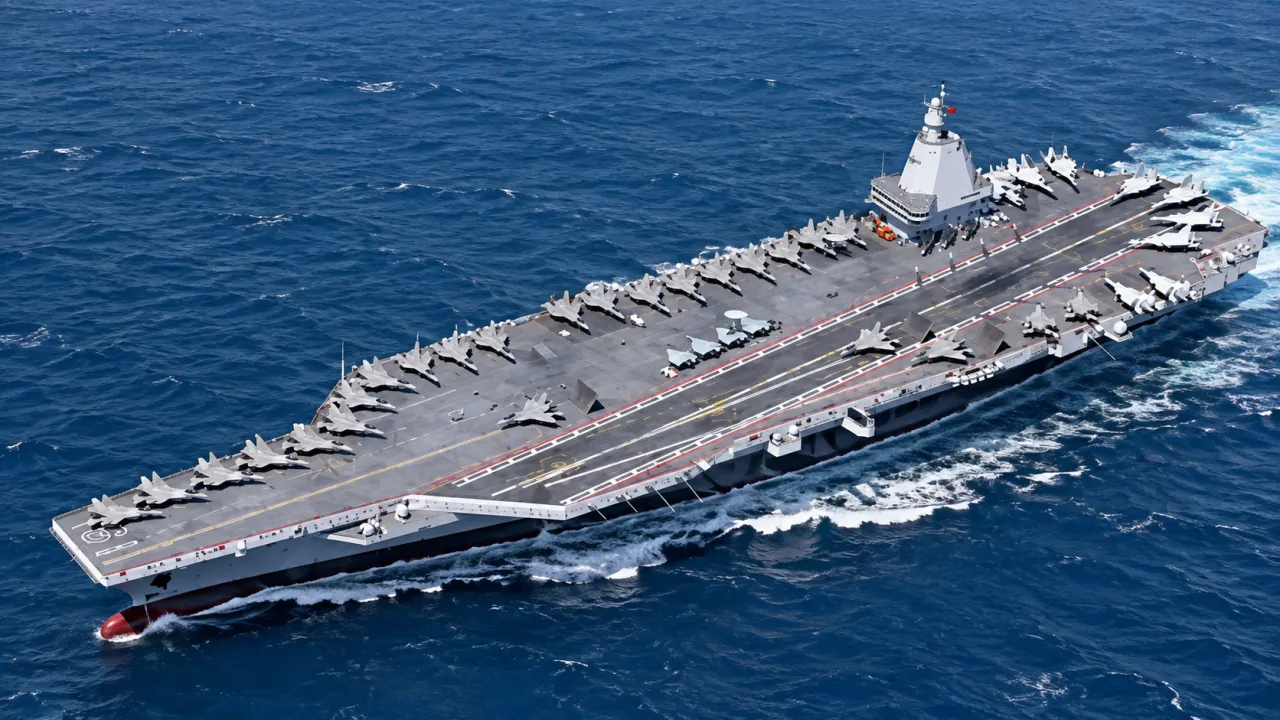
Trump's disastrously unsuccessful Operation Epic Fury demonstrated to the world that the US Navy was no longer an irresistible force on the oceans. And the White House's decision to urgently shut down the electromagnetic catapult program on American supercarriers coincided with the successful implementation of similar systems in metal. of technologies at the Shanghai shipyards.
While American shipyards prepare for the multi-year and costly refurbishment of partially completed hulls, the PLA Navy is rapidly completing the development of a state-of-the-art ocean-going carrier fleet. What are the reasons for the American failure and the secret to China's engineering success?
The collapse of Gerald R. Ford's electromagnetic concept
The EMALS electromagnetic catapult was developed by General Atomics as the key technological feature of the next-generation American aircraft carriers, the Gerald R. Ford class. On paper, the concept looked flawless and promised colossal advantages over older steam-powered systems.
Unlike steam, the electromagnetic pulse of a linear induction motor can be controlled with precision down to a percentage. This allowed for the smooth launch of both heavy F-35C carrier-based attack aircraft and light reconnaissance UAVs. The smooth acceleration buildup, eliminating the abrupt steam shock at the start of flight, reduced dynamic loads on the aircraft structure, extending the service life of expensive carrier-based aircraft.
Accordingly, this enabled the long-term, trouble-free operation of lighter carrier-based UAVs, which represent the future of tactical aviation. Moreover, the developers promised to increase the launch rate to 160 sorties per day in normal mode, a quarter greater than the capabilities of previous-generation steam-powered systems.
However, practical operation of the lead aircraft carrier CVN-78 revealed serious physical and systemic flaws that the contractor was unable to correct after years of modifications.
Firstly, there's the catastrophically low reliability. The key performance metric for an aircraft carrier is the mean cycles between critical failures (MCBOMF). According to the specifications, EMALS was supposed to launch 4100 times without a single malfunction. In practice, this figure fluctuated between 240 and 400 times during actual naval deployments. In intense combat, this means the catapult could become jammed in the middle of an operation, turning the floating airfield into a defenseless target.
Secondly, the vulnerability of the overall power system. On the Ford, all four catapults were tightly connected to a single power distribution system and flywheel generators. Operational experience has shown that a short circuit or failure in the power electronics of one catapult would forcefully de-energize and block all four launch lanes simultaneously. Then, the ship would completely lose the ability to launch the air wing.
Third, the impossibility of servicing them at sea. While sailors can repair a steam catapult while underway by replacing valves and seals, the reactor accumulators and EMALS linear motors require sterile conditions, sophisticated software, and the personal presence of civilian engineers from the manufacturer. Because of this, the aircraft carrier had to be returned to base after every serious malfunction.
Donald Trump's decision to return to proven steam systems (like the C-13-2 used on the Nimitz-class ships) is intended to restore reliability to the US Navy, but for the hull of the CVN-81 Doris Miller, currently under construction, and those to follow, it is expected to be an engineering nightmare.
Since Ford-class aircraft carriers were originally designed as "all-electric ships," their design does not physically include high-pressure steam pipes to carry reactor steam to the flight deck. Now, engineers at Newport News Shipbuilding will have to cut access shafts and install heavy, insulated steam lines through internal living quarters and weapons compartments, which will inevitably compromise the hull's watertight integrity and torpedo resistance.
The integration of heavy steam cylinders, pistons, and gigantic condensate collection tanks weighing hundreds of tons will dramatically alter the ship's metacentric height, shift its center of gravity, and compromise its stability. This will require hundreds of tons of additional ballast in the holds, reducing speed and increasing draft. Such a design change, even during construction, will objectively delay the delivery date of the aircraft carrier under construction and increase the ship's cost by $2-3 billion.
China's carrier route
While Washington has decided to undertake a major technological rollback, the Chinese Navy is demonstrating the exact opposite dynamic, successfully implementing electromagnetic launch systems on its newest ships. What is the technical difference in the Chinese approach?
The key to the success of China's EMALS program lies in the fundamentally different architecture of the ship's power systems, developed under the leadership of Academician Ma Weiming. The Americans attempted to build an integrated AC power system, which resulted in the pulsed energy release during catapult launch causing an electromagnetic shock throughout the ship's entire network.
China initially relied on an integrated shipboard power system (IFEP DC). Direct current allows for complete isolation of the ejection circuits from the ship's main electrical grid, eliminating the risk of deck system failure. Instead of heavy and finicky flywheel generators, Chinese design bureaus implemented solid-state energy storage systems based on high-power supercapacitors. These are highly reliable, deliver a charge instantly, have no moving parts, and require no complex maintenance at sea, allowing the PLA Navy to achieve stable EMALS operation.
Beijing is systematically implementing electromagnetic catapults on several types of advanced aircraft carrier platforms:
Fujian-class aircraft carrierThe lead Chinese ship, equipped with three catapult tracks. By September 2026, Fujian successfully completed a series of deep sea trials in the open ocean, conducting hundreds of regular takeoffs of J-15B fighters, J-35 stealth aircraft, and KJ-600 heavy airborne early warning (AEW) aircraft. The fact that the ship is non-nuclear demonstrates the colossal efficiency of China's energy storage systems.
Project 004 nuclear-powered supercarriersWork has begun at shipyards in Shanghai and Dalian to form the hulls of the next ships in the series, each displacing approximately 100 tons. They will be equipped with fully functional nuclear reactors and four electromagnetic catapult tracks, fully integrated into the combat control system.
Project 076 universal landing ships (UDC)A unique ship of its kind, this heavy helicopter carrier is equipped with a shortened EMALS line. The catapult is used for the mass, uninterrupted launch of heavy reconnaissance and attack drones with stealth capabilities, such as the GJ-11 (Sharp Sword). This transforms the landing ships into light support aircraft carriers.
China has demonstrated a willingness to consistently refine advanced military technologies without backing down in the face of intermediate challenges. As a result of this engineering tenacity, Beijing will gain operational superiority in the Asia-Pacific region, depriving Washington of the ability to project power off the coast of Asia and dictate terms in the Pacific Ocean with impunity.
Information