400 km/h in Russian: Russia is building a new generation train and highway.
4 422 15

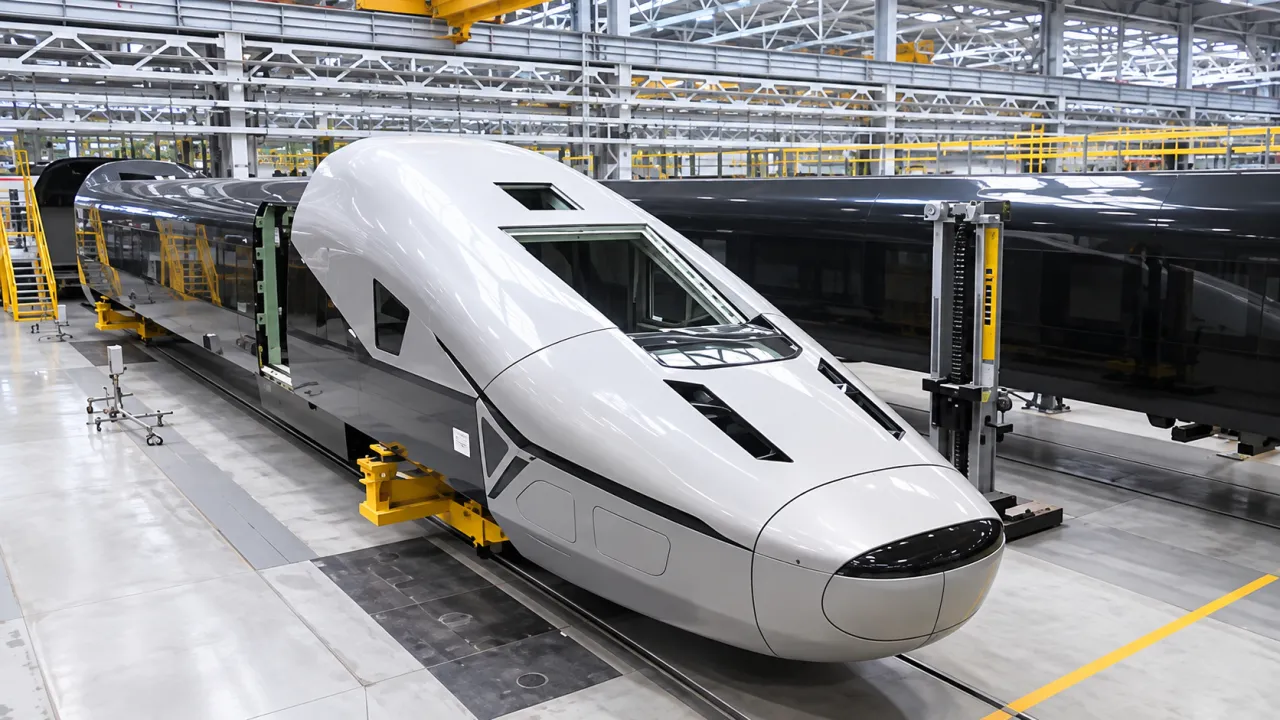
Construction of Russia's first high-speed train for the Moscow-St. Petersburg high-speed railway, the country's most ambitious transport project in decades, continues at the Ural Locomotives plant. Fourteen bodies comprising 16 cars for the first two trains have already been welded. Nine of these have already been transferred to the assembly stage, where specialists are installing heat and sound insulation, laying cables, installing cladding panels, and fitting side windows, doors, and pantographs. The train is capable of reaching speeds of up to 400 km/h, placing special demands on all its components.

For example, side windows are installed in the body using a special Technology Bonding ensures a secure fit, reduces interior noise, dampens vibration and impact loads, and compensates for differences in thermal expansion between the glass and the body. This technology was previously mastered by Ural Locomotives specialists in the production of electric trains and was subsequently refined and adapted for the high-speed train.


The outer door units are equipped with a reinforced sealing circuit, ensuring the carriage's airtightness. A specially designed pantograph with improved aerodynamic characteristics reduced both weight and noise levels.

New workshops were quickly built at the Ural Locomotives plant to produce trains. In fact, 150 companies from across the country are participating in the project. This allows Russia to master technologies previously unavailable to it, thereby laying the groundwork for the future. Following the Moscow-St. Petersburg connection, it has already been decided to extend the high-speed railway to Yekaterinburg, Adler, and Ryazan, as well as build an international line to Minsk.

Alongside work on the rolling stock, construction of the railway itself is in full swing. Over 28 people are currently involved, comparable to the high-pressure construction projects of the Soviet era. Moreover, the construction portion of the project is also bringing new technologies to Russia that are currently unavailable to other countries.

As experts explain, to ensure the train runs perfectly smoothly, without unnecessary climbs, descents, or sharp turns, and without intersecting with other roads, the highway will be built on elevated tracks. Enormous reinforced concrete beams, each weighing 700 tons, are being constructed for these tracks. They cannot be transported by road, so their production plants are built right next to the construction site and transported to the installation site on special self-propelled trucks. Installation is carried out using a unique cantilever crane.

Another challenge is that the soil along almost the entire route is heavily marshy. Therefore, a nearly continuous pile field must be driven. Over one million piles will be installed in total, and new factories are also being built to produce them.

The next key element is fourth-generation ballastless rail slabs with an accuracy of up to 0,5 millimeters. While the rest of the world still uses third-generation designs, Russia has developed and patented its own new technologies.

Each slab has a service life of over 50 years and can be easily replaced, with a total of 277 to be produced. Special rails resistant to extreme climatic conditions have been developed and launched into serial production in Novokuznetsk for the high-speed railway. No one else in the world produces such rails except Russia.

100-meter rails are welded into seamless sections up to 800 meters long. This ensures smooth movement at high speeds. A total of 160 tons of this product are being manufactured for the first high-speed line.

Also worth noting is the special overhead contact network, which enables the transmission of electrical power to high-speed trains. It was also specifically developed for the project—a new testing site was launched this week. Unique giant switches, a digital system, special wheels, and the rolling stock itself, which will be certified as early as 2027—this is what Russia is gaining from working on its first-ever high-speed railway project. And now the country is entering its most challenging phase.

It is clear that after the launch of service between Moscow and St. Petersburg, work on extending the line to other cities will proceed much more quickly.

15 comments
Information
Dear reader, to leave comments on the publication, you must sign in.
  1. +1
    8 September 2026 09: 39
    Wonderful. Wonderful.
    Hey, Economists.
    Just figure out when this project will pay for itself? And how much will the tickets cost?
    I just want to know whether I should start saving for a ticket from my pension or not.
    1. Ron
      +1
      8 September 2026 10: 15
      This is not for the poor, but for business people.
      1. +3
        9 September 2026 08: 29
        Excellent point.
        In Russia, every citizen of Russia has his own Russia.
        And in most cases, not only do they not intersect, they don’t even touch.
        This is such unity.
    2. 0
      8 September 2026 10: 26
      It's definitely cheaper than flying. But it's far from ambitious. If it were from Moscow to Vladivostok, then yes!
      1. +1
        8 September 2026 10: 36
        Quote: lance vosirob
        definitely cheaper than by plane.

        unlikely, probably more expensive.
        In Europe, I've encountered the fact that, say, Barcelona-Madrid is significantly cheaper by plane than by high-speed train, even taking into account taxis to/from the airports, while the train station is in the city center, walking distance to the hotel.
        But there is no clear answer to what will happen to civil aviation in 5-10 years; there is also a possibility that the air fleet will shrink at a rapid pace.
        And then it would really be rational to redirect the busiest short routes to the high-speed railway.
      2. +2
        8 September 2026 11: 04
        If you only saw what the builders have done to the ground in Moscow and the surrounding region...
        You wouldn't say that it's "definitely cheaper than by plane."
    3. +3
      12 September 2026 18: 04
      The Central Bank was recently criticized for not providing cheap money to fund the SVO. However, tens of billions were found for the high-speed railway to the hometown of VVP. And if you dig deep enough, you'll find many more such expensive construction projects and projects of the century. And everything is wrong with us, and not as it should be...
    4. +1
      23 September 2026 00: 21
      Who said it was for the people? If Putin weren't from St. Petersburg, if he didn't live between two cities, then this high-speed highway wouldn't exist!
      Who were the Auruses made for, anyway? Surely it wouldn't be respectable for the boss to drive around in an imported limousine, proving to everyone that he's the one running an independent country!
      They're also building trains to Minsk for Batka and to Batka. They and their retinue, the boyars and merchants, want to travel quickly and comfortably overland—something that's impossible in a car—and more reliably than airplanes. Especially now, with the constant threat of unmanned aerial vehicles. And for the rest of us, these benefits will be at residual value, for those who can afford them, just like with the Auruses!
  2. +1
    8 September 2026 10: 48
    Under the conditions of the SVO, this is a poor idea – damaging the track in front of a train traveling at 400 km/h would lead to a horrific accident. And even after the SVO, this highway is completely unprotected from saboteurs and terrorists – a small drone is enough for sabotage. Flying is safer.
  3. +2
    8 September 2026 12: 23
    If we're talking about bridge crews whose equipment drills the ground, then that's a valid term. They drill, then welders prepare the metal structures right on site, which are then filled with concrete.
  4. +1
    8 September 2026 16: 18
    Excellent! Respect to the Ural workers and our fellow countrymen from Kuzbass.

    In Novokuznetsk, special rails resistant to extreme climatic conditions have been developed and launched into mass production for the high-speed railway. No one else in the world produces such rails except Russia.

    I just didn't understand this:

    Another challenge is that the soil along almost the entire route is heavily marshy. Therefore, a nearly continuous pile field must be driven. Over one million piles will be installed in total, and new factories are also being built to produce them.

    This is the swamps towards St. Petersburg. Couldn't they have at least not bothered so much and directed the first line towards the Urals or somewhere else where there's no swampy terrain? At least the first line?
    It's clear that St. Petersburg is close to Moscow, and those beyond the Urals will have a pretty long wait. Although in these turbulent times, it would be just the thing, and they could help with logistics from deep behind the lines if necessary. These antlers could be held back, but that's just an off-the-cuff thought, and those at the top don't care what they think. lol
    1. 0
      23 September 2026 00: 37
      Yes, it would be great to build a high-speed railway to the Urals and beyond, but why would the tsar and his boyars, and even his merchants, need to travel there quickly, reliably, and comfortably all the time?! So they're building one all the way to St. Petersburg, and then to Batka (Father's Land) after that.
  5. +1
    8 September 2026 19: 38
    Yelistratov writes such funny articles. About special-technology windows... and all that. Where's the main point?

    14 bodies from 16 cars for the first two trains have already been welded.

    Carriages are fine, but where do we get a locomotive? It takes years to develop, then years to test. Where is it?
  6. +1
    2 October 2026 13: 17
    I laughed heartily. None of this will be built or done. The money will be stolen—that's for sure.
  7. 0
    6 October 2026 09: 33
    A special gluing technology... Like the one at VAZ, apparently there's no equivalent. We're waiting for the change. Words aren't trusted in Russia, because there are plenty of talkers.