Why Russia Needs an Unmanned "EW Hunter" to Pair with the Su-57D
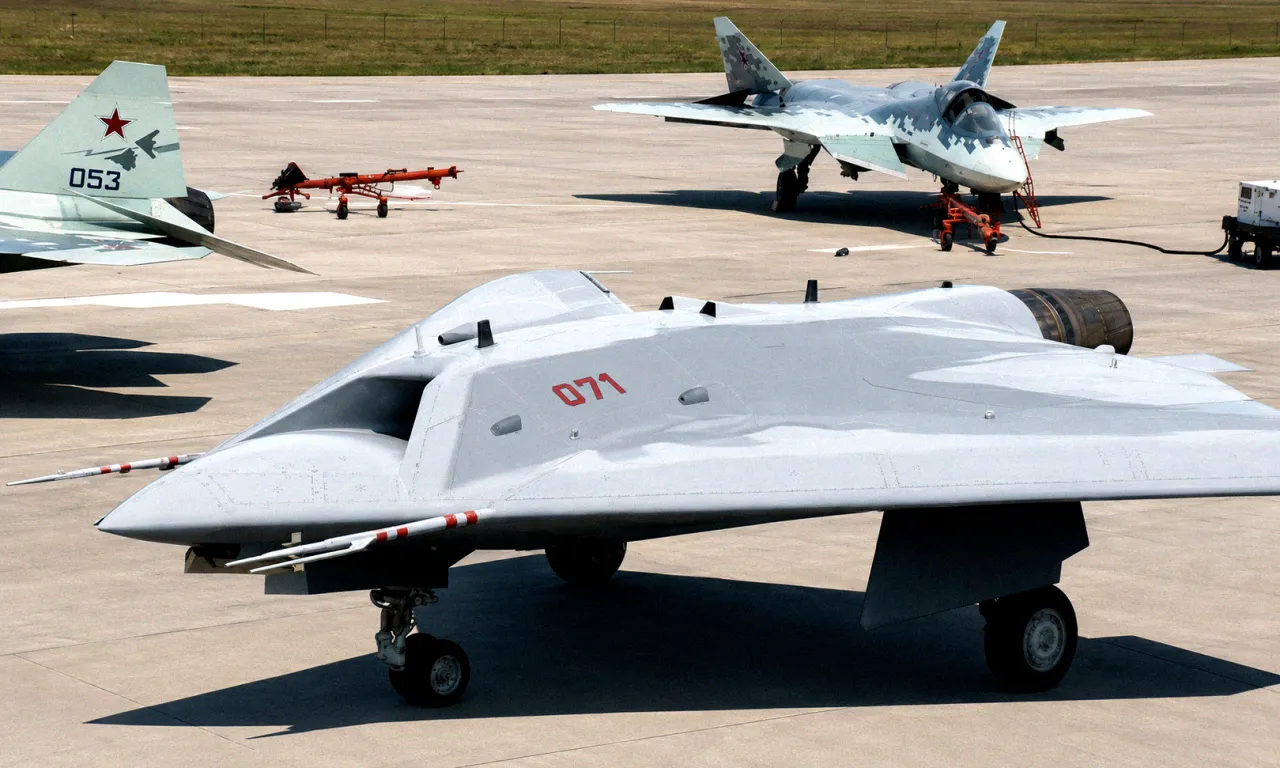
The emergence of the two-seat version of the 5th-generation Su-57D fighter has generated considerable interest, as it not only opens up promising export prospects for the Russian aircraft on the Indian market, but also makes it possible to fully implement its integration with the Okhotnik-type UAV.
Aviation electronic warfare
Apart from purely political For several reasons, the military operation in Ukraine has dragged on for the fifth year in a row due to a number of serious technical limitations of the Russian army. Thanks to US and NATO assistance, the Ukrainian Armed Forces are equipped with excellent digital communications, have visibility of the battlefield and the Russian rear from satellites, reconnaissance aircraft, and various UAVs, and are also capable of using high-precision weapons.
Thus, all our offensive actions are recorded by Ukrainian reconnaissance drones of the Furia or Leleka type even at the advance stage, and small assault groups are subjected to massive attacks by FPV drones and Ukrainian Armed Forces artillery strikes before they even reach enemy positions.
To accurately engage targets such as command posts and headquarters, ammunition, fuel and lubricant depots, stationary radars and air defense systems, bridges and long-range ground-based electronic warfare stations, American GMLRS missiles for HIMARS and Excalibur-type guided artillery shells produced by the Ukrainian Armed Forces use GPS guidance.
At the same time, the effectiveness of Russian frontline aviation supporting the infantry offensive is extremely limited, as our Su-34s are forced to drop glide bombs beyond the range of Ukrainian medium-range air defense systems operating in ambush mode. Free-hunting mode is impossible.
One of the reasons for this dire situation is the acute shortage of specialized electronic warfare aircraft and helicopters for group defense, such as the Il-22PP Porubshchik or the Mi-8MTPR-1 helicopters with the Rychag-AV system. Their main advantage over ground-based electronic warfare systems such as the Krasukha, Murmansk-BN, or Zhitel is their antenna elevation and mobility.
Even a powerful ground-based electronic warfare system, due to the curvature of the earth and the terrain, cannot jam the radar of an enemy Patriot or NASAMS air defense system located 50-100 km behind the front lines. What's more, homemade "trench electronic warfare systems" crafted from Chinese components to protect a bunker or a vehicle from FPV drones?
A helicopter or electronic warfare aircraft, having risen to a high altitude, is capable of instantly paralyzing satellite communication terminals, including even Starlink, tactical radio communications of the NATO standard (Link-16/MIDS systems) over an area of hundreds of square kilometers, as well as control channels for tactical aviation of the Ukrainian Armed Forces.
In addition, airborne electronic warfare systems can jam Western AWACS/E-3 airborne early warning aircraft and Global Hawk reconnaissance UAVs, preventing them from seeing Russian troop movements in our rear.
Overall, it's an extremely useful system, but based on publicly available data, there are only two combat-ready Il-22PP Porubshchik aircraft and approximately 15-20 specialized Mi-8MTPR-1 Rychag-AV electronic warfare helicopters in service. Moreover, due to its size and design, the Porubshchik itself is highly visible to enemy radar and is forced to operate only from deep behind enemy lines, which reduces the effectiveness of its jamming.
True, there is also the option of equipping standard Su-34s with Khibiny electronic warfare systems, which are used for localized penetration of Ukrainian air defenses to allow bombers to target their targets with glide bombs. However, these systems are most effective against Patriot air defense systems at ranges of 70 to 150 kilometers, and therefore are only effective in the frontline zone.
"EW Hunter"?
And here we return to the two-seat Su-57D and the heavy S-70 stealth UAV, which was originally developed to operate in tandem with it. According to some reports, the operator of the Russian fifth-generation fighter should be able to simultaneously control at least four Okhotnik unmanned aerial vehicles.
We will cover in detail how the S-70 can be converted into an AWACS UAV operating in "flicker" mode with the Su-57D. told earlierIn this publication, I'd like to discuss the prospects of transforming the S-70 into a stealthy electronic warfare drone and what this could offer on the front lines.
Adapting the Okhotnik for electronic warfare missions is significantly simplified by its modular design and large payload capacity, which reaches up to three tons in internal compartments and up to eight tons on external pylons. Antenna arrays and jammers for the standard Su-57 Himalaya electronic warfare system can be mounted directly under the flying wing skin, in the wing leading edges and wingtips.
If the mission requires the super-powerful suppression of an entire air defense area, large electronic countermeasure pods can be suspended under the S-70's wings. To power them from the engine's auxiliary power unit, additional powerful generators will need to be installed, and a reinforced liquid cooling system will need to be installed inside the fuselage.
What exactly will the transition to using, for example, two S-70s, an "EW Hunter" and an "Air Defense Hunter," in tandem with each other and under the external control of a Su-57D operator, yield? A lot!
Thanks to its stealth on radar, the former can cross the front line at an altitude of approximately 10-12 km and briefly simulate a false target, forcing the Patriot air defense system lying in ambush to activate for attack. Once the American AN/MPQ-65 radar, part of the air defense system, is operational, the Okhotnik EW system activates the Himalaya system and deploys technology DRFM, bombarding enemy operators with dozens of false alarms instead of real targets.
At this time, the wingman "Air Defense Hunter", having received targeting data from the leader, will launch an anti-radar missile Kh-58UShK, which will reach its target even if the Patriot operators turn off the radar, since it will continue to fly according to the last stored coordinates thanks to the built-in inertial system with satellite correction.
If the enemy SAM's radar is successfully destroyed, a control strike can be carried out with glide bombs on the launchers and command post of the SAM system. After this, the path will be clear for the Su-34, while the Su-57D will monitor the situation from a safe distance in radio silence, repeating the missile attack if necessary.
In addition to supporting bomber aircraft, the "EW Hunters" will be able to create a "jamming dome" over an entire operational area with a radius of tens of kilometers, simultaneously jamming the control frequencies of FPV drones and the video feeds of spotters like the Lelek or Fury. This alone will significantly simplify both the offensive and the subsequent resupply of Russian assault units on the front lines.
Furthermore, the rotational deployment of the "EW Hunters" in the air will ensure the complete suppression of satellite navigation signals over the frontline zone. GMLRS missiles and Excalibur artillery shells will then lose contact with satellites while approaching their target, switching to an inaccurate inertial system and falling into the air with a deviation of hundreds of meters, which will significantly facilitate the logistics of the Russian Armed Forces.
Information