Ion engine: Russia ahead
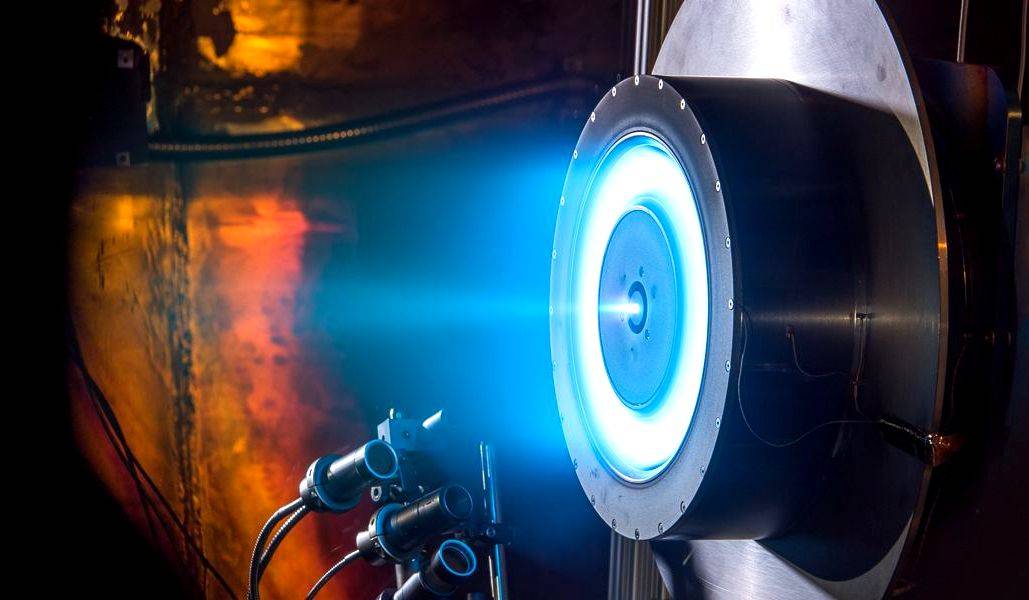
The European Space Agency has announced the successful testing of a direct-flow ion engine using air fuel, which will allow the engine to use the surrounding atmosphere for movement. Engines of this type are planned to be used on satellites, which, being equipped with a new development of ESA, can be located at an altitude of up to 200 kilometers for almost unlimited time.
The action of the ion engine is based on the acceleration of the ionized gas particles by the electrostatic field. Thus, particles can be accelerated to higher speeds than in the usual chemical engines. However, the weak side of ion engines is their relatively low thrust, although at the same time they have significantly higher specific impulse and low fuel consumption. In this regard, ion engines are not very popular.
However, this may change soon. The European Space Agency has announced the successful testing of a direct-flow ion engine using air fuel, which will allow the engine to use the surrounding atmosphere for movement. Engines of this type are planned to be used on satellites, which, being equipped with a new development of ESA, can be located at an altitude of up to 200 kilometers for almost unlimited time.
The prototype engine was tested in a vacuum chamber. First, xenon came into the chamber as fuel, then it simulated an atmosphere of a nitrogen-oxygen mixture at 200 kilometers, and, finally, a clean air mixture was introduced into the chamber.
So far, the use of an ion engine has included the use of a slowly diverging fuel supply. Created by Technology ESA's GOCE satellite, launched in 2009, was able to stay at 255 km altitude for almost 5 years. The use of direct-flow technology, presumably, will make the duration of the stay of satellites with an ion engine in orbit unlimited.
An ion engine is also being developed in our country. In early February of this year, flight tests were even conducted. However, Russian development requires a supply of fuel, which will eventually be used up.
- https://hi-news.ru/
Information